A software team can build an impressive product and still run into trouble when a real customer tries to use it. The customer's data may be stored in several systems. Their APIs may behave differently from the documentation. Security rules can restrict access. A workflow that looked simple during a demo can become complicated once it reaches production.
This is where the FDE (Forward Deployed Engineer) role becomes important. Instead of working only inside a product team's normal development cycle, an FDE works closely with customers or business teams to understand a specific problem, build the required solution, integrate it with existing systems, and help get it into actual use.
The role has become particularly relevant as companies deploy AI applications. A model or AI platform is only one part of the solution. Someone still has to connect it to company data, business applications, authentication systems, evaluation processes, and production infrastructure. Recent FDE roles increasingly combine software engineering with applied AI and customer-facing engineering.
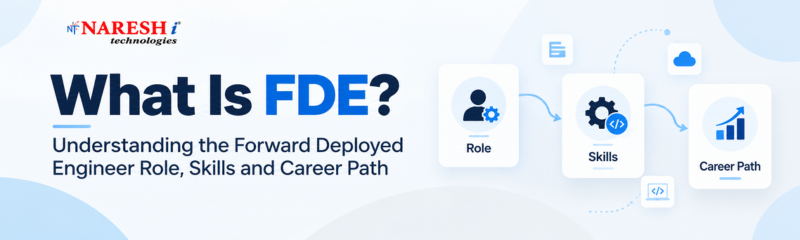
FDE stands for Forward Deployed Engineer. An FDE is a software engineer who works closely with customers or business teams to build, integrate, customize, and deploy technical solutions for real-world problems.
The word “forward” describes the position of the engineer. Rather than staying completely separated from the end user, the engineer moves closer to the environment where the technology will actually be used.
An FDE may spend part of the week writing code and another part talking with users, understanding requirements, investigating an unfamiliar system, testing integrations, or demonstrating a working solution.
That combination makes the Forward Deployed Engineer role different from a conventional product-development position.
An FDE might be asked to:
The exact responsibilities vary by company. Some FDE teams concentrate on enterprise software, while newer roles are increasingly focused on AI applications, LLMs, agents, data integration, and production deployment.
The Forward Deployed Engineer role usually covers more of the delivery process than simply writing application code.
A typical engagement can begin with an unclear request such as:
“We want to use AI to reduce the time our support team spends searching internal documentation.”
That sentence is not yet a technical specification.
The FDE needs to discover what the support team actually does. Which documents are authoritative? Where are they stored? What authentication system is used? What information can employees access? What happens when the AI gives an uncertain answer? How will the team measure whether the system is useful?
From there, the engineer may design a solution using document retrieval, an LLM API, an internal knowledge base, application APIs, authentication, logging, and an evaluation process.
The work therefore often moves through several stages:
Discovery → Technical design → Prototype → Integration → Testing → Deployment → Feedback → Iteration
The stages are not always linear. An integration problem can send the engineer back to the design stage, while user feedback can change the original requirements.
Common FDE responsibilities include:
The important point is ownership. An FDE is often expected to stay involved until the solution works in the environment where it is supposed to operate.
Consider a simple example.
A manufacturing company wants an internal assistant that can answer questions about maintenance procedures.
A basic demonstration could connect an LLM to a few PDF files and produce convincing answers. But deploying the system inside the company creates several additional engineering problems.
The FDE may need to:
Suppose the assistant gives the correct answer but cites an outdated maintenance procedure. The problem is not necessarily the language model. The retrieval process or document-management rules may need to change.
That is an important part of FDE work: the engineer has to investigate the entire system rather than assuming every problem is a coding problem.
For AI projects, current FDE guidance increasingly emphasizes areas such as RAG, agent systems, evaluation, observability, APIs, cloud deployment, and security.
The FDE role overlaps with several established engineering positions, which is why the job title can initially be confusing.
|
S.No |
Role |
Primary focus |
Typical responsibility |
|
1 |
Software Engineer |
Building and maintaining software products |
Develop features, services, APIs, and systems |
|
2 |
Solutions Engineer |
Helping customers understand and adopt a technical product |
Technical demonstrations, solution design, integration guidance |
|
3 |
Forward Deployed Engineer |
Building and deploying solutions directly around customer problems |
Discovery, coding, integration, deployment, iteration |
|
4 |
Data Scientist |
Extracting insights and building analytical or ML solutions |
Data analysis, modeling, experimentation |
|
5 |
AI Engineer |
Building AI-powered applications and systems |
Models, APIs, RAG, agents, evaluation, deployment |
The boundaries are not universal. Companies may define an FDE position differently, and some organizations use titles such as Customer Engineer, Deployment Engineer, AI Solutions Engineer, or similar names for related work.
The simplest distinction is this:
A software engineer generally builds within a product or engineering organization, while an FDE takes engineering into the customer's specific environment and owns the technical implementation of the solution.

Strong Forward Deployed Engineer skills combine software development, systems knowledge, problem-solving, and communication.
You do not need to master every technology available. The more useful goal is to become strong enough in a core engineering area to investigate unfamiliar systems and build working solutions.
Python is particularly useful because it is widely used for APIs, automation, data processing, and AI applications. TypeScript, Java, Go, or another production language can also be valuable depending on the target role.
The important skill is not memorizing syntax. An FDE should be comfortable reading an unfamiliar codebase, debugging failures, writing tests, and turning a requirement into working code.
Real deployments rarely exist as isolated applications.
An FDE should understand:
For example, an AI assistant becomes much more useful when it can securely retrieve information from the systems employees already use.
Knowledge of AWS, Azure, or Google Cloud can be useful, along with Docker and basic CI/CD concepts.
You should understand how an application moves from:
Local development → Test environment → Production
You should also know enough about logs, networking, permissions, secrets, and monitoring to investigate deployment problems.
Modern FDE positions increasingly touch AI systems.
Useful concepts include:
Current FDE skills reports also show growing attention to AI/ML, cloud, security, Python, APIs, and LLM-related capabilities.
Technical ability alone does not define an FDE.
You may need to ask a customer why a workflow exists, challenge an unclear requirement, explain a technical limitation, demonstrate a prototype, and document the final implementation.
That requires clear communication without unnecessary technical jargon.
There is no single degree or certification that automatically makes someone an FDE.
A practical learning path starts with software engineering fundamentals and gradually adds deployment, integration, domain knowledge, and customer-facing skills.
Start with Python or another production language.
Learn:
Build applications that communicate with a database and at least one external API.
For example, create a service that retrieves customer records, applies business rules, and exposes the result through an API.
Deploy your project instead of leaving it on your laptop.
Learn one cloud platform well enough to understand compute, storage, networking, identity, and application deployment.
If you are targeting an AI-focused FDE engineer position, learn how LLM applications are actually built.
Build a small RAG application, experiment with an LLM API, create an agent that can call a controlled tool, and learn how to evaluate its outputs.
Avoid a portfolio containing only tutorials.
Build something with:
User problem → Data → Application → API → Deployment → Testing → Monitoring
Document why you made each technical decision. An FDE portfolio should demonstrate that you can solve an ambiguous problem, not simply reproduce a coding tutorial.
The Forward Deployed Engineer career path can vary considerably between companies.
A person might begin as a software engineer, backend developer, cloud engineer, data engineer, solutions engineer, or another technically strong professional. From there, the path can move toward senior FDE responsibilities and eventually broader technical leadership.
A simplified path could look like:
Software/Cloud/AI Engineer → FDE → Senior FDE → Lead/Principal FDE → Solutions Architecture or Engineering Leadership
Another possible direction is specialization. An FDE can become particularly strong in AI deployment, cloud architecture, data systems, cybersecurity, enterprise integration, or a specific business domain.
The transferable skill is the ability to connect technical systems with real operational requirements.
For students and freshers, the role can be challenging because some companies expect practical engineering experience. That does not make the career path inaccessible. Building deployed projects, contributing to real applications, learning APIs and cloud infrastructure, and practising technical communication can provide useful preparation.
AI has changed the nature of some software deployments.
A traditional application usually follows predictable rules. An AI application can produce different outputs for similar inputs, depend heavily on the quality of retrieved information, and require continuous evaluation.
A company may have access to a powerful model but still need an engineer to answer questions such as:
That is one reason the modern FDE role increasingly overlaps with applied AI engineering.
A recent example is Anthropic's announcement of its Claude Frontier Academy, which describes “Frontier Deployed Engineers” as engineers trained to help organizations move AI projects from experimentation into production.
The broader lesson for learners is more useful than any particular company announcement: AI engineering increasingly involves deployment, integration, evaluation, and real user workflows not just model selection or prompt writing.
For someone preparing for an FDE role, that makes a broad engineering foundation especially valuable.
An FDE, or Forward Deployed Engineer, is a software engineer who works closely with customers to build, integrate, and deploy solutions for their specific technical problems.
The role combines software development with system integration, troubleshooting, technical communication, and deployment.
A Forward Deployed Engineer in 2026 typically needs software development, API integration, cloud, databases, communication, and increasingly AI engineering skills.
For AI-focused roles, RAG, LLM APIs, agents, evaluation, observability, and security are useful additions.
FDE can be a suitable career path for software developers who enjoy both building systems and working directly with customers or business teams.
Developers who prefer solving ambiguous problems and seeing their software operate in real environments may find the role particularly relevant.
AI and LLM skills are increasingly useful for Forward Deployed Engineers working on modern AI products, although not every FDE position is an AI role.
The required depth depends on the company's product and the customer's technical problems.
Build a deployed application that solves a realistic user problem and demonstrates APIs, data handling, cloud deployment, testing, and clear technical documentation.
An AI-focused project could add RAG or an agent workflow, but the project should demonstrate reliable engineering rather than simply calling an LLM API.

A Forward Deployed Engineer sits close to the point where software meets a real business problem. The role requires more than programming because the engineer has to understand the customer's environment, work with existing systems, make technical decisions under imperfect conditions, and stay involved through deployment.
For someone considering this career, the practical starting point is straightforward: strengthen programming fundamentals, learn APIs and databases, deploy real applications, understand cloud infrastructure, and then add AI engineering if the roles you are targeting require it.
The best portfolio project is not necessarily the most complicated one. A small application that solves a realistic problem, works in production, and is well documented can demonstrate much more about your FDE skills.
If you were preparing for an FDE role today, which would you learn first: cloud deployment, AI engineering, or customer-focused system design and why?
Follow NareshIT for more practical insights on technology, skills, and career development.
 +91 8179191999

 +91
8179191999
+91
8179191999

_online_training.jpg)







.png)