Training Type
Select faculty
Select Date
Dur:
4
months
Course fee :
35000
/-
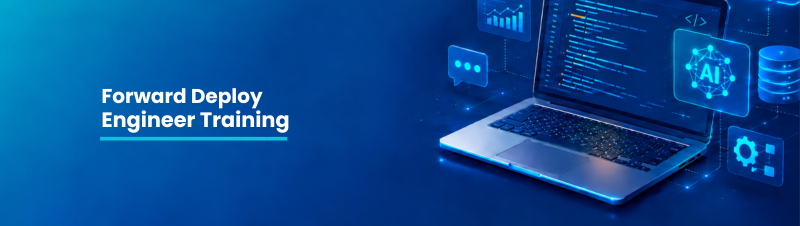
Great engineering starts with understanding the problem behind the request. Forward Deployed Engineer Training connects software development with customer needs, helping learners approach technical challenges with business context. Explore how requirements become working solutions through problem discovery, application design, data integration, testing, and deployment. Develop the ability to ask useful questions, explain technical decisions, and adapt when project requirements change.
This course brings attention to the complete solution journey, from the first customer conversation to ongoing improvements. Build an engineering mindset that values practical usefulness, dependable delivery, and clear communication alongside code, preparing you to contribute thoughtfully to customer projects.
A customer may know what is slowing their team down without knowing which technology can fix it. Forward Deployed Engineer Training explores how to close that gap. The course brings together requirement analysis, programming, APIs, databases, solution architecture, and deployment fundamentals within a customer focused engineering approach.
Learners examine how to break broad requests into manageable tasks, connect existing systems, troubleshoot integration issues, and communicate progress. Attention also goes to documentation, user feedback, security awareness, and maintaining solutions after delivery. The emphasis is on understanding why a solution is needed, how it should work, and what makes it useful in practice. Develop a structured approach to building software that fits the people, processes, and constraints of a real business environment.
Forward Deployed Engineer Training aims to help learners connect technical execution with customer understanding. The course objectives are to:
Identify business problems through questions, stakeholder conversations, and observation of existing workflows.
Translate customer requirements into tasks, acceptance criteria, and delivery priorities.
Apply programming, database, and API concepts to design solutions that exchange information across systems.
Evaluate architecture choices against practical considerations such as reliability, security, maintainability, and resources.
Understand testing, deployment, monitoring, and troubleshooting as connected responsibilities throughout the solution lifecycle.
Explain technical concepts in accessible language and communicate decisions to technical and business audiences.
Use documentation and version control to support collaboration, trace changes, and simplify future maintenance.
Assess feedback, identify limitations, and improve solutions without losing sight of the original business need.
Develop ownership by recognizing risks, asking for clarification, and following through on implementation tasks.
Build confidence in presenting solution approaches and discussing engineering tradeoffs with stakeholders.
Before starting Forward Deployed Engineer Training, learners should understand basic Python syntax and feel comfortable using a computer terminal.
You should be able to follow simple programs, work with variables, functions, loops, and collections, and troubleshoot basic coding errors.
Familiarity with Git and introductory SQL provides a useful foundation for the project work.
If these areas need strengthening, complete preparatory practice before entering the main curriculum.
Advanced machine learning mathematics, transformer training, and specialist cloud administration are outside the core entry expectations.
Plan for approximately 12 to 15 learning hours each week, including instruction, labs, project development, and review.
Bring a willingness to debug, document decisions, receive feedback, and explain your reasoning throughout practical assignments and simulated customer delivery exercises.
Forward Deployed Engineer Training suits learners with basic Python knowledge who want to connect software engineering with practical AI delivery.
Graduates and final year students can use the pathway to build projects that demonstrate integration, deployment, and technical reasoning.
Backend and full stack developers can explore AI workflows, evaluation, and enterprise security.
Engineers working with cloud platforms or implementation projects can strengthen application development and customer discovery skills.
Aspiring applied AI engineers and solutions engineers can practise turning business requirements into usable systems.
Career switchers may also consider the program after developing the recommended programming foundations.
It is particularly relevant to learners who enjoy investigating problems, communicating with stakeholders, testing assumptions, and taking responsibility for how software works after deployment
Average package of course (Forward Deployed Engineer)


Elevate your career with essential soft skills training for effective communication, leadership, and professional success.

Learn from trainers with extensive experience in the industry, offering real-world insights.

Enjoy round-the-clock access to course materials and resources for flexible learning.

Benefit from specialized programs focused on securing job opportunities post-training.
Learn by doing with hands-on practice, mastering skills through real-world projects
State-of-the-art lab facility, guided by experienced mentors, ensures hands-on learning excellence in every session

















Top 5 Technologies to learn
Register for the Course !

 +91 8179191999

 +91
8179191999
+91
8179191999

_at_Naresh_IT.png)
.jpg)





.png)