Next Batch : Invalid Date
Stock market research requires more than checking share prices. Analysts examine company performance, financial statements, market news, investor sentiment, and potential risks before reaching conclusions. Gathering this information from multiple sources can be time-consuming.
Generative AI and Agentic AI are introducing new ways to manage these activities. Instead of using one AI model for every task, developers can create specialized AI agents that collect information, analyze financial data, and prepare research reports collaboratively.
These systems can improve research efficiency, although their findings still require human verification.
AI Agents in Stock Market research are intelligent software components designed to perform specific financial analysis tasks using AI models, external tools, and available datasets.
For example, one agent might collect quarterly financial statements while another examines historical stock prices.
Unlike traditional chatbots, AI agents can follow predefined workflows, retrieve information, process data, and communicate results to other agents.
When several specialized agents collaborate, they form Multi Agent AI Systems.
This approach divides complex research into smaller activities, making the overall process easier to organize and review.

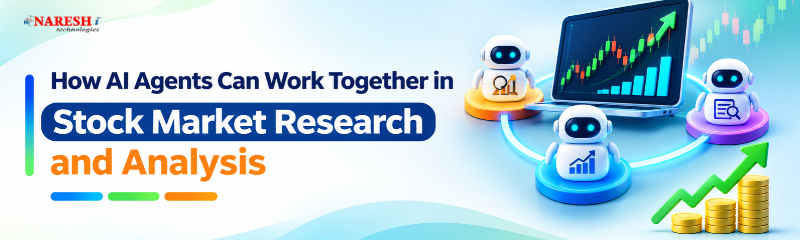
A multi-agent stock research system can include different agents, each responsible for a particular activity.
This agent retrieves financial information such as revenue, net profit, earnings per share, debt, and cash flow.
It supports AI Financial Data Analysis by organizing financial statements into structured information.
The market research agent examines company announcements, industry developments, economic conditions, and relevant financial news.
Its responsibility is to identify developments that may influence company performance.
This agent examines financial headlines and market commentary to identify positive, negative, or neutral sentiment.
AI Market Sentiment Analysis provides additional context about public discussions, although sentiment cannot reliably predict future prices.
The technical agent studies historical price movements, trading volumes, moving averages, and volatility indicators.
It identifies patterns that researchers may investigate further.
This agent evaluates potential concerns, including financial instability, liquidity limitations, volatility, and incomplete information.
Finally, the reporting agent combines the findings into a structured document, highlighting important observations and uncertainties requiring verification.
A collaborative research workflow begins when a user selects a company for analysis.
Research Request → Supervisor Agent → Specialized Agents → Data Verification → Research Report → Human Review
The supervisor assigns responsibilities to different agents. Each component performs its analysis and shares the results.
A verification stage checks financial figures, source reliability, and conflicting findings before preparing the final report.
This demonstrates how Multi Agent Systems in Finance can support coordinated research without replacing professional judgment.
Imagine an analyst researching a publicly listed technology company.
The financial agent collects quarterly revenue and profitability figures.
Meanwhile, the research agent examines company announcements and industry developments.
The sentiment agent evaluates relevant financial news, while the technical agent studies historical trading patterns.
The risk agent identifies potential concerns such as increasing debt or unusual price volatility.
Finally, the reporting agent organizes these findings into a readable summary.
This example shows how AI Stock Market Analysis can support informed research rather than automatically generate investment recommendations.
|
Activity |
Traditional Research |
Multi-Agent Research |
|
Data collection |
Manual gathering |
Automated retrieval |
|
Financial analysis |
Spreadsheet calculations |
AI-assisted processing |
|
News monitoring |
Individual searches |
Dedicated research agent |
|
Sentiment analysis |
Manual interpretation |
Automated text analysis |
|
Risk evaluation |
Analyst review |
AI-assisted assessment |
|
Reporting |
Manual preparation |
Automated draft generation |
Both approaches require accurate information and careful interpretation.
Agentic AI in Finance can reduce repetitive work and improve the organization of complex research activities.
Different agents can examine financial statements, company announcements, and market information simultaneously.
Other potential benefits include consistent reporting, faster information processing, easier company comparisons, and improved documentation.
However, AI Agents for Financial Analysis remain dependent on reliable datasets, correct calculations, and carefully designed workflows.
Adding more agents does not automatically improve research accuracy.
Developers interested in AI in Stock Market Research can begin with Python and explore AI development frameworks.
|
Technology |
Application |
|
Python |
Data processing and automation |
|
Pandas |
Financial data analysis |
|
NumPy |
Numerical calculations |
|
LangChain |
AI application development |
|
LangGraph |
Multi-agent workflows |
|
Scikit-learn |
Machine learning models |
|
Financial APIs |
Market data retrieval |
Learning Generative AI and Agentic AI with Python can help students understand API integration, language models, agent coordination, and automated reporting.
Beginners should start with simple data-analysis projects before building systems involving multiple agents.
Financial AI systems can produce incorrect calculations, misunderstand company announcements, or rely on outdated information.
Unexpected economic events also make stock market predictions uncertain.
Therefore, research systems require source verification, data validation, security controls, and human supervision.
Developers skilled in Generative AI and Agentic AI can explore opportunities in AI engineering, financial technology, data science, and intelligent automation.
Practical projects involving real datasets can help demonstrate their technical abilities.
AI agents are specialized software components that collect, process, and analyze financial information through automated workflows.
Multiple agents perform separate tasks, share findings, and combine information into structured research reports.
AI agents can analyze patterns, but they cannot guarantee accurate stock predictions or profitable investments.
Python is widely used because it supports financial data processing, machine learning, APIs, and AI-agent frameworks.
Developers should learn Python, data analysis, APIs, machine learning fundamentals, prompt engineering, and agent orchestration.

AI agents are creating new possibilities for collaborative financial research. Specialized systems can collect company information, examine market developments, assess risks, and generate structured reports.
For aspiring developers, multi-agent financial research projects provide practical exposure to Python, AI frameworks, and data processing.
The goal is to make research more efficient while keeping financial decisions grounded in verified information and human judgment.
 +91 8179191999

 +91
8179191999