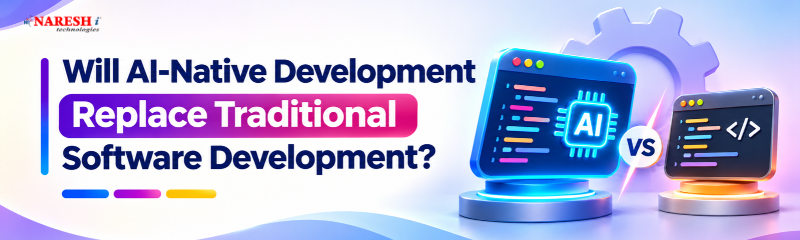
Artificial intelligence can now generate code, identify bugs, write test cases, and assist with application development. Tasks that once required hours of manual coding can sometimes be completed much faster. Naturally, this raises an important question: will developers still need traditional programming skills?
The growing adoption of AI-Native Development is changing how software is designed, built, and maintained. However, creating an application involves much more than generating code. Developers must understand business requirements, design reliable systems, protect data, and ensure applications work correctly.
So, is traditional software development becoming outdated, or are we entering a new phase where developers work alongside AI?
AI-Native Development is a software engineering approach in which artificial intelligence is integrated into the development process from the beginning, influencing how applications are planned, coded, tested, and maintained.
Instead of using AI only for code suggestions, developers may use intelligent agents to examine requirements, generate application components, execute tests, and recommend improvements.
For example, a developer building an e-commerce application might ask an AI coding agent to create product APIs, generate database models, and prepare automated tests.
However, the developer must still verify business logic, security, performance, and integration requirements.
AI-native development can therefore change the development workflow without eliminating engineering responsibilities.

Traditional Software Development generally follows a structured process where developers manually design, implement, test, and maintain applications using programming languages and engineering tools.
A typical development lifecycle includes requirement analysis, system design, coding, testing, deployment, and maintenance.
Developers use technologies such as Java, Python, JavaScript, SQL, Git, and cloud platforms to build applications.
Even when teams follow Agile or DevOps methodologies, human expertise remains central to technical decisions and software quality.
|
Development Area |
Traditional Development |
AI-Native Development |
|
Requirement analysis |
Primarily manual |
AI-assisted interpretation |
|
Code development |
Developer-written code |
AI-generated and developer-reviewed code |
|
Testing |
Manually designed automated tests |
AI-assisted test generation |
|
Debugging |
Developer investigates errors |
AI suggests causes and fixes |
|
Documentation |
Primarily human-written |
AI-generated drafts with review |
|
System architecture |
Human-led decisions |
Human-led with AI recommendations |
|
Developer responsibility |
Direct implementation |
Implementation, supervision, and validation |
The biggest difference is not whether developers write code. It is how much development work can be delegated to intelligent tools.
AI is particularly useful for repetitive, predictable, and well-defined development tasks.
Modern AI-Powered Coding Tools such as GitHub Copilot, Cursor, and Claude Code can assist developers with:
However, AI-generated code may contain incorrect assumptions, insecure implementations, or hidden defects.
Complex architecture decisions, unclear business requirements, production accountability, and critical security considerations still require experienced human judgment.
Consider a team developing an online banking platform.
Using AI-Assisted Software Development, programmers might generate login interfaces, transaction APIs, validation functions, and testing scripts.
AI could also suggest database queries and help investigate errors.
But financial transactions require precise calculations, access controls, regulatory compliance, auditability, and reliable failure handling.
An AI-generated payment function cannot be trusted simply because the code executes successfully.
Developers must evaluate transaction correctness, concurrency, exception handling, security, and recovery procedures.
This example demonstrates why AI in Software Engineering is valuable but cannot automatically replace engineering expertise.
As AI-Driven Development becomes more common, developers should combine programming fundamentals with practical AI skills.
Important areas include:
For freshers, learning to understand, debug, and improve generated code is more valuable than simply copying AI-generated solutions.
The Future of Software Development will likely combine traditional engineering practices with increasingly capable AI systems.
According to Stack Overflow's 2026 Developer Survey, 66% of respondents use AI coding assistants or agents at work. However, trust remains conditional, with many developers preferring outputs they can independently verify.
This suggests that AI adoption is growing without making technical knowledge unnecessary.
Developers who understand architecture, testing, security, and AI workflows will be better prepared for changing industry expectations.
AI-native development is unlikely to completely replace traditional software engineering. It can automate many development activities, but human expertise remains important for architecture, security, validation, and business decisions.
Yes. Programming fundamentals help developers understand AI-generated code, identify errors, optimize performance, and build reliable applications.
AI-assisted development uses AI to support individual tasks. AI-native development integrates AI more fundamentally into development workflows, architecture, and engineering processes.
Yes. Freshers can begin with programming fundamentals, Git, APIs, databases, testing, and AI coding assistants before exploring more advanced AI development workflows.
Programming, system design, debugging, cloud computing, cybersecurity, AI integration, automated testing, and the ability to validate AI-generated solutions will remain valuable skills.

AI-Native Development is not simply replacing traditional software development. It is changing how software engineering work gets done.
AI can accelerate coding, debugging, documentation, and testing, but reliable products still depend on clear requirements, sound architecture, security, and human accountability.
Developers who combine strong technical foundations with practical AI knowledge will be better positioned to adapt as development workflows evolve.
Discussion Question: If AI can generate most of an application's code, which developer skill will matter most in the future: programming, problem-solving, system architecture, or AI tool expertise?
 +91 8179191999

 +91
8179191999