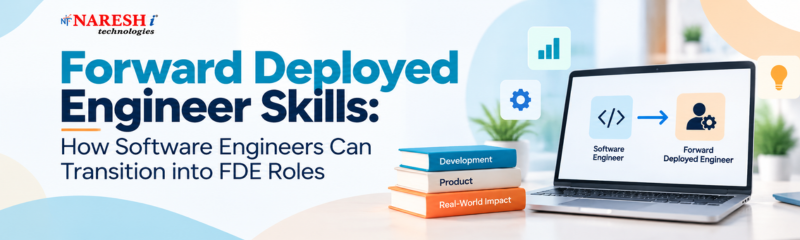
Picture a company that has just bought a data platform. A month in, their records live in an old system with mismatched IDs, the operations team doesn't trust the first report, and nobody is sure which integration path fits. Filing a ticket with the vendor's product team means waiting weeks. What the customer needs is an engineer who can sit beside them and fix it. That engineer is usually called a Forward Deployed Engineer.
If you are a software engineer, the role will feel half familiar. You still ship production code. The difference is that the requirements arrive as a fuzzy business problem instead of a neat ticket. This article explains what the job involves, which Forward Deployed Engineer skills you already have, which ones to build, and how to make the move in a realistic order.
A Forward Deployed Engineer (FDE) is an engineer who works embedded with a customer, building and running software inside that customer's real environment. Some companies use titles such as forward-deployed software engineer or customer-embedded engineer for the same work.
The phrase comes from military usage, where forward-deployed units are stationed close to the action instead of at headquarters. In software, it means you work next to the problem, not next to the product roadmap.
Day to day, Forward Deployed Engineer responsibilities usually include:
That last item matters. FDEs often become the most reliable source of insight into what the product is missing.
| S.No |
Software Engineer |
Solutions / Sales Engineer |
Forward Deployed Engineer |
|
|
1 |
Who they serve |
Many users through the product |
Prospects before they buy |
One or a few customers after they buy |
|
2 |
Typical output |
Features in a shared codebase |
Demos, proofs of concept, design advice |
Working integrations and customer-specific software |
|
3 |
Measured by |
Product quality and delivery |
Deals supported |
Whether the customer's problem is solved in production |
Be careful with job titles, because companies apply them inconsistently. Some postings labelled FDE are renamed solutions-engineering or customer-success jobs. Read the description and look for ownership of production code, deployment and debugging. If the work is mostly demos and presentations, it is a different role under the same name.

Here is an illustrative scenario, not a real company. A logistics customer wants delivery-delay predictions inside the platform they bought.
You start by meeting their operations team and discover that "delay" means three different things depending on who is speaking. Next, you find that their warehouse system exports a nightly CSV whose order IDs don't match the transport system, so you write a job to reconcile them. Later in the week you release a small service behind a feature flag and demo it to the operations lead. Along the way you note a missing import option and send it to the product team.
Look at where the time went: agreeing on definitions, cleaning data, and building trust. The modelling work was small. Many developers find this the biggest surprise about Forward Deployed Engineering.
FDEs are often described as T-shaped: deep in one area, reasonably capable in many others, and comfortable with customers. The table shows what that means in practice.
|
S.No |
Skill |
Why it matters |
Where software engineers usually stand |
|
1 |
Solid coding in Python or TypeScript, plus a second language |
Whatever blocks the deployment becomes your task |
Strong; widen your range |
|
2 |
API integration (authentication, pagination, retries, webhooks) |
Customer systems rarely match the documentation |
Often good; practise on messy third-party APIs |
|
3 |
SQL and data quality |
Many problems turn out to be data problems |
Often shallow; practise joins and cleaning |
|
4 |
Deployment basics (Docker, logs, monitoring, one cloud) |
You deploy into restricted environments |
A gap if you only used managed pipelines |
|
5 |
Debugging unfamiliar systems |
You seldom see the whole codebase |
Practise reading other people's code |
|
6 |
Scoping and communication |
Vague requests need a clear plan |
Usually the largest gap |
Coding is not optional. This is an engineering role, and it is different from sales work, so you need to be able to build.
Communication needs deliberate practice. Write short status updates that lead with what changed. Learn to say "that belongs in phase two" without damaging trust. Explain trade-offs to someone who has never read a stack trace. Feature teams rarely give you many chances to practise these habits.
Many FDE roles in 2026 involve AI work, since customers want to apply language models to their own documents and processes. If you are targeting those roles, learn how to call LLM APIs, build retrieval-based applications (RAG), use tool calling, and evaluate outputs.
Customers rarely ask for "an agent." They ask to spend fewer hours reading invoices, or to find answers in a mountain of policy documents. Your job is to build something small, test it on their real data, and show clearly where it fails. Being able to measure answer quality on a customer's own examples is worth more than knowing the newest framework.
This Forward Deployed Engineer roadmap produces evidence of the skills employers look for, which is more persuasive than a keyword list. Later career paths can include senior FDE roles, technical leadership, solutions architecture, product roles or early-stage startup engineering. None of these is guaranteed, and each depends on the company and your own track record.
Useful Forward Deployed Engineer training looks like the plan above. It should include projects with imperfect data, real integration work, deployment, a basic AI application, and practice presenting to non-technical people.
Be cautious about programs that only list tool names, promise placements, or never ask you to ship something that runs outside your own laptop. Because the title varies between companies, also check what your target job postings ask for, and train for those requirements.
The work suits people who tolerate ambiguity, like talking to non-engineers, and enjoy owning a result from start to finish. It suits you less if you prefer long stretches of focus on a single codebase or deep architectural work on one product. Travel and on-site time differ by employer, so ask about them early.
No, an FDE builds and owns production software in the customer's environment, while a solutions engineer mainly supports the sales process.
Not for every role, but many current FDE openings involve AI, so LLM, RAG and evaluation skills give you a clear advantage.
It is possible but harder, because most employers expect some production engineering experience before placing you with a customer.
Python is the practical first choice for integrations and AI work, with SQL alongside it.
It depends on your starting skills, but building and showing two or three realistic projects is a more useful milestone than counting months.

A Forward Deployed Engineer is a software engineer who takes responsibility for a customer's outcome, not just a feature. The transition succeeds when you can show that you handle messy data, deploy into unfamiliar environments, and explain decisions clearly.
For your next step, choose one inconsistent real-world data source this week and build a small pipeline and service on top of it, with a README written for a non-technical reader.
If you were moving from software engineering into FDE work, which would you build first to prove yourself: a data integration project or an AI assistant over customer-style documents, and why?
Follow NareshIT for more practical insights on technology, skills, and career development.
 +91 8179191999

 +91
8179191999
+91
8179191999

_online_training.jpg)









.png)