Next Batch : Invalid Date
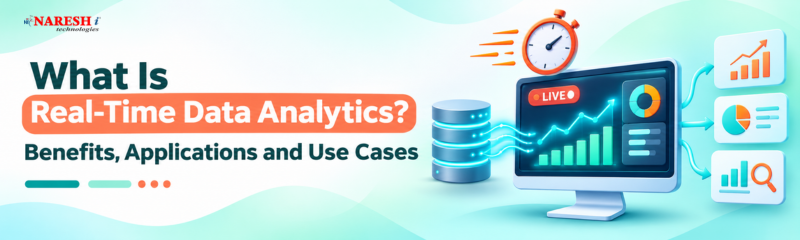
What Is Real-Time Data Analytics? Benefits, Applications and Use Cases
Every second, businesses generate information through online transactions, mobile applications, customer interactions, and connected devices. However, collecting large amounts of data is not enough. Organizations must analyze information quickly to identify problems, respond to customers, and make informed decisions.
Traditional reporting often examines historical data, while Real-Time Data Analytics allows businesses to process and interpret information as it arrives.
From detecting suspicious banking transactions to monitoring website activity, real-time analytics helps organizations respond to changing situations without waiting for the next scheduled report.
Table of Contents
What Is Real-Time Data Analytics?
How Does Real-Time Data Analytics Work?
Real-Time vs Batch Analytics
Benefits of Real-Time Data Analytics
Real-Time Analytics Applications and Use Cases
Popular Real-Time Data Analytics Tools
Challenges and Career Skills
Frequently Asked Questions
What Is Real-Time Data Analytics?
Real-Time Data Analytics is the process of collecting, processing, and analyzing continuously generated data with minimal delay to support timely business decisions.
Unlike traditional analytics, which often uses information collected over hours or days, real-time systems process incoming events continuously.
For example, an e-commerce platform can monitor customer activity, track product demand, and identify unusual transaction patterns while customers interact with the application.
However, real-time does not always mean instantaneous. Processing delays depend on infrastructure, data volume, network performance, and application requirements.
How Does Real-Time Data Analytics Work?
Real-Time Data Processing involves several connected stages.
1. Data Generation
Information is generated through websites, mobile applications, payment systems, sensors, and business software.
Each interaction creates an event that may contain useful analytical information.
2. Data Ingestion
Streaming platforms collect incoming events and transfer them to processing systems.
Technologies such as Apache Kafka help manage continuous event streams.
3. Data Processing
Stream-processing engines analyze incoming information, apply calculations, filter records, and identify patterns.
Apache Flink is one example of a technology used for continuous data processing.
4. Analysis and Visualization
Processed information becomes available through dashboards, alerts, reports, or connected applications.
Businesses can monitor relevant metrics and investigate unusual changes.
5. Business Action
Organizations use analytical findings to respond appropriately.
Actions may include investigating suspicious transactions, adjusting inventory decisions, or resolving operational problems.
Real-Time Analytics vs Batch Analytics
Feature
Real-Time Analytics
Batch Analytics
Data processing
Continuous
Scheduled intervals
Data freshness
Low latency
Depends on batch frequency
Main purpose
Immediate insights
Historical analysis
Processing approach
Event streams
Collected datasets
Common example
Fraud monitoring
Monthly sales reports
Infrastructure
Streaming pipelines
Batch processing systems
Both approaches remain important. Real-time analytics supports immediate responses, while batch analytics is useful for large historical investigations.
Benefits of Real-Time Data Analytics
The Benefits of Real-Time Data Analytics extend across operational efficiency, customer experience, and business intelligence.
Faster Decision-Making
Organizations can identify changes as they happen instead of waiting for scheduled reports.
This improves the relevance of information used in time-sensitive decisions.
Improved Customer Experience
Businesses can analyze customer interactions and respond with relevant recommendations, alerts, or assistance.
Early Problem Detection
Continuous monitoring helps identify unusual activity, system failures, and operational irregularities.
Better Operational Visibility
Real-time dashboards provide updated information about transactions, application performance, and business activities.
These capabilities strengthen Data Analytics in Business Decision-Making when supported by accurate data and appropriate interpretation.
Real-Time Analytics Applications and Use Cases
Several industries use Streaming Data Analytics to process continuously changing information.
1. Banking and Financial Services
Financial organizations analyze transaction activity to identify suspicious behavior and support fraud investigations.
2. E-Commerce and Retail
Online retailers monitor customer activity, product demand, inventory changes, and purchasing patterns.
3. Healthcare Operations
Healthcare organizations can monitor connected equipment, appointment demand, and operational information to support timely responses.
4. Digital Marketing
Marketing teams use Real-Time Business Analytics to monitor campaign performance, website traffic, customer engagement, and conversion activity.
5. Manufacturing and IoT
Connected sensors generate equipment information that can support operational monitoring and early fault detection.
These Real-Time Analytics Use Cases demonstrate how continuous analysis supports different business requirements.
Popular Real-Time Data Analytics Tools
Several Real-Time Data Analytics Tools support streaming pipelines and analytical applications.
Apache Kafka: Collects and distributes event streams.
Apache Flink: Processes continuous data using stateful computations.
Azure Stream Analytics: Supports managed stream-processing applications.
Google Cloud Dataflow: Processes streaming and batch data.
Power BI: Visualizes updated business information through supported data connections.
Tool selection depends on processing requirements, available infrastructure, and business objectives.
Challenges and Skills Required
Real-time analytics introduces challenges involving data quality, processing latency, scalability, infrastructure costs, and security.
Developers must also handle delayed events, duplicate records, and unexpected processing failures.
Students interested in this field should learn SQL, Python, statistics, data visualization, streaming concepts, and cloud fundamentals.
Understanding databases and distributed processing helps learners explore modern Real-Time Analytics Applications and data engineering workflows.
Frequently Asked Questions
1. What is Real-Time Data Analytics?
Real-Time Data Analytics continuously processes incoming information to generate timely insights and support business decisions.
2. How is real-time analytics different from traditional analytics?
Real-time analytics processes continuously arriving data, while traditional batch analytics generally analyzes information at scheduled intervals.
3. What are common real-time analytics use cases?
Common applications include fraud monitoring, website analytics, inventory tracking, manufacturing monitoring, and customer behavior analysis.
4. Which tools are used for real-time data analytics?
Apache Kafka, Apache Flink, Azure Stream Analytics, Google Cloud Dataflow, and Power BI support different parts of real-time analytics workflows.
5. Is real-time data analytics important for career development?
Yes. Skills involving SQL, Python, streaming systems, visualization, and cloud technologies are useful for data analytics and data engineering careers.
Conclusion
Real-Time Data Analytics helps organizations transform continuously generated information into timely insights.
Its applications across banking, retail, healthcare, marketing, and manufacturing demonstrate its importance in modern business operations.
However, successful implementation requires reliable data pipelines, appropriate technologies, and skilled professionals who can interpret analytical results.
Discussion Question: Which industry benefits most from real-time analytics: banking, healthcare, e-commerce, or digital marketing?
 +91 8179191999

 +91
8179191999