Next Batch : Invalid Date
Businesses generate enormous amounts of data through customer interactions, sales transactions, websites, and digital platforms. However, converting this information into meaningful insights often requires several steps, including data cleaning, querying, visualization, and interpretation.
Traditional analytics tools help professionals understand data, but many activities still require manual effort.
This is where Agentic Analytics introduces a different approach. Instead of simply displaying information, AI agents can investigate business questions, analyze datasets, identify patterns, and recommend possible actions.
As organizations adopt more intelligent technologies, understanding agentic analytics is becoming increasingly relevant for students, data analysts, and technology professionals.
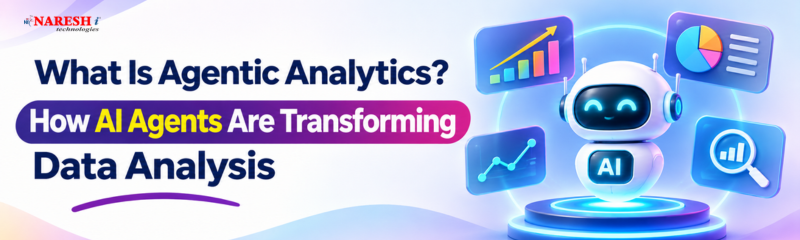
Agentic Analytics is an AI-driven approach to data analysis in which intelligent agents plan, execute, and refine analytical tasks with limited human intervention.
Unlike traditional dashboards that display predefined metrics, agentic systems can investigate questions through multiple analytical steps.
For example, a business manager might ask, "Why did our sales decrease last month?"
An AI agent can examine sales records, compare previous periods, investigate customer segments, and identify possible reasons for the decline.
This approach combines machine learning, large language models, data processing, and automated workflows.

Agentic AI in Data Analytics typically follows a structured process involving several stages.
AI agents interpret questions written in natural language.
Users can describe business problems without manually writing every SQL query.
Agents connect to authorized databases, data warehouses, or analytical platforms.
They retrieve relevant information based on the question and available permissions.
Agents can execute SQL queries, use Python libraries, identify trends, and compare datasets.
This supports AI-Powered Data Analysis across multiple analytical activities.
After analyzing results, agents summarize findings and explain potential patterns.
They may also generate tables, charts, or recommendations to support business decisions.
Advanced systems can examine intermediate results, identify inconsistencies, and perform additional investigations.
Human verification remains important before acting on critical findings.
|
Feature |
Traditional Analytics |
Agentic Analytics |
|
Analysis approach |
User-directed |
Goal-directed |
|
Data queries |
Manually prepared |
AI-generated and executed |
|
Reporting |
Predefined dashboards |
Dynamic investigations |
|
Decision support |
Analyst interpretation |
AI-assisted recommendations |
|
Automation |
Rule-based workflows |
Multi-step agent workflows |
|
Human involvement |
Continuous interaction |
Oversight and validation |
Agentic Data Analytics does not eliminate traditional business intelligence. It extends existing analytical capabilities through more flexible automation.
Retail businesses can use AI agents to investigate sales changes, compare product categories, and identify customer purchasing patterns.
Agents can help analysts discover which factors may be affecting business performance.
Financial organizations can use intelligent analytics to examine transaction patterns, monitor unusual activity, and investigate financial trends.
Sensitive decisions still require appropriate governance and professional review.
Healthcare organizations can analyze operational information such as appointment schedules, resource utilization, and patient service demand.
AI agents may help identify bottlenecks and support administrative planning.
Marketing teams can investigate campaign performance, conversion trends, customer engagement, and advertising expenses.
For example, agents can compare campaign results and identify potential reasons for declining conversions.
These are practical examples of AI-Driven Data Analytics across industries.
Several modern analytics platforms provide capabilities relevant to agent-based analysis.
These Agentic AI Analytics Tools offer different capabilities. Some are ready-to-use enterprise features, while others help developers build customized analytical agents.
Autonomous Data Analytics can reduce repetitive analytical work and make data exploration more accessible.
Potential benefits include faster investigations, flexible reporting, improved accessibility, and automated follow-up analysis.
However, AI agents may generate incorrect queries, misunderstand business metrics, or produce misleading conclusions.
Organizations must therefore establish data permissions, validation procedures, monitoring, and human approval for sensitive actions.
Students interested in this field should learn Python, SQL, statistics, data visualization, machine learning fundamentals, and analytical problem-solving.
Knowledge of APIs, large language models, and AI agent frameworks can provide additional advantages.
Data Analytics with AI & ML combines analytical foundations with machine learning concepts, helping learners understand how intelligent systems process information and support decisions.
Agentic Analytics uses AI agents to plan, execute, and refine data analysis tasks through multiple steps with limited human intervention.
Traditional analytics relies heavily on predefined reports and manual exploration, while agentic analytics can dynamically investigate questions using AI agents.
Yes. Authorized AI agents can retrieve data, execute queries, identify patterns, and generate insights, although results require validation.
Microsoft Fabric Data Agents, Databricks Genie Agents, LangGraph, Python, and SQL are relevant technologies for agentic analytics.
Yes. Understanding AI agents alongside SQL, Python, statistics, and visualization can help professionals prepare for evolving analytical workflows.

Agentic Analytics represents an important shift from manually exploring dashboards toward intelligent systems that can investigate data through multiple analytical steps.
Its capabilities can improve analytical productivity, but reliable results still depend on accurate data, sound statistical reasoning, and human oversight.
The Future of Data Analytics will increasingly involve collaboration between skilled analysts and intelligent AI agents.
Discussion Question: Will AI agents become the primary tools for business data analysis, or will traditional dashboards remain equally important?
 +91 8179191999

 +91
8179191999