Imagine learning Python and getting stuck on a simple program. Instead of searching through several tutorials, you ask an AI tool to explain the error.
Within seconds, it suggests a solution and explains what went wrong.
Now imagine the same tool writing the entire program for you. Did you actually learn anything?
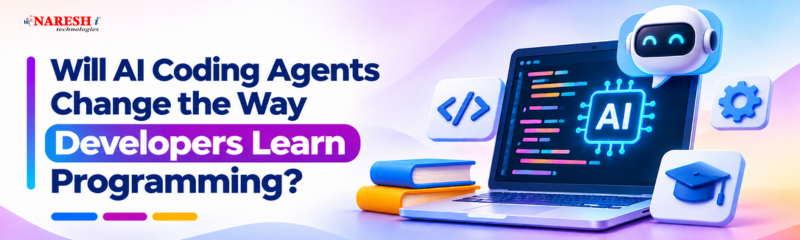
This question is becoming important as AI Coding Agents enter programming classrooms, training programs, and software development environments.
These tools can make learning more accessible, but they also raise concerns about independent thinking, problem-solving, and practical coding skills.
AI Coding Agents are AI-powered systems that can perform programming tasks through multiple steps, including examining code, editing files, executing commands, and running tests.
Unlike basic code-completion tools, some agents can work across several files and propose changes to an application.
For example, a developer might ask an agent to create a REST API, add validation, and generate unit tests.
Tools such as GitHub Copilot's coding agent, Claude Code, and Cursor's agent features support different forms of agent-assisted development.
However, generated code still requires human review, testing, and security checks.

The growing use of AI in Programming Education is changing how beginners approach coding problems.
Traditional tutorials often follow fixed explanations.
With AI Powered Coding Assistants, students can ask follow-up questions, request simpler explanations, and explore alternative solutions.
For example, someone learning Java inheritance can ask an assistant to explain the concept using a banking application.
This makes difficult concepts easier to explore at an individual pace.
Beginners frequently struggle to understand compiler errors and unexpected outputs.
AI Coding Agents for Beginners can help explain error messages, identify possible causes, and suggest debugging steps.
However, students should attempt to identify the problem themselves before requesting a complete solution.
AI Assisted Programming can help learners organize project requirements, understand application structure, and create basic prototypes.
A student building an expense tracker might use AI to understand database connections or API integration.
The real learning happens when the student can explain, modify, and test the application independently.
|
Learning Activity |
Traditional Approach |
AI-Assisted Approach |
|
Understanding concepts |
Books and instructor explanations |
Interactive explanations |
|
Writing programs |
Manual coding practice |
Coding with AI suggestions |
|
Debugging |
Documentation and manual investigation |
AI-guided troubleshooting |
|
Building projects |
Step-by-step development |
Assisted planning and development |
|
Reviewing code |
Instructor or peer feedback |
AI feedback with human verification |
|
Assessing skills |
Coding tests and projects |
Independent tasks plus AI literacy |
Both approaches remain valuable. AI assistance becomes more useful when combined with independent programming practice.
AI Tools for Learning to Code can provide immediate explanations, suggest practice exercises, and help students understand unfamiliar programming concepts.
They can also support learners experimenting with Python, Java, JavaScript, SQL, and other technologies.
The biggest concern is accepting generated solutions without understanding them.
A 2026 Anthropic study found that participants using AI assistance scored lower on a subsequent coding-skills assessment than those completing the task manually.
The findings suggest that AI assistance can weaken learning when developers rely on answers instead of developing their own understanding.
This does not mean AI tools should be avoided. How students use them matters.
Students can follow a practical learning approach:
For example, when practising a Java array problem, ask AI to identify mistakes in your logic rather than generate the entire program.
This approach strengthens reasoning while developing familiarity with modern tools.
The Future of Programming Education will likely combine traditional programming fundamentals with responsible AI-tool usage.
AI in Software Developer Training can support personalized explanations, debugging exercises, automated feedback, and project-based learning.
However, instructors will still play an important role in evaluating understanding, correcting misconceptions, and developing problem-solving abilities.
For freshers, learning both programming and AI-assisted development can help prepare for changing software engineering workflows.
AI Coding Agents are systems that can perform multistep programming tasks, including generating, modifying, and testing code.
Yes. They can explain concepts and support debugging, provided beginners continue practising independently.
AI can assist learning, but independent coding, structured practice, and technical understanding remain essential.
GitHub Copilot, ChatGPT, Cursor, and Claude Code are examples, although their capabilities and access requirements differ.
AI is more likely to complement programming education than completely replace instructors, practical exercises, and independent assessments.

AI Coding Agents are changing how people explore programming, solve problems, and build applications.
They can make technical concepts easier to understand and reduce time spent on repetitive tasks. However, convenience should not replace genuine learning.
The strongest developers will be those who understand programming fundamentals, solve problems independently, and use AI assistance responsibly.
Discussion Question: Should beginners learn programming fundamentals before using AI coding agents, or should AI tools become part of their learning from day one?
 +91 8179191999

 +91
8179191999