.png)
Next Batch : Invalid Date
Artificial intelligence is becoming part of software, business applications, analytics, automation, and many other areas of technology. For someone beginning their AI journey, however, the biggest challenge is often deciding what to learn first.
There are Python courses, machine learning tutorials, deep learning frameworks, large language models, generative AI tools, retrieval systems, AI agents, cloud platforms, and many other technologies to explore. Looking at all of them at once can make learning feel much harder than it actually is.
The solution is to create an order.
You do not need to study every AI technology before building your first project. Instead, learn the fundamentals, practice them, and then add more advanced concepts as your projects require them.
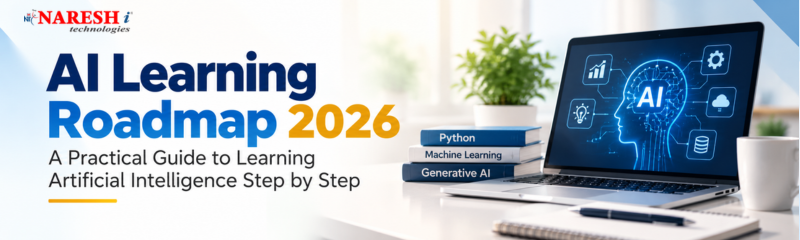
This AI Learning Roadmap is designed to give beginners and working professionals a practical direction for 2026. It covers programming, mathematics, machine learning, deep learning, generative AI, large language models, retrieval-augmented generation, AI agents, deployment, and project development.
If you are completely new to technology, programming should be one of your first priorities.
Python is a particularly useful language for an AI Roadmap for Beginners because it is used in data analysis, machine learning, deep learning, automation, and AI application development.
You do not need to know every feature of Python before starting artificial intelligence. Focus on the parts that you will regularly use while working with data and applications.
Start with:
Try to connect programming concepts with small tasks.
For instance, imagine creating an AI-powered customer-support application. Python could be responsible for accepting a question, checking the input, sending information to an AI service, handling an error, and displaying the final response.
The model itself is only one component of that application.
This is an important idea for beginners: AI development is also software development.
A strong understanding of programming will make it much easier to work with AI tools later.
Before moving into advanced topics, learn what the major AI terms actually mean.
Artificial intelligence is the broader field. Machine learning is one approach used to create systems that learn from data. Deep learning uses neural networks to solve more complex problems. Generative AI focuses on systems that can produce new content such as text, images, audio, or code.
You should also become familiar with terms such as:
Do not try to memorize a dictionary of AI terminology.
Instead, learn each concept while working on a small example. When you can explain what a term means and show where it appears in a project, you are much more likely to remember it.
Many beginners hear the word mathematics and immediately assume they need an advanced mathematical background.
That is not necessary when you are starting.
You should learn the mathematical ideas that help you understand what your models are doing. You can study these topics alongside your programming and machine learning practice.
|
S.No |
Topic |
Where It Helps |
|
1 |
Statistics |
Understanding datasets and model results |
|
2 |
Probability |
Working with uncertainty |
|
3 |
Linear algebra |
Understanding vectors and matrices |
|
4 |
Calculus |
Understanding gradients and model optimization |
|
5 |
Optimization |
Understanding how training improves a model |
For example, when training a neural network, the model needs a way to measure how far its current output is from the expected result. Optimization techniques help the training process adjust the model so that the error can be reduced.
You do not need to begin by solving complicated mathematical proofs.
Once you are comfortable with Python and basic mathematics, machine learning is the next major stage.
Machine learning teaches you how computer programs can identify relationships in data and use those relationships to produce useful results.
Begin with the major concepts rather than trying to memorize dozens of algorithms.
Important topics include:
Python libraries such as NumPy, Pandas, and Scikit-learn can make practice much easier.
Imagine a bank has historical transaction records and wants to identify transactions that may require additional review.
The dataset could contain information such as transaction amount, time, location, account activity, and other relevant attributes.
A machine learning model can learn from previously labeled examples and produce predictions for new transactions.
But getting a prediction is only the beginning.
You should also ask:
These questions help you understand the difference between experimenting with an algorithm and building a useful machine learning solution.

After learning the fundamentals of machine learning, you can start exploring deep learning.
Deep learning uses neural networks containing multiple computational layers. These networks can learn complicated patterns and are used in areas such as image processing, speech recognition, natural language processing, and many modern AI systems.
At this stage, learn concepts such as:
You do not need to study every neural network architecture.
Instead, choose a small project and experiment.
Train a model, examine the result, change one setting, and train it again. Compare what happened.
Generative AI is one of the major areas learners are interested in during 2026.
Unlike systems designed only to classify or predict information, generative models can create new content. Depending on the model, that content may include text, software code, images, audio, or other forms of media.
For learners interested in modern AI application development, large language models are particularly important.
Start by understanding:
Do not focus only on learning how to write better prompts.
A developer working with LLM applications also needs to understand how the application communicates with the model, how information is supplied to it, how the output is processed, and what happens when the model produces an unsuitable response.
Large language models do not automatically know the private documents or internal information belonging to a particular organization.
Suppose a company has thousands of employee documents and wants to create an internal question-answering assistant.
Instead of expecting the model to know every document, a retrieval-based system can first locate useful information and provide that information as context.
A simplified process looks like this:
Employee asks a question
↓
Application searches available information
↓
Relevant content is selected
↓
Selected content is provided to the model
↓
Model prepares the response
↓
Application displays the answer
This approach is commonly called retrieval-augmented generation, or RAG.
When learning RAG, focus on understanding the complete process rather than becoming attached to one particular framework.
You should know why information needs to be retrieved, how relevant content is selected, how that content reaches the model, and how the final response is generated.
AI agents are another area worth exploring after you understand basic large language model applications.
An agent can combine a language model with tools, application logic, external information, and multiple steps.
Consider an IT-support assistant.
It could:
The difficult part is not simply connecting a model to a tool.
A useful agent needs boundaries.
You need to decide what the system is allowed to access, how errors are handled, how actions are checked, and when a human should take control.
These engineering decisions become increasingly important as AI applications move beyond simple chat interfaces.
Watching courses can help you understand a concept, but projects force you to make decisions for yourself.
That is where much of the real learning happens.
Instead of building one massive application immediately, increase the difficulty gradually.
Create a document-based question-answering application.
Use a small collection of documents and allow a user to ask questions about their content.
The purpose is not to create a production-ready system. Use it to understand how documents are processed and how an application can provide relevant information to an AI model.
Build a customer-support assistant.
Include features such as:
This project combines several skills instead of focusing on one isolated AI concept.
Create a tool-using AI application.
The application could receive a request, decide what information is needed, use an approved tool, process the returned information, and generate a structured response.
You can also introduce authentication, monitoring, testing, and deployment.
A portfolio does not need ten complicated projects.
Two or three projects that you can explain confidently can be more useful.
For each project, document:
This demonstrates your ability to solve problems rather than simply reproduce tutorial code.
An AI project running successfully on your computer is not necessarily ready for real users.
Once you understand the basics, learn how an AI application can be turned into a usable software system.
Useful topics include:
You should also learn about AI evaluation.
Traditional software testing often checks whether a program produces the expected result for a known input.
AI applications can be more complicated because the output may vary.
Imagine an AI customer-support application.
It may technically run without an error while still giving an incorrect answer.
Your evaluation process should therefore check questions such as:
Learning to evaluate AI output is an important part of becoming an AI application developer.
There is no single schedule that works for everyone.
Someone who has never programmed will need more time with Python. A software developer may already understand APIs, databases, Git, testing, and application development.
A learner with a data science background may be able to move more quickly through statistics and traditional machine learning.
Instead of following a rigid timetable, use the following progression as a guide:
|
Stage |
Focus |
Suggested Practice |
|
1 |
Python and programming |
Build small applications |
|
2 |
Mathematics and AI basics |
Explore and analyze datasets |
|
3 |
Machine learning |
Create a prediction or classification project |
|
4 |
Deep learning |
Train a basic neural network |
|
5 |
Generative AI |
Build an application using an LLM |
|
6 |
RAG and agents |
Create a document or tool-based assistant |
|
7 |
Engineering and deployment |
Put an AI application online |
|
8 |
Portfolio development |
Improve and document your best projects |
The table is a learning direction, not a rule that says everyone must spend the same amount of time at every stage.
Your existing knowledge should determine where you begin.
Start with Python programming and basic AI concepts, then move into machine learning before exploring advanced generative AI topics.
No, advanced mathematics is not necessary at the beginning.
You can experiment with Generative AI at any stage, but basic machine learning knowledge gives you useful technical background.
Software developers should learn Python, model APIs, LLM application development, RAG, tool calling, evaluation, databases, deployment, and fundamental machine learning concepts.
Start with two or three projects that you understand well.

There is no need to learn the entire field of Artificial Intelligence before you start building something.
Begin with programming. Learn how data is handled. Understand the foundations of machine learning. Move into neural networks when you are ready, and then explore generative AI, large language models, RAG, agents, and deployment.
Most importantly, allow your projects to guide your learning.
If a project requires an API, learn APIs. If it needs document retrieval, study RAG. If it needs deployment, learn the relevant cloud and software engineering concepts.
That approach keeps learning practical and prevents you from spending months collecting tutorials without building anything.
If you were starting your AI journey in 2026, which would you learn first: Python, machine learning, or generative AI? What is your reason?
For students, developers, and working professionals looking for practical technology learning, NareshIT provides training and learning resources across several IT domains.
 +91 8179191999

 +91
8179191999
+91
8179191999



.png)





.png)