.png)
Next Batch : Invalid Date
A computer science graduate messaged me last month, stuck in what most people call tutorial hell: three months of watching machine learning videos, a stack of certificates, and still no idea how to actually build anything from scratch. She could recite what a neural network was. She couldn't write one, debug one, or explain why her one attempt at a project kept throwing shape errors.
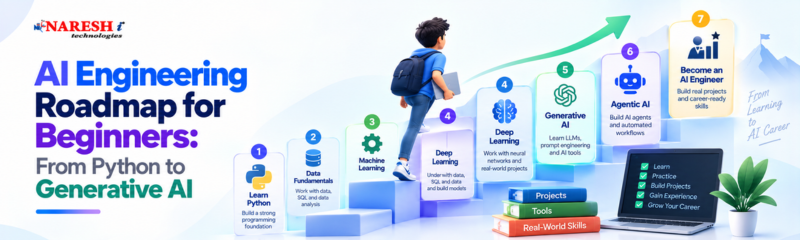
That's the usual outcome when someone treats "Become an AI Engineer" as a single destination instead of a sequence of skills that build on each other. There's a real order to this, not because one exists in some official rulebook, but because each stage genuinely depends on the one before it. Trying to understand transformer architectures before you're comfortable with basic Python data structures is like trying to read blueprints before you know what a wall is.
This is a practical AI Engineer Roadmap: what to learn, in what order, and why skipping ahead usually costs more time than it saves.
Python is where almost every AI engineer career path starts, and it's also where a lot of people stall, because knowing Python syntax and knowing how to use Python to build AI systems are different skills. You can write a for loop and still have no idea why a training loop diverges, or why a model's predictions come back the wrong shape.
The roadmap that actually works treats Python as the tool, not the destination. It's the language you'll use at every later stage, but the value comes from what you build with it: data pipelines, models, and eventually generative AI applications. Rushing past fundamentals to get to the "exciting" generative AI part usually means backtracking later once a gap becomes impossible to ignore.

Not all of Python matters equally here. What you'll actually use constantly: functions, classes, list and dictionary comprehensions, error handling, and enough file I/O to read and process data. Decorators and metaclasses can wait, they're rarely the reason a beginner's project breaks.
More important than syntax is comfort with the libraries that show up in nearly every AI project: pandas for tabular data, numpy for numerical operations, and enough familiarity with virtual environments and package management that dependency conflicts don't eat an entire afternoon. This stage is finished when you can take a messy CSV file and clean, filter, and reshape it without looking up basic syntax every few minutes.
You don't need a math degree, but a working, applied understanding of a few areas pays off constantly: basic linear algebra (vectors, matrices, and why a matrix multiplication shape mismatch is the single most common error in this field), probability and statistics (distributions, expected value, why correlation isn't causation), and enough calculus to understand what a gradient is and why it matters for training a model.
The goal isn't proving theorems, it's building intuition. When a loss value refuses to decrease during training, understanding roughly what a gradient represents helps you reason about whether the learning rate is wrong, the data is broken, or the model architecture itself doesn't fit the problem.
This is the stage most beginners want to skip, and it's the one that pays off the most later. Classical machine learning, using libraries like scikit-learn for regression, classification, and clustering, teaches concepts that apply everywhere afterward: train-test splits, overfitting, cross-validation, and evaluation metrics that actually mean something for your specific problem.
python
from sklearn.model_selection import train_test_split
from sklearn.ensemble import RandomForestClassifier
from sklearn.metrics import classification_report

X_train, X_test, y_train, y_test = train_test_split(
    features, target, test_size=0.2, random_state=42
)

model = RandomForestClassifier(n_estimators=100, random_state=42)
model.fit(X_train, y_train)

predictions = model.predict(X_test)
print(classification_report(y_test, predictions))
Notice this code isn't complicated. That's the point of this stage: build the intuition for what "training a model" actually means, what overfitting looks like in practice, and how to evaluate whether a model is genuinely good or just memorizing its training data, using something simple enough that the concept isn't buried under architectural complexity.
Once classical ML concepts feel natural, deep learning is a more approachable jump than it looks from the outside. This stage covers neural network fundamentals, layers, activation functions, backpropagation conceptually, and hands-on work with a framework like PyTorch or TensorFlow.
The important shift here isn't just a bigger, more complex model. It's understanding when deep learning is actually the right tool, image and text data, large datasets, complex patterns, versus when the classical methods from Stage 3 would have solved the problem faster and more reliably. A lot of unnecessary complexity in real projects comes from reaching for a neural network when a random forest would have done the job in a fraction of the time.
This is usually the stage people are most excited to reach, and it's genuinely more approachable once the earlier stages are solid, because generative AI application work is largely about API integration, prompt design, and connecting a language model to real data, more engineering than deep research.
Here you'll work with language model APIs directly, learn how tokens and context windows constrain what you can send and receive, and build your first retrieval-based application, feeding a model relevant documents rather than relying on it to already know your specific data. This is also where prompt engineering becomes a practical, daily skill rather than an abstract topic.
Once you're comfortable with basic generative AI applications, Agentic AI is the natural next step: giving a model access to tools and functions it can call, letting it reason about which action to take next based on results, rather than just generating a single response.
This stage requires more care than the previous ones, since an agent that can execute code or call external APIs needs careful scoping to avoid unintended actions. It's also where the earlier stages start paying off directly, a solid grasp of Python fundamentals is what lets you write the tool functions an agent actually calls.
A model that only runs in a notebook isn't an AI engineering skill yet, it's a proof of concept. This stage covers wrapping a model or application in an API (commonly with FastAPI), containerizing it, and understanding the basics of monitoring a deployed system, does it still perform well on new data, is latency acceptable, what happens when it fails.
This is often the most overlooked stage in self-directed learning, since it's less visually exciting than training a model, but it's frequently what separates someone who can build a demo from someone employable as an AI engineer in practice.
Pulling all of this together doesn't require anything elaborate. A reasonable capstone: build a tool that answers questions about a small set of your own documents, notes, a product manual, articles you've saved, using retrieval and a language model, then wrap it in a simple API and deploy it somewhere accessible.
That single project touches data handling (Stage 1-2), evaluation thinking from classical ML if you compare retrieval approaches (Stage 3), a generative AI integration (Stage 5), and a deployment step (Stage 7), without needing deep learning from scratch or complex agentic tool use. It's small enough to finish and complete enough to demonstrate real understanding across the roadmap.
|
S.No |
Stage |
Focus |
You're Ready to Move On When |
|
1 |
Python Fundamentals |
Functions, data structures, pandas/numpy |
You can clean and reshape real data without friction |
|
2 |
Math & Data Handling |
Linear algebra, statistics, gradients |
You can explain why a model's loss isn't decreasing |
|
3 |
Classical ML |
Regression, classification, evaluation |
You understand overfitting and can evaluate a model honestly |
|
4 |
Deep Learning |
Neural networks, PyTorch/TensorFlow |
You know when deep learning is the right tool, not just how to use it |
|
5 |
Generative AI |
LLM APIs, tokens, retrieval, prompting |
You can build a basic RAG application end to end |
|
6 |
Agentic AI |
Tool use, scoped autonomy |
You can safely define what an agent is and isn't allowed to do |
|
7 |
Deployment |
APIs, containers, monitoring |
Your project runs somewhere other than your own laptop |
For a beginner working through this roadmap part-time, the stages don't take equal time. Something closer to this is a realistic split, illustrative rather than a fixed rule:

A bar chart fits better than a pie chart here since these are sequential stages with independent durations, not one fixed total being divided into shares, and comparing bar heights makes it easy to see that classical machine learning and deep learning, the stages people most want to rush through, tend to take the longest to actually absorb.
The most common mistake is skipping classical machine learning entirely to jump straight into deep learning or generative AI, which leaves a gap in understanding evaluation, overfitting, and why a model behaves the way it does, gaps that resurface painfully once real projects get complicated.
The second is collecting certificates without building anything. Watching a course on transformers is not the same as debugging a shape mismatch in your own code at 11 p.m., and the second experience is where the actual learning happens.
The third is treating deployment as optional. A model that works in a notebook but was never deployed, monitored, or exposed through an API leaves a real, visible gap in a portfolio, and often in actual job readiness, since production concerns are a meaningful part of the job itself.

If you're evaluating a structured AI engineering course rather than assembling a self-taught learning path, look for one that mirrors this same order, Python and fundamentals first, classical ML before deep learning, generative and agentic AI later, with hands-on projects at each stage rather than lecture-only content. A course that jumps straight to "build a chatbot in week one" without covering data handling and evaluation first tends to produce the same tutorial-hell outcome as self-directed learning without structure.
Start with Python fundamentals and basic data handling, then classical machine learning to build core evaluation intuition, then deep learning, then Generative AI and Agentic AI, finishing with deployment basics. Each stage builds on the one before it, so skipping ahead usually means backtracking later.
A degree helps but isn't the only path. What matters more is demonstrable skill: a portfolio of real, working projects that show you can handle data, train and evaluate a model honestly, and build a generative AI application end to end, not just a list of completed courses.
Solid Python, comfort with pandas and numpy, an understanding of classical ML evaluation concepts, basic deep learning familiarity, and increasingly, hands-on experience with generative AI APIs and prompt engineering. Deployment basics, even simple ones, are also expected in most postings now.
The core sequence, fundamentals before advanced topics, hasn't changed. What has shifted is how much weight generative AI and agentic AI skills carry relative to a few years ago, when the field leaned more heavily toward classical ML and early deep learning as the main focus for entry-level roles.
For someone learning part-time alongside other commitments, several months is a reasonable estimate to reach a genuinely functional level across all seven stages, though the pace depends heavily on prior programming experience and how much time you can consistently dedicate each week.
There's no shortcut around the order here, not because the industry insists on it, but because each stage in this AI engineer roadmap actually depends on the one before it. Generative AI and Agentic AI are genuinely more approachable once classical machine learning and deep learning fundamentals are solid, and deployment is what turns a personal project into something an employer can actually evaluate.
If you're mapping out your own AI engineer career roadmap, the most useful thing you can do this week isn't watching another video, it's picking one small project that forces you to move through at least two or three of these stages together.

Which stage of this roadmap are you currently stuck on, and what's the one project that would force you to move past it?
Follow NareshIT for more practical insights on technology, skills, and career development.
 +91 8179191999

 +91
8179191999
+91
8179191999


.png)

.png)
.png)