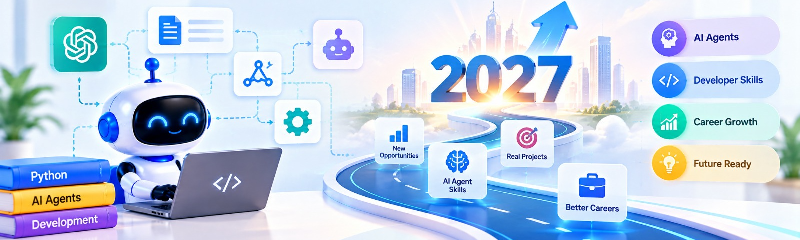
You've probably used an AI coding assistant to write a function, fix a syntax error, or explain an unfamiliar piece of code. It works well until the problem requires more than one step. What happens when a bug involves an API, a database, and three different services?
You still have to investigate the problem, decide which files matter, test possible fixes, and check the results.
AI agents are being developed to handle parts of that process. Instead of responding to a single question, they can work through connected tasks using tools and information from different systems. For developers planning their careers, Agentic AI Skills for 2027 are worth exploring because building these systems requires real software engineering knowledge.
Table of Contents
Why Developers Are Paying Attention to AI Agents
Writing code is only one part of a developer's job. Much of the working day goes into understanding requirements, investigating failures, reviewing changes, and checking whether software behaves correctly.
Consider a failed payment API. An AI coding assistant might suggest reasons for the failure. An agent connected to approved tools could examine the error response, retrieve relevant logs, and prepare a report identifying possible causes.
There's an important distinction here. The agent is performing a sequence of actions rather than simply producing an explanation.
That's what makes Agentic AI for Software Developers interesting. The challenge shifts from asking AI to write code toward designing systems that can perform useful work without losing control of the process.

What Actually Happens Inside an AI Agent?
An AI agent typically uses a language model to interpret instructions and decide when to call a tool.
Suppose you ask an agent to investigate why a scheduled application task failed.
It might retrieve the execution history, identify an unsuccessful database query, inspect the error message, and recommend what to check next.
The model doesn't magically know what happened inside your application. It needs access to relevant information through APIs, tools, or other approved connections.
A developer also decides when the agent should stop, what information it can access, and which actions require permission.
An agent with read-only access to logs is very different from one permitted to delete records or change production configurations.
The Agentic AI Skills Developers Need for 2027
You don't need to learn every AI framework before building your first agent. Start with the engineering skills that make these systems work.
Python and API Development
Python is widely supported across AI development libraries. Understanding functions, JSON, HTTP requests, authentication, and exception handling gives you a useful foundation.
For AI Agent Development in Python, API integration matters particularly because agents often need information from external applications.
LLMs and Tool Calling
Learn how language models receive instructions, select tools, and interpret tool responses.
A tool might search a knowledge base, calculate a result, or retrieve application records. The developer defines what each tool can do and how its inputs should be validated.
Context Engineering and MCP
An agent needs the right information at the right moment. Supplying every document and log entry can make the task harder rather than easier.
Context engineering focuses on choosing and organizing useful information.
Model Context Protocol, or MCP, provides a standardized way for compatible AI applications to interact with external tools and resources. Its 2026 specification updates also address areas such as authorization and interoperability.
Testing and Security
A successful demonstration isn't proof that an agent is reliable.
You need to check how it behaves when an API fails, a document contains misleading instructions, or a tool returns unexpected information.
These are essential AI Agent Development Skills, especially for applications handling customer or business data.
A Practical Project: Building a Bug Investigation Agent
Imagine a student building a small application that tracks support tickets.
Instead of creating another chatbot, they decide to build an agent that helps investigate reported application errors.
The first version has a simple job: accept a ticket number, retrieve the ticket description, search a collection of application logs, and prepare a diagnostic report.
For example, a ticket says users cannot upload profile images. The logs reveal repeated file-size validation errors. The agent reports the relevant error and suggests checking upload restrictions.
It shouldn't immediately change those restrictions. That decision belongs to the developer.
The project can begin with sample tickets and locally stored logs. Later, the student can connect actual APIs and add an approval step before any modification.
That small project demonstrates more engineering knowledge than a chatbot that simply answers programming questions.
Which Tools Are Worth Learning?
Frameworks change, and new ones will appear before 2027. It's more useful to understand their purpose than to memorize a long list of names.
|
Technology |
Why It Matters |
|
Python |
Writing agent logic and connecting APIs |
|
FastAPI |
Building backend endpoints for agent applications |
|
LangGraph |
Managing stateful, multi-step workflows |
|
OpenAI Agents SDK |
Building agents that use tools |
|
MCP |
Connecting compatible AI applications with tools and resources |
|
Docker |
Packaging applications for consistent execution |
Pick one agent framework initially. Switching between several frameworks before completing a working project often creates unnecessary confusion.
Where AI Agents Can Go Wrong
Here's a situation worth thinking about.
An agent reviews server logs and concludes that old database records are causing slow performance. It recommends removing them.
But what if those records are needed for financial reporting?
The recommendation might sound reasonable while being completely unsuitable for the business.
AI agents can misunderstand context, select inappropriate tools, and produce inaccurate results. Some tasks also involve information the agent cannot access.
Career Opportunities for Developers
Agentic AI Career Opportunities are not limited to jobs with "AI Agent" in the title.
Backend engineers may build services that agents call. AI application developers may work on model integration and workflow design. Automation specialists might connect internal tools, while QA engineers could develop agents that assist with investigating test failures.
What employers require will vary. Knowing an agent framework alone isn't a substitute for programming, databases, system design, or debugging.
Among the Future AI Skills for Developers, the ability to evaluate automated decisions deserves particular attention.
A developer who understands why an agent made the wrong API call can contribute far more than someone who only knows how to run a demonstration.
A Sensible Way to Start Learning
If you already know Python, begin by connecting a simple application to an external API. Make sure you understand the request, response, and error-handling process.
Next, introduce a language model that can select between two clearly defined tools.
Once that works, create a multi-step workflow. Add logging so you can inspect each decision. Finally, test failed requests, incorrect tool arguments, and situations where the agent should ask for approval.
Students comparing an Agentic AI Course in Hyderabad should look closely at practical assignments. Does the training cover API development, tool calling, MCP, testing, and deployment? Will students build an application they can explain during a technical interview?
Those questions matter more than the number of frameworks listed in a course brochure.

Conclusion
Learning Agentic AI isn't about handing every programming task to a language model. It's about knowing how to connect models with software tools, manage their decisions, and recognize when human judgment is necessary.
Build one small agent that solves a problem you understand. Test what happens when things go wrong. You'll learn more from that experience than from watching several polished demonstrations.
If you were building your first AI agent, would you choose bug investigation, automated code review, or API testing and what would you let it do without approval?
Follow NareshIT for more practical insights on technology, skills, and career development.
Frequently Asked Questions
1. Do software developers need to learn Agentic AI in 2027?
Learning Agentic AI can be valuable for developers working with AI-powered applications and automation. It complements traditional programming skills rather than replacing them.
2. Is Python enough to build an AI agent?
Python is enough to begin developing AI agents, but practical projects also require knowledge of APIs, language models, tool integration, and testing.
3. What is the difference between MCP and an AI agent framework?
MCP provides a standardized way to connect compatible applications with tools and resources, while an agent framework helps organize the agent's execution and decisions.
4. Can a fresher learn Agentic AI without advanced mathematics?
Yes, freshers can build API-based AI agents without advanced mathematics. Programming fundamentals and problem-solving skills are more immediately useful for beginner projects.
5. Should beginners learn LangGraph or build a simple agent first?
Beginners should understand a simple tool-calling agent before moving to complex workflows. LangGraph becomes useful when an application needs persistent state, branching, or human approval steps.
 +91 8179191999

 +91
8179191999
+91
8179191999






.png)