AI coding tools can generate a working application in minutes. But what happens when the generated code contains a security weakness, incorrect logic, or an outdated dependency?
Many developers now use AI assistants to write functions, debug errors, and build applications faster. However, code that looks correct does not always behave correctly.
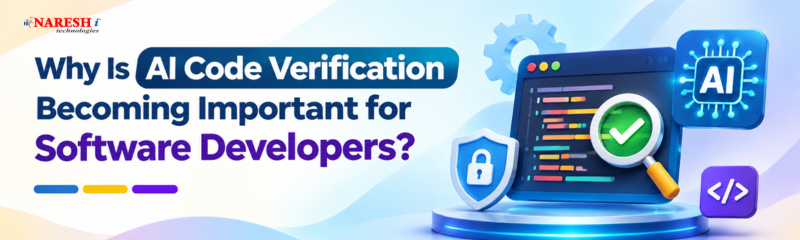
This is where AI Code Verification becomes important. Developers must examine AI-generated code before using it in real applications to ensure that it meets functional, security, and quality requirements.
AI Code Verification is the process of reviewing, testing, and validating code produced by artificial intelligence tools to determine whether it works correctly, follows security standards, and meets project requirements.
It combines human code review, automated testing, static analysis, and security checks.
For example, an AI assistant may generate a Python function that processes customer information. The function might execute successfully but fail to handle invalid inputs or expose sensitive data.
Verification helps developers identify these problems before deployment.

Tools such as GitHub Copilot, ChatGPT, Cursor, and Claude Code are changing how developers write software.
Google's 2025 DORA research reported that 90% of surveyed technology professionals used AI at work, highlighting its growing presence in development workflows.
As AI-generated contributions increase, AI Code Review becomes essential for maintaining consistent engineering standards.
AI models predict code based on learned patterns and supplied context.
They do not automatically understand every business requirement.
Generated programs may contain incorrect calculations, missing conditions, or unnecessary operations.
AI Code Validation helps confirm whether the implementation matches the expected functionality.
Security is another major concern.
AI-generated programs may introduce SQL injection vulnerabilities, insecure authentication, hardcoded credentials, or outdated dependencies.
Proper AI Code Security checks help detect these weaknesses before applications reach production.
A program can produce the expected output while still containing duplicated logic, unclear variable names, or complicated structures.
Maintaining AI Generated Code Quality requires readable code, appropriate architecture, useful documentation, and consistent coding standards.
|
Potential Problem |
Example |
Verification Method |
|
Logic errors |
Incorrect discount calculation |
Unit testing |
|
Security flaws |
Unsafe database query |
Security scanning |
|
Missing conditions |
Invalid input not handled |
Negative testing |
|
Poor performance |
Repeated unnecessary database calls |
Profiling |
|
Outdated dependencies |
Unsupported package version |
Dependency scanning |
|
Poor readability |
Duplicated application logic |
Human code review |
These problems are not unique to AI. However, rapid code generation can increase the amount of software requiring review.
A reliable AI Generated Code Verification workflow should include several steps.
Read the code carefully and confirm that you understand its purpose, inputs, outputs, and dependencies.
Avoid accepting unfamiliar code simply because it executes successfully.
Check naming conventions, error handling, business logic, and architectural consistency.
Human reviewers should pay additional attention to authentication, authorization, and sensitive information.
AI Code Testing should include unit tests, integration tests, and negative test cases.
For example, a login function should be tested with valid credentials, incorrect passwords, empty inputs, and unauthorized requests.
Use static analysis and dependency scanning to identify vulnerabilities.
Developers should also check whether AI-recommended packages actually exist and come from trustworthy sources.
Run the application in a controlled environment, review test results, and confirm that performance and functionality meet requirements.
Several tools support different parts of the verification process.
|
Tool |
Primary Purpose |
|
SonarQube |
Code quality and static analysis |
|
Semgrep |
Security-focused code analysis |
|
GitHub CodeQL |
Code security analysis |
|
Snyk |
Dependency and code vulnerability detection |
|
JUnit / pytest |
Automated unit testing |
|
GitHub Actions |
Automated CI/CD verification |
These AI Code Verification Tools can complement AI Coding Tools for Developers, but automated findings still require appropriate human judgment.
As AI-assisted development expands, developers benefit from combining programming expertise with code analysis and software testing.
Important skills include debugging, secure coding, Git, automated testing, CI/CD, API validation, and application architecture.
For freshers, building a small project with AI assistance and independently reviewing its functionality provides valuable practical experience.
AI Code Verification checks AI-generated code for correctness, security, performance, and compliance with software requirements.
AI-generated code can contain logic errors, vulnerabilities, outdated dependencies, or missing functionality despite appearing correct.
SonarQube, Semgrep, CodeQL, Snyk, JUnit, and pytest support code analysis, security checks, and automated testing.
Yes, provided it undergoes appropriate code review, testing, security validation, and deployment approval.
It is already valuable and is likely to become increasingly important as AI-assisted software development expands.

AI coding tools can accelerate software development, but faster code generation does not automatically guarantee reliable applications.
AI Code Verification helps developers identify defects, protect sensitive information, and maintain software quality.
The ability to generate code is useful. Understanding, testing, securing, and improving that code is what makes it dependable.
Discussion Question: When using AI coding tools, do you verify the generated code manually, through automated testing, or both?
 +91 8179191999

 +91
8179191999