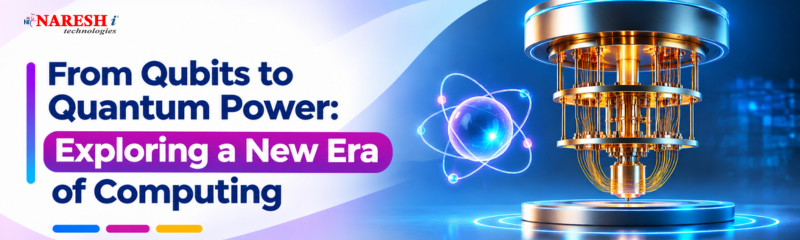
Quantum Computing Meaning: Quantum computing is a way of performing calculations using the behaviour of quantum systems rather than relying only on ordinary binary logic. It uses quantum bits, known as qubits, which can exhibit superposition and entanglement. Researchers are exploring this approach because certain problems in science and mathematics may benefit from quantum algorithms.
Here's an interesting question: if we already have powerful supercomputers, why are scientists building another type of computer?
The answer becomes clearer when we look at the problems that ordinary computers find difficult. Some involve enormous numbers of possible arrangements. Others involve the behaviour of atoms and electrons, which doesn't always fit neatly into classical calculations.
Quantum computers offer another way to investigate such problems. They're promising, but they're also far from being everyday machines.
Picture a researcher studying a new battery material.
They want to know how electrons interact inside the material and whether changing its structure might improve performance.
The problem isn't simply collecting more data. Electrons behave according to quantum physics, and describing their interactions accurately can become extremely demanding.
Even powerful classical computers must sometimes use approximations.
A quantum computer could eventually simulate certain quantum systems more naturally. That's one of the reasons laboratories and technology companies are investing in this field.
For someone asking What Is Quantum Computing, this is a useful starting point: it's a different approach to computation, developed for problems where quantum behaviour may offer an advantage.

Take any ordinary computer. Deep inside its hardware, information is represented using bits, with values of 0 or 1.
Quantum Bits (Qubits) behave differently.
A qubit can be prepared in a superposition of the states labelled 0 and 1. When measured in that basis, however, the result is still one definite value.
So, where does the advantage come from?
It comes from what can happen before measurement.
Quantum operations manipulate probability amplitudes. With the right algorithm, different computational possibilities can interfere with one another, changing the likelihood of particular results.
Entanglement adds another interesting property. Two qubits can share a quantum state that cannot be described as two independent states.
These properties don't make quantum computers magical. They provide mathematical tools that classical computing doesn't use in the same way.
Suppose you're experimenting with two qubits.
You first prepare them in a known state. Then you apply quantum gates, which are operations that change their quantum state.
A Hadamard gate can place a qubit into superposition.
A CNOT gate can then connect the behaviour of two qubits, creating entanglement when used with a suitable input state.
At the end, both qubits are measured.
For a particular two-qubit Bell-state circuit, the measurement results are either 00 or 11, each with a probability of 50% in an ideal simulation.
You won't see 01 or 10 in that ideal case.
Repeating the experiment lets you examine the relationship between the measurement outcomes.
This small exercise provides a practical introduction to How Quantum Computing Works without requiring a complicated scientific calculation.
The answer depends on the task.
A quantum processor isn't a faster replacement for the CPU inside your laptop.
Think about the applications you use every day. Browsers, accounting software, video editors, and databases work extremely well on classical systems.
Quantum machines are being investigated for selected problems where suitable quantum algorithms may offer advantages.
|
Area |
Classical Computing |
Quantum Computing |
|
Information |
Uses bits |
Uses qubits |
|
Operations |
Classical logic gates |
Quantum gates and measurements |
|
Everyday applications |
Well established |
Not a practical replacement |
|
Molecular simulation |
Uses classical methods and approximations |
May benefit certain simulations |
|
Hardware maturity |
Reliable and widely available |
Specialized and still developing |
The Quantum Computing vs Classical Computing discussion is often presented as a race.
In practice, the two are likely to complement each other. Quantum systems already depend on classical computers for control, programming, and interpreting results.
One promising area is chemistry.
Researchers are interested in quantum simulations that could improve their understanding of molecular structures and reactions.
That knowledge might eventually support the development of better batteries, industrial catalysts, or new materials.
Cybersecurity presents a different problem.
A sufficiently powerful fault-tolerant quantum computer could threaten certain public-key cryptographic methods. Security organizations are already preparing algorithms designed to resist future quantum attacks.
Optimization is another research area. Problems involving scheduling, resource allocation, and complicated mathematical choices are being investigated using quantum methods.
However, there is no guarantee that current quantum approaches outperform the strongest classical techniques on practical optimization tasks.
These Quantum Computing Applications are worth studying, provided we distinguish research possibilities from demonstrated commercial results.
A major focus in 2026 has been the engineering required to build larger, more reliable quantum systems.
In August 2026, IBM reported successfully connecting and cooling two modular cryogenic systems into a shared environment. The equipment is intended to support future systems linking larger numbers of quantum chips.
The operating conditions are remarkable. Some superconducting quantum hardware must be cooled to temperatures measured in millikelvin, extremely close to absolute zero.
IBM is also targeting a fault-tolerant quantum system called Starling for 2029.
That remains a development target rather than an existing commercial capability.
Meanwhile, the US National Institute of Standards and Technology published additional transition guidance in October 2026 to help organizations move toward post-quantum cryptography.
The important development isn't that quantum computers have suddenly replaced conventional machines. It's that researchers are making progress on the hardware and reliability problems standing in the way of more capable systems.
Quantum computers are unusually sensitive to errors.
A disturbance from the surrounding environment can affect a qubit's state.
Imperfect gates and measurements introduce additional problems.
Some types of quantum hardware also require expensive cooling and control equipment.
Then there's the challenge of scale.
Building a processor with more physical qubits doesn't automatically make it more useful. Engineers need ways to protect quantum information while performing increasingly complicated operations.
Quantum error correction is central to this effort.
These limitations matter when evaluating claims about Quantum Computing Technology. A successful experiment with a specialized circuit doesn't prove that the same machine can handle every large scientific problem.
Quantum computing is a method of calculation that uses quantum properties such as superposition, entanglement, and interference. It operates using qubits rather than only classical bits.
Not for every problem. Quantum computers may offer advantages for selected calculations, but conventional supercomputers remain more practical for most computing workloads.
Yes. Beginners can use Python-based tools such as Qiskit to create quantum circuits and examine simulated measurement results.
No. Quantum hardware remains specialized, and classical computers will continue handling everyday applications and general-purpose workloads.
Yes. Researchers are exploring quantum machine learning, but widespread practical advantages over established classical AI techniques have not been demonstrated.

Quantum computing is interesting because it challenges some familiar assumptions about how information can be processed.
Its long-term value will depend on more than the number of qubits researchers can build. Reliability, useful algorithms, and practical performance will determine where the technology succeeds.
If you're curious about the subject, begin with a simple quantum circuit.
Understanding what happens during that experiment is a better first step than trying to predict when quantum computers will become mainstream.
Discussion Question: If you were exploring quantum technology for the first time, would you begin with quantum programming, cryptography, or molecular simulation and why?
Follow NareshIT for more practical insights on technology, skills, and career development.
 +91 8179191999

 +91
8179191999