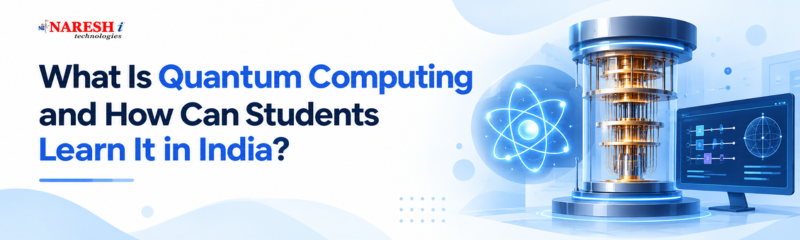
You may have read that quantum computers can solve in minutes what normal computers need years for. That is only half true. They are not faster at everything. They are built for a small set of very hard problems, and they work in a completely different way.
This guide explains quantum computing in simple words and shows how students in India can start learning it, even without a physics degree.
Quantum computing is a way of computing that uses the rules of quantum physics. These rules describe how very tiny things, like electrons and photons, behave. Quantum computers use that behaviour to handle certain problems, such as simulating molecules, in ways normal computers struggle with.
Quantum Computing explained for students comes down to three ideas:
A normal bit is like a coin lying flat: heads (0) or tails (1). A qubit is more like a coin spinning in the air. Until it lands, it is not simply one or the other.
A common myth says a quantum computer tries every answer at once. That is not quite right. Instead, the computer is designed so that wrong answers cancel each other out and right answers become more likely. This effect is called interference. Good quantum algorithms are clever ways of using it.

Quantum hardware is still young. Today’s machines have a limited number of qubits, and those qubits make errors easily, so researchers are working on error correction. They will not replace your laptop or phone. Promising uses include simulating molecules and materials, certain optimisation problems, and breaking some current encryption methods, which is why work on new security methods is also growing.
India is building its own capability. The National Quantum Mission has an outlay of ₹6,003.65 crore. In April 2025, QpiAI launched a 25-qubit system that the Department of Science and Technology described as the country’s first full-stack quantum computer.
|
Skill |
How much you need |
Why it helps |
|
Python |
Beginner level |
Most quantum tools, like Qiskit, use Python |
|
Linear algebra |
Basics: vectors and matrices |
Qubits and gates are described with them |
|
Probability |
Basics |
Measurement results are random |
|
Physics |
Helpful, not required at first |
Gives intuition later |
If you are weak in maths, do not panic. Beginners usually pick up the needed linear algebra along the way, especially when they see it in small programs.
Here are the main routes, from free to formal:
Always read the eligibility rules, since many formal programs are limited to engineering or science students.
You do not need real quantum hardware. Try this in a free simulator:
This tiny project teaches superposition, measurement and entanglement better than hours of reading.
Quantum computing is an emerging field, and the number of jobs today is small compared with normal software. Many roles are in research labs, universities and a few specialised companies. A report by NITI Aayog is said to estimate that India will need around 100,000 quantum developers for the 2030s, but projections like this can change. Treat quantum skills as an addition to your main field, such as software, chemistry or finance, because no course can guarantee a job.
Quantum computing uses qubits and principles of quantum physics to tackle specific complex problems that can be difficult for conventional computers to solve efficiently.
Yes, because basic Python and linear algebra are enough to begin.
Begin with a free NPTEL or IBM course and practise with Qiskit on a simulator.
No, free simulators and cloud tools are enough for beginners.
No, they are meant to help with specific problems, not everyday tasks.

Getting started with Quantum Computing is manageable when you learn the basic concepts gradually, one step at a time. Learn the basic ideas, pick up some Python, and practise on a free simulator. For your next step, build the one-qubit coin-flip circuit this week and explain the result to a friend.
If you were starting today, would you begin with a free online course or look for a college minor, and why?
Follow NareshIT for more practical insights on technology, skills, and career development.
 +91 8179191999

 +91
8179191999
+91
8179191999




.png)
.png)