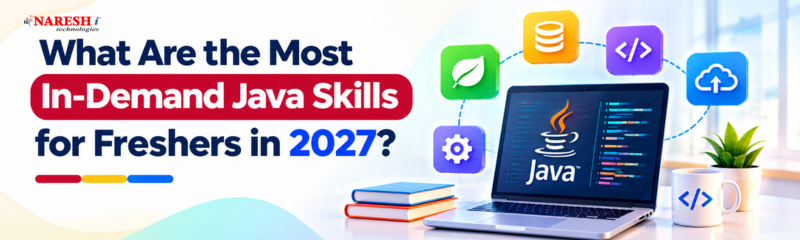
Knowing Java syntax is a good start, but is it enough to get a software developer job in 2027?
Many freshers can write basic programs but struggle when interviewers ask them to develop APIs, connect databases, or explain application architecture. Companies need developers who can apply programming knowledge to practical problems.
Understanding the Java Skills for Freshers that employers value can help beginners prepare more effectively. Based on current hiring requirements and Java development practices, here are the skills likely to remain important in 2027.
Java continues to support enterprise applications, banking systems, e-commerce platforms, and backend services.
However, knowing Core Java alone may not be enough for many development positions.
Employers increasingly value candidates who understand databases, REST APIs, Spring Boot, testing, and collaborative development.
Freshers preparing for 2027 should focus on building complete applications rather than memorizing programming definitions.

Core Java is the foundation of Java development.
Important topics include:
Understanding these concepts helps developers create maintainable applications.
For example, an online shopping system might use separate classes for products, customers, orders, and payments.
Problem-solving remains important in technical interviews.
Freshers should regularly practise Java coding problems involving arrays, strings, linked lists, stacks, queues, sorting, and searching.
Instead of memorizing solutions, understand why an algorithm works and how its time complexity changes with input size.
Most enterprise applications store information in databases.
Java developers should understand SQL queries, joins, constraints, indexes, and transactions.
Learning MySQL or PostgreSQL helps beginners connect Java applications with real databases.
Spring Boot is an important part of modern Backend Java Developer Skills.
Students planning to learn Spring Boot from scratch should understand dependency injection, controllers, services, repositories, and application configuration.
They should also practise REST APIs using GET, POST, PUT, and DELETE requests.
For example, a student management application can expose APIs to register students, retrieve records, and update course information.
Hibernate and Jakarta Persistence API (JPA) simplify interactions between Java applications and relational databases.
Freshers should understand entities, repositories, relationships, and basic query operations.
These skills are useful when building Spring Boot applications with persistent data.
Developers rarely work on isolated programs in professional environments.
Git helps teams manage code changes, while JUnit and Mockito support automated testing.
Basic knowledge of Maven, Docker, and CI/CD pipelines can provide additional advantages.
Cloud deployment knowledge is useful, although advanced DevOps expertise is not essential for every entry-level Java position.
|
Skill |
Priority |
Practical Application |
|
Core Java and OOP |
Essential |
Application logic |
|
DSA |
Essential |
Coding interviews |
|
SQL |
Essential |
Database operations |
|
Spring Boot |
High |
Backend development |
|
REST APIs |
High |
Service communication |
|
Hibernate/JPA |
High |
Database integration |
|
Git and Testing |
High |
Team development |
|
Docker and Cloud |
Additional |
Deployment |
Effective Java interview training should combine conceptual understanding, coding practice, and project explanations.
A practical preparation approach includes:
A library management system or employee management application can demonstrate database integration, backend logic, and API development.
Candidates should also practise explaining technical decisions rather than simply presenting completed code.
Freshers with practical Java development skills can explore positions such as:
Learning frontend technologies such as HTML, CSS, JavaScript, and React can expand opportunities in full-stack development.
Structured learning through Full Stack Java Online Training can help beginners connect Java fundamentals with Spring Boot, databases, frontend technologies, and practical projects.
Core Java, OOP, DSA, SQL, Spring Boot, REST APIs, Git, and testing are among the most useful skills.
Core Java provides the foundation, but many backend positions also require database knowledge, Spring Boot, and practical development experience.
Yes. Spring Boot is widely used for developing Java backend applications and REST APIs.
Yes. Coding assessments commonly evaluate problem-solving abilities using arrays, strings, collections, and basic algorithms.
Yes. Freshers can prepare by combining Java, Spring Boot, SQL, REST APIs, and frontend development skills with projects.

The most valuable Java Skills for Freshers in 2027 will likely combine strong programming fundamentals with practical backend development abilities.
Learning Core Java, SQL, Spring Boot, testing, and Git provides a solid foundation. Building complete applications and explaining them confidently can make that knowledge more useful during recruitment.
Discussion Question: Which Java skill do you find most challenging DSA, SQL, Spring Boot, or REST API development?
 +91 8179191999

 +91
8179191999