Imagine an online banking application suddenly becoming unavailable during peak transaction hours. Customers cannot access their accounts, payments fail, and business operations slow down. Even a short cloud outage can create serious problems.
This is why Multi-Cloud Disaster Recovery matters. Businesses increasingly depend on cloud platforms, but relying on one provider without a recovery plan can create operational risks.
A well-designed recovery strategy helps organizations restore applications, protect critical information, and maintain essential services when unexpected failures occur.
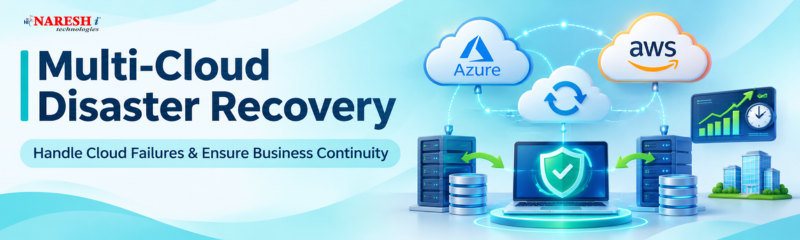
Multi-Cloud Disaster Recovery is a business continuity strategy that uses infrastructure or recovery capabilities across two or more cloud providers to protect applications and data against major disruptions.
For example, an organization might run its primary application on Amazon Web Services (AWS) while maintaining a recovery environment on Microsoft Azure.
If the primary environment becomes unavailable, the organization can activate its secondary infrastructure.
Unlike traditional backup systems, disaster recovery also considers application availability, networking, security, dependencies, and restoration procedures.

Cloud platforms provide reliable infrastructure, but failures can still occur.
Common causes include:
Effective disaster recovery in cloud computing addresses these risks through redundancy, recovery procedures, automated deployment, and protected backups.
A multi-cloud recovery environment generally uses a primary cloud platform and an independent secondary environment.
Consider an e-commerce company hosting its application on AWS.
The company could maintain compatible infrastructure and protected backups on Azure. If AWS experiences a major outage, recovery procedures would restore or activate the application on Azure.
A typical recovery process involves:
Recovery speed depends on architecture, replication methods, automation, and available infrastructure.
Two measurements guide disaster recovery planning.
Recovery Time Objective (RTO) defines the maximum targeted time for restoring services.
Recovery Point Objective (RPO) defines the maximum acceptable period of data loss.
For instance, an RPO of 15 minutes means the organization aims to lose no more than 15 minutes of data.
AWS and Microsoft Azure provide services that support business continuity and recovery operations.
|
Feature |
AWS Disaster Recovery |
Azure Disaster Recovery |
|
Recovery service |
AWS Elastic Disaster Recovery |
Azure Site Recovery |
|
Backup service |
AWS Backup |
Azure Backup |
|
Infrastructure |
Amazon EC2 |
Azure Virtual Machines |
|
Monitoring |
Amazon CloudWatch |
Azure Monitor |
|
Automation |
CloudFormation, Systems Manager |
ARM, Azure Automation |
AWS disaster recovery can use backup-and-restore, pilot-light, warm-standby, and active-active architectures.
Azure disaster recovery supports virtual-machine replication, failover planning, and workload restoration.
However, native AWS and Azure recovery services do not automatically provide complete cross-provider failover. Multi-cloud architectures require additional integration, compatible infrastructure, data replication, and testing.
Organizations should approach cloud computing backup and recovery as an ongoing operational responsibility.
Store protected backup copies separately from production systems. Use encryption, appropriate access controls, and immutable backups where supported.
Infrastructure as Code tools such as Terraform and automation pipelines can help rebuild environments consistently.
A backup is useful only when it can be successfully restored. Conduct recovery drills and verify applications, databases, networking, and access permissions.
Industry research, including the Gartner Magic Quadrant disaster recovery evaluations, can support vendor research. However, organizations should prioritize technical requirements, recovery objectives, compatibility, and independent testing rather than rankings alone.
Cloud engineers and DevOps professionals increasingly work with availability, infrastructure automation, monitoring, and security.
Useful skills include AWS, Azure, Linux, networking, Terraform, Docker, Kubernetes, and CI/CD pipelines.
Practical learning through DevOps Online Training or DevOps with Multi-Cloud Training can introduce these technologies alongside deployment and recovery exercises.
It is a recovery strategy using multiple cloud providers to restore applications and protect business operations during infrastructure failures.
Backup preserves recoverable data copies. Disaster recovery restores applications, infrastructure, connectivity, and operational services.
Yes. Organizations can design cross-cloud recovery architectures, although additional configuration, replication, and compatibility testing are required.
Costs depend on storage, network transfers, recovery infrastructure, licensing, and the selected availability strategy.
AWS, Azure, Linux, networking, automation, backup management, monitoring, and troubleshooting provide a strong technical foundation.

Cloud failures cannot always be prevented, but their business impact can be reduced through thoughtful planning.
Multi-Cloud Disaster Recovery helps organizations improve resilience by combining independent infrastructure, protected backups, automation, and regularly tested recovery procedures.
For aspiring cloud engineers, understanding recovery architecture is a valuable step toward managing real-world enterprise systems.
Discussion Question: Would you prefer a single-cloud recovery architecture or a multi-cloud strategy for a business-critical application?
 +91 8179191999

 +91
8179191999