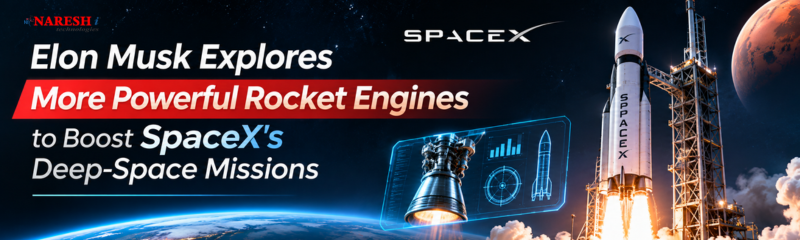
Summary: SpaceX CEO Elon Musk is exploring more powerful rocket engine technology to strengthen the company's future Moon and Mars missions.
His proposed Raptor 4 engine could deliver approximately 300 metric tons of thrust, exceeding the performance of previous versions. The development reflects SpaceX's efforts to improve rocket efficiency, payload capacity, and reusable space transportation.
November 7, 2026: Elon Musk has shared new details about SpaceX's plans to develop a more powerful rocket engine as the company continues advancing its Starship spacecraft for deep-space exploration.
On October 26, Musk indicated that the proposed Raptor 4 engine could generate approximately 300 metric tons of thrust at sea level while maintaining a weight similar to its predecessor.
The development could help SpaceX improve the performance of Starship, its reusable rocket system designed to transport astronauts, satellites, and cargo to destinations including the Moon and Mars.
Supercharged Daily+1
SpaceX's Raptor engines use liquid methane and liquid oxygen as propellants, supporting the company's long-term plans for reusable space transportation.
The Raptor 3 engine already incorporates design improvements intended to reduce complexity and increase thrust.
The proposed Raptor 4 would represent another technological advancement, potentially allowing Starship to carry heavier payloads while improving overall propulsion efficiency.
However, Raptor 4 remains a proposed development. SpaceX has not publicly demonstrated a completed engine or announced a confirmed operational launch date.
SpaceX is developing Starship as a fully reusable transportation system capable of supporting ambitious space exploration missions.
In September 2026, Starship achieved its first orbital flight, deploying 26 next-generation Starlink satellites.
The milestone demonstrated progress in SpaceX's efforts to expand launch capabilities, although additional testing is necessary before the vehicle can support routine deep-space missions.
Starship Flight 14
Deep-space missions require advanced propulsion systems capable of transporting large quantities of equipment, fuel, and scientific instruments.
More powerful engines could improve rocket performance and help SpaceX develop transportation systems for future lunar missions and potential human expeditions to Mars.
However, propulsion upgrades alone will not guarantee successful deep-space travel. SpaceX must also demonstrate reliable orbital refueling, spacecraft landing, thermal protection, and long-duration mission capabilities.
Developing next-generation rocket engines presents several engineering challenges.
Higher thrust places additional demands on engine components, combustion systems, temperature management, and structural reliability.
SpaceX must complete extensive ground testing and flight demonstrations before incorporating future propulsion technology into operational missions.
The company continues evaluating Starship performance through repeated testing to identify technical limitations and improve reliability.
Elon Musk's proposed Raptor 4 engine highlights SpaceX's ambition to develop more powerful and efficient rocket technology.
With a potential thrust output of 300 metric tons, the engine could contribute to future improvements in Starship's performance and payload capabilities.
Although development remains at an early stage, the proposal reflects continued investment in reusable launch systems and deep-space transportation.
For the global aerospace industry, advances in rocket propulsion could eventually support more ambitious lunar exploration, satellite deployment, and missions beyond Earth.

 +91 8179191999

 +91
8179191999