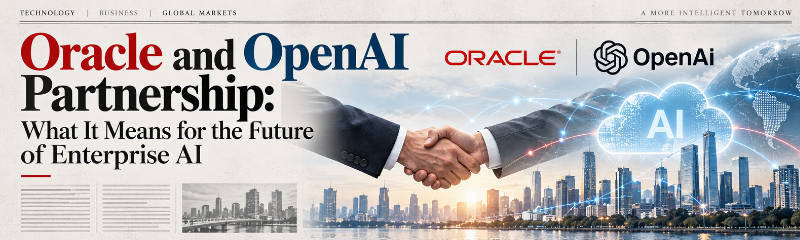
October 30, 2026: Oracle and OpenAI have announced an expanded partnership aimed at bringing advanced artificial intelligence capabilities into everyday business operations. The collaboration, unveiled on October 27, focuses on combining OpenAI's AI models with Oracle's enterprise applications, databases, and cloud infrastructure.
The announcement comes as businesses increasingly explore artificial intelligence beyond traditional chatbots. Organizations are looking for AI-powered solutions that can analyze business information, automate repetitive tasks, and support operational decisions.
One of the major developments is Oracle AI Workspace, designed to connect OpenAI technologies with Oracle's existing business applications.
The platform aims to allow employees to interact with enterprise systems using natural-language instructions. Businesses could use these capabilities across finance, human resources, customer management, and other operational functions.
For example, finance departments could analyze expenditure patterns, while HR teams could streamline administrative activities. The goal is to improve efficiency without compromising enterprise access controls and governance requirements.
The partnership also introduces opportunities for AI-assisted software development.
Oracle App Composer incorporates OpenAI Codex capabilities to help developers build applications connected to enterprise databases and business workflows.
This could reduce time spent on repetitive coding activities and support faster application development.
Cybersecurity is another important focus. Oracle AI Security Mesh is designed to combine AI-driven security capabilities with Oracle's existing infrastructure to identify potential vulnerabilities and strengthen organizational protection.
These developments reflect growing enterprise demand for AI systems that balance automation with security and reliability.

The collaboration is expected to increase interest in professionals skilled in artificial intelligence, cloud computing, application development, and cybersecurity.
As enterprises integrate AI into their technology environments, developers may increasingly need knowledge of Python, APIs, enterprise databases, AI agents, and cloud deployment.
Students and fresh graduates can prepare for these developments by gaining practical experience in AI integration, application testing, and automation projects.
However, the partnership does not guarantee immediate job creation. Its employment impact will depend on how businesses adopt and scale these technologies.
The Oracle-OpenAI partnership marks another development in the transition from experimental AI tools to integrated enterprise solutions.
By bringing advanced AI capabilities into business applications, software development, and security systems, the companies aim to simplify enterprise AI implementation.
The long-term impact will depend on adoption, security, costs, and measurable business outcomes.
For the technology industry, the collaboration signals growing demand for practical AI capabilities and professionals who can integrate intelligent systems into real business environments.
Short Summary: Oracle and OpenAI have expanded their partnership to integrate advanced artificial intelligence into enterprise applications, cloud infrastructure, software development, and cybersecurity. The collaboration aims to help businesses automate operations, improve productivity, and accelerate enterprise AI adoption.
 +91 8179191999

 +91
8179191999