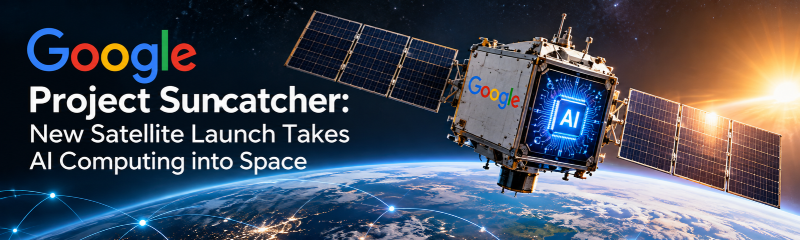
October 31, 2026: Google has taken an important step toward developing space-based artificial intelligence infrastructure through Project Suncatcher. The company successfully launched its prototype satellite aboard SpaceX's Transporter-18 mission on October 1, in collaboration with satellite manufacturer Planet.
On October 30, Google announced that its satellite had successfully processed an AI request using its onboard Gemma 4 model and transmitted the response back to Earth.
The achievement demonstrates that Google's specialized AI hardware can perform machine learning operations in orbit, marking an early milestone in its ambitious research project.
Project Suncatcher is Google's research initiative exploring whether future AI computing infrastructure could operate in space using solar energy.
Traditional AI data centers require substantial electricity, cooling infrastructure, and physical space. Google is investigating whether satellites equipped with Tensor Processing Units (TPUs) could eventually provide an alternative computing environment.
According to Google, satellites in suitable low-Earth orbits could access nearly continuous sunlight and potentially generate significantly more solar energy than comparable Earth-based installations.
The long-term vision involves interconnected satellite networks capable of processing large AI workloads.
The prototype satellite carries Google's specialized TPU chips designed for machine learning operations.
Following the launch, engineers completed initial checks, activated the computing hardware, and conducted preliminary AI tests.
During a ground-station communication session, Google sent a request to the onboard Gemma 4 model. The satellite successfully generated a short poem about space and transmitted it back to Earth.
This confirmed that AI inference could operate successfully aboard the experimental spacecraft.
Google will now investigate how its computing hardware performs under radiation exposure, temperature variations, and other challenges associated with space.
Despite the successful experiment, several engineering challenges remain.
AI processors generate significant heat, making cooling particularly difficult in the vacuum of space. Radiation exposure can also affect electronic components.
Additional challenges include satellite communication, launch expenses, hardware maintenance, and reliable power management.
Google plans to test two interconnected satellites in 2027, exploring high-speed communication between computing systems in orbit.
Google's Project Suncatcher represents an experimental approach to expanding artificial intelligence computing beyond traditional Earth-based data centers.
The successful satellite launch and first AI-generated response demonstrate promising technical progress, although commercially viable orbital data centers remain a long-term possibility.
If future experiments succeed, space-based AI infrastructure could introduce new opportunities in machine learning, satellite engineering, cloud computing, and advanced hardware development.
For now, Project Suncatcher remains a research initiative, but its latest achievement offers an early glimpse into how AI computing infrastructure might evolve beyond Earth.
Summary: Google has achieved a major milestone in Project Suncatcher, its ambitious initiative to explore artificial intelligence computing in space. Following the successful launch of a prototype satellite on October 1, 2026, the company confirmed its first AI-generated response from orbit on October 30. The experiment could pave the way for future solar-powered AI data centers beyond Earth.

 +91 8179191999

 +91
8179191999