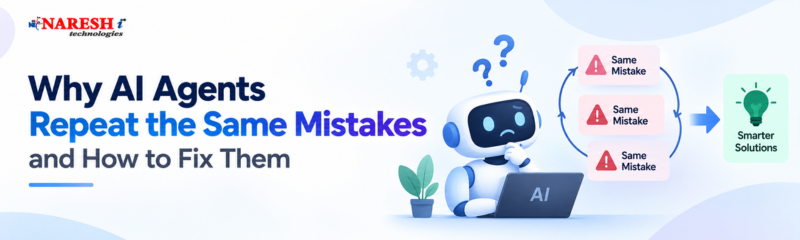
Why AI Agents Repeat the Same Mistakes and How to Fix Them
If your AI agent keeps making the same error, the problem usually isn't the model. It's the loop around it.
Anyone who has spent real time with an AI agent has seen this pattern: it fails at a task, you correct it, it fixes that specific instance, and then two steps later it makes the exact same mistake again. Not a similar mistake. The same one.
This isn't a sign that agentic AI doesn't work. It's a sign of a design gap that shows up constantly in early agent implementations: the agent has no reliable way to remember what went wrong, or no mechanism forcing it to check its own work before repeating an action. Once you understand why this happens, fixing it stops being mysterious and starts being an engineering problem with concrete solutions.
This article breaks down the real reasons agents repeat mistakes, then walks through practical fixes you can actually apply, whether you're building agents yourself or just trying to get more reliable results from the ones you use.
Table of Contents
- What "Repeating the Same Mistake" Actually Looks Like
- Why This Happens: The Real Root Causes
- Root Cause 1: No Persistent Memory of Past Failures
- Root Cause 2: No Verification Step Before Acting Again
- Root Cause 3: Context Window Limits and Truncation
- Root Cause 4: Vague or Incomplete Task Definitions
- Root Cause 5: No Feedback Loop From Outcomes to Future Behavior
- How to Fix It: A Practical Framework
- Benefits and Limitations of These Fixes
- Common Mistakes When Trying to Fix This
- What Should You Learn?
- Career and Industry Relevance
- Future Outlook
- Practical Next Steps
- FAQs
1. What "Repeating the Same Mistake" Actually Looks Like
A few common examples make this concrete:
- An agent writes code that fails a test, gets corrected, and then makes an almost identical error in a different file later in the same session
- A customer support agent gives an answer that was flagged as wrong, then gives a very similar wrong answer to a related question minutes later
- A research agent cites a source that turned out to be unreliable, is told so, and then pulls from a similarly unreliable source in its next step
In each case, the correction "worked" in the moment, but nothing about the underlying process changed. That's the actual problem worth solving.
2. Why This Happens: The Real Root Causes
It's tempting to blame "the model isn't smart enough," but that's rarely the real issue. Most repeated mistakes trace back to how the agent's loop is designed, not the raw capability of the underlying model. Here's a quick overview before going deeper into each one:
|
S.No
|
Root Cause
|
What It Looks Like
|
Why It Causes Repetition
|
|
1
|
No persistent memory
|
Correction only applies within the current step
|
Next task starts with no record of the mistake
|
|
2
|
No verification step
|
Agent acts, then moves on without checking
|
Same flawed pattern isn't caught before repeating
|
|
3
|
Context window limits
|
Earlier corrections get pushed out of context
|
The fix is technically "forgotten" mid-session
|
|
4
|
Vague task definitions
|
Goal doesn't specify constraints clearly
|
Agent has no clear rule to avoid the mistake
|
|
5
|
No feedback loop to future behavior
|
Outcomes aren't fed back into how the agent plans
|
Nothing updates the agent's approach going forward
|
3. Root Cause 1: No Persistent Memory of Past Failures
Many agent setups only hold context for the current task. Once that task ends, or once the conversation moves far enough forward, the specific correction you gave is gone. The agent isn't ignoring you. It genuinely has no record that the correction happened.
This is especially common in simple chatbot-style tools being used in an agentic way without any memory system attached. Without persistent storage of "this approach failed, here's why," every session effectively starts from zero.
4. Root Cause 2: No Verification Step Before Acting Again
An agent that generates an action and executes it immediately, without checking the result against some standard, has no way to catch a repeated error before it happens. Verification isn't just about catching failure after the fact. It's about building a checkpoint the agent has to pass before repeating a similar action.
Without this, "learning from a mistake" only happens if a human manually intervenes every single time, which defeats much of the point of using an agent in the first place.
5. Root Cause 3: Context Window Limits and Truncation
Even when an agent does have context about a past correction, long sessions can push that information out of the active context window. The correction was there. It just got crowded out by everything that happened afterward.
This is a subtle failure mode because it looks like the agent "forgot on purpose," when really it's a structural limit of how much information can stay active at once without deliberate memory management.
6. Root Cause 4: Vague or Incomplete Task Definitions
Sometimes the agent isn't malfunctioning at all. It's doing exactly what it was told, and the instruction simply didn't rule out the mistake. If a task description doesn't specify a constraint clearly ("don't use this deprecated function," "always validate this field before submitting"), the agent has no rule to check against, so a similar action can look perfectly valid to it twice in a row.
7. Root Cause 5: No Feedback Loop From Outcomes to Future Behavior
In a well-designed system, the outcome of an action should influence how future actions are planned. In a poorly designed one, the agent's planning step has no access to "what happened last time I tried something like this," so it plans the next step exactly as if the earlier failure never occurred.
8. How to Fix It: A Practical Framework
Each root cause above has a fairly direct fix. Here's what a more resilient agent loop looks like compared to a simple, repetition-prone one:
python
# Simple agent loop: prone to repeating mistakes
def simple_agent(task):
    action = decide_action(task)
    result = execute(action)
    return result

# Improved agent loop: memory, verification, and feedback built in
def resilient_agent(task, memory_store):
    past_failures = memory_store.get_related_failures(task)
    action = decide_action(task, avoid=past_failures)

    result = execute(action)
    passed, reason = verify(result, task.criteria)

    if not passed:
        memory_store.log_failure(task, action, reason)
        action = revise_action(action, reason)
        result = execute(action)

    memory_store.log_outcome(task, action, result)
    return result
The core additions are simple to describe even if they take real engineering effort to build well:
- Persistent memory that stores past failures in a way future tasks can actually query, not just within one session
- A verification step that checks the result against clear criteria before considering the action complete
- A feedback write-back that logs the outcome so future planning has access to what happened before

9. Benefits and Limitations of These Fixes
Benefits:
- Noticeably reduces repeated errors across a working session and across separate sessions
- Makes agent behavior more predictable, since failures get recorded and referenced instead of disappearing
- Builds a growing record of edge cases that improves reliability over time
Limitations:
- Memory and verification systems add real engineering complexity and cost, they aren't free
- Poorly designed memory can introduce a new problem: outdated or incorrect "lessons" getting reused inappropriately
- Verification steps slow down execution, which matters for latency-sensitive applications
- None of this guarantees zero mistakes, it reduces repetition of the same mistake, not all possible errors
10. Common Mistakes When Trying to Fix This
"Just add more context and the problem goes away." Bigger context windows help, but without a deliberate memory and verification structure, important details still get lost in the noise of everything else in the conversation.
"One correction should be enough." A single correction inside one conversation often doesn't persist to a new session or a different task. If reliability matters, the fix needs to be stored somewhere the agent will actually check again.
"Verification steps are optional overhead." Skipping verification to save time is usually what causes the repeated mistake in the first place. It's rarely optional if reliability matters for the task.
11. What Should You Learn?
For students and freshers, the useful mental model is simple: an agent's reliability depends on its loop design, not just the model powering it. Understanding memory, verification, and feedback loops conceptually will help you evaluate any agent tool you work with later.
For working professionals and career switchers:
- Learn the basics of how memory systems work in agent frameworks, at least conceptually
- Practice writing clear, specific task instructions with explicit constraints, since vague instructions are a common hidden cause of repeated errors
- Get comfortable designing simple verification checks for any AI-driven process you're responsible for
- When evaluating an agentic tool, specifically ask how it handles memory across sessions, since this is often overlooked in demos
12. Career and Industry Relevance
As more teams put agents into real production workflows, the ability to diagnose why an agent is behaving unreliably is becoming a genuinely valuable skill, distinct from just knowing how to prompt one. Being able to say "this is a memory problem" versus "this is a verification problem" versus "this is a task definition problem" is the difference between fixing an issue and just re-prompting around it temporarily.
13. Future Outlook
Expect memory and verification to become standard, built-in features of agent frameworks rather than something every team has to engineer from scratch. As that happens, the skill that matters most will shift from building these systems yourself to knowing how to configure and evaluate them properly for a given task.
What's your experience been? Have you seen an AI agent repeat a mistake in a way that revealed a specific gap in how it was designed?
14. Practical Next Steps
- Next time an agent repeats a mistake, pause and identify which root cause it actually matches: memory, verification, context limits, task definition, or feedback loop
- If you're building agents, add even a simple logging mechanism that records failures in a way future tasks can reference
- Review your task instructions for vague language and add explicit constraints where a mistake has happened before
- Build the habit of designing a verification check for any AI-driven process before trusting its output at scale
15. Frequently Asked Questions
1. Why does my AI agent keep making the same mistake?
Usually because there's no persistent memory of the failure, no verification step catching it, or the task instructions didn't rule it out clearly.
2. Does a bigger context window fix this problem?
It helps, but it's not a complete fix. Without deliberate memory and verification design, important corrections can still get lost among everything else in a long session.
3. Is this a sign the underlying AI model is weak?
Not usually. Most repeated mistakes come from how the agent's loop is designed, not the raw capability of the model itself.
4. What's the single most effective fix?
Adding a verification step before an action is finalized tends to catch the most repeated errors, especially when paired with basic memory of past failures.
5. Can I fix this without building my own memory system?
Yes, to an extent. Writing clearer, more specific task instructions and manually reviewing outputs against a checklist can reduce repetition even without custom infrastructure.
6. Does this only apply to coding agents?
No. The same root causes (memory, verification, feedback loops) apply to customer support agents, research agents, and any other agentic workflow.
7. How do I know if the issue is memory or task definition?
If the agent repeats a mistake across different sessions with a similar but not identical task, check task definitions first. If it repeats the exact same corrected mistake shortly after being told, suspect memory or context limits.
Conclusion
AI agents don't repeat mistakes because they're incapable of learning. They repeat mistakes because too many agent loops are missing memory, verification, and feedback by design. Once you see the pattern this way, fixing it stops being guesswork and becomes a concrete engineering task.
Takeaway: Next time an agent repeats an error, resist the urge to just re-prompt and move on. Identify which specific gap caused it, memory, verification, or unclear instructions, and fix that gap directly. That's what actually stops the pattern from happening again.
Follow NareshIT for more practical insights on technology, skills, and career development.
.png)


 +91 8179191999

 +91
8179191999
+91
8179191999





.png)









.png)