Next Batch : Invalid Date
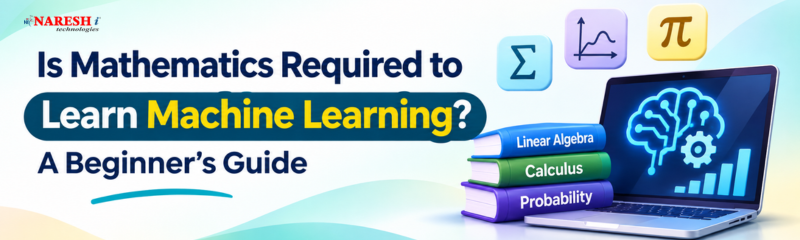
Many students are interested in machine learning but hesitate when mathematics enters the conversation. Some remember struggling with equations in school. Others assume that building AI models requires advanced calculus from day one.
Fortunately, the reality is more encouraging.
Mathematics Required for Machine Learning depends on what you want to achieve. Beginners can start building simple models with basic algebra, statistics, and Python. Advanced mathematics becomes more important when you want to understand algorithms deeply, improve model performance, or develop new AI techniques.
The right approach is to learn mathematics alongside practical machine learning, rather than waiting until you have mastered every topic.
You do not need to be a mathematics expert to begin machine learning.
However, mathematics helps you understand why an algorithm makes predictions, how it learns from data, and what causes errors.
For example, imagine building a model to predict house prices in Hyderabad.
You provide information about property size, location, and previous selling prices.
Python libraries can train the model, but mathematical knowledge helps you understand the relationships between these variables and evaluate whether the predictions are reliable.
This is why mathematics for machine learning and data science becomes increasingly useful as projects become more complicated.

Four mathematical areas provide a useful foundation.
Algebra helps describe connections between inputs and outputs.
In linear regression, a simple equation might look like:
y = mx + c
Here, x represents an input, m represents its influence, and c represents the starting value.
Understanding equations, variables, functions, and graphs is enough to begin exploring regression models.
Statistics helps you interpret datasets rather than simply feeding numbers into algorithms.
Important concepts include:
For example, when analysing student examination results, an average score alone may hide substantial differences between students.
Statistics helps reveal those differences and supports better decisions.
Machine learning models frequently process many values simultaneously.
Linear algebra introduces vectors, matrices, and matrix multiplication.
Consider an image recognition system. An image contains numerical pixel values arranged in arrays. Linear algebra provides the mathematical framework for processing such information.
It is particularly important in neural networks and deep learning.
Calculus becomes useful when studying how models improve their predictions.
During training, algorithms often adjust parameters to reduce errors.
Derivatives help describe how changes in those parameters affect the error.
Beginners can first understand this idea visually without solving complicated equations.
Not every technology role requires the same mathematical depth.
| Career Path | Mathematical Knowledge |
| Data Analyst | Statistics, basic algebra |
| Machine Learning Beginner | Algebra, statistics, introductory linear algebra |
| Data Scientist | Statistics, probability, linear algebra, calculus |
| ML Engineer | Linear algebra, probability, optimization |
| AI Researcher | Advanced mathematics and optimization |
The table describes typical learning needs, not fixed employment requirements. Actual expectations depend on the employer and project.
Yes. Many beginners learn more effectively by combining coding exercises with mathematical explanations.
Start with Python Training to become comfortable with variables, functions, lists, and libraries.
Next, explore pandas, NumPy, and scikit-learn. Build a small prediction model and examine its results.
A Data Science Course Online can provide structure, while Data Analytics Training helps learners practise statistics using realistic datasets.
Students interested in Generative AI & Agentic AI with Python can also begin experimenting with existing models and APIs before studying the mathematics behind model training.
Using AI tools and understanding their internal mathematics are different skill levels.
A practical learning sequence is:
Stage 1: Revise school-level algebra, percentages, graphs, and averages.
Stage 2: Practise statistics and probability using small datasets.
Stage 3: Learn vectors and matrices through NumPy exercises.
Stage 4: Explore derivatives while studying model optimization.
Stage 5: Apply these concepts through regression, classification, and evaluation projects.
When choosing a machine learning math course or the best math course for machine learning, prioritise worked examples and Python exercises over lengthy theoretical lectures.
One useful mathematics for machine learning book is Mathematics for Machine Learning by Marc Peter Deisenroth, A. Aldo Faisal, and Cheng Soon Ong.
Basic mathematics is strongly recommended. You can begin practical machine learning without advanced calculus, but mathematical understanding becomes important as you progress.
Yes. Start with simple algebra and statistics, practise with Python, and gradually learn additional concepts through projects.
Algebra, statistics, probability, linear algebra, and calculus are the main areas. Their importance varies with the learning level.
Basic math for AI and machine learning supports understanding, while deeper knowledge of linear algebra and calculus helps explain neural network training.
Begin with Python and basic mathematics together. Coding exercises make mathematical ideas easier to understand and remember.

Mathematics should support your machine learning journey, not prevent you from starting it.
A beginner who understands basic statistics, writes Python programs, and completes small projects can develop a meaningful foundation before approaching advanced mathematical topics.
Discussion Question: Which part of machine learning feels more challenging to you understanding the mathematics or writing the Python code?
 +91 8179191999

 +91
8179191999