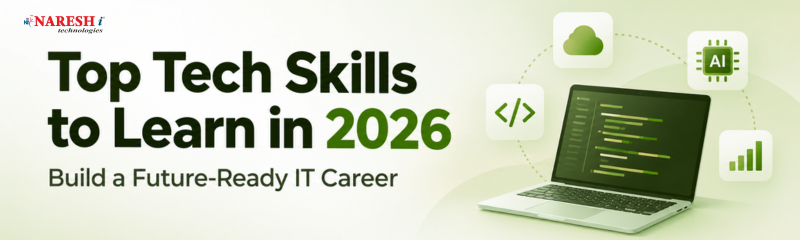
A student can spend months learning a programming language, only to discover that entry-level development work now involves AI coding assistants, cloud platforms, APIs, automated testing, and deployment pipelines as well.
That does not mean traditional programming has become irrelevant. It means the definition of being a good technology professional is getting broader. Knowing syntax is useful, but knowing how to build, test, deploy, troubleshoot, and improve a real application matters much more.
For anyone planning an IT career in 2026, the challenge is not finding a list of 50 technologies to learn. The harder question is deciding which skills are worth spending serious time on and how those skills fit together.
AI is no longer something developers encounter only while experimenting with chatbots. It is becoming part of normal development workflows.
GitHub's 2025 Octoverse research found that more than 1.1 million public repositories were using an LLM SDK, while AI-related repositories had grown to more than 4.3 million. The same research also showed TypeScript becoming the most-used language on GitHub by monthly contributors in August 2025, while Python remained particularly important for AI and data projects.
The important lesson is not that everyone should immediately become an AI engineer.
Instead, developers need to understand how AI fits into software development, while AI-focused professionals need strong foundations in programming, data, cloud infrastructure, testing and security.
That is why the most useful tech skills to learn in 2026 are connected rather than isolated.
Generative AI skills are among the most practical additions to a developer's toolkit.
You do not necessarily need to train a large language model from scratch. For most application developers, the more useful starting point is understanding how existing models can be integrated into software.
Important areas include:
Consider a customer-support application. A basic chatbot may simply send a question to an LLM and display the response. A production application might retrieve relevant company documents, pass that information to the model, validate the output, record the interaction and apply access controls.
The second application requires considerably more engineering.
That is where AI engineering becomes useful. The skill is less about knowing every new AI model and more about connecting models with reliable software systems.
Python is particularly useful here. GitHub's 2026 analysis found that nearly half of new AI-focused projects in its 2025 data were primarily built with Python.
Generative AI usually responds to a request. Agentic AI can go a step further by planning a task, using tools, maintaining context and completing multiple steps.
For example, imagine an internal IT-support agent.
A user reports that a software account is locked. Instead of simply explaining how to reset a password, an agent could:
This introduces a different set of engineering problems: tool calling, permissions, state management, evaluation, observability and human approval.
Current developer platforms are already exposing these capabilities. OpenAI's Agents SDK, for example, supports agents that can use tools, work across multiple steps and coordinate with other agents. Microsoft Foundry documentation similarly covers agent development, deployment, evaluation, monitoring and agent-to-agent connections.
For learners, useful agentic AI skills include:
Do not start with multi-agent systems just because they are popular. Build one useful agent first.
Programming fundamentals remain one of the safest investments for an IT career.
AI coding tools can generate functions quickly, but they do not remove the need to understand data structures, algorithms, debugging, APIs, databases, version control and software design.
Python is especially valuable for AI, machine learning, automation, backend development and data work.
TypeScript deserves attention for modern web and full-stack development. GitHub reported that TypeScript moved ahead of Python and JavaScript to become its most-used language by monthly contributors in August 2025.
That does not mean Java, C#, JavaScript or other established languages are suddenly poor choices. The better approach is to become strong in one primary language and understand enough of another ecosystem to work across modern applications.
A learner could choose:
| Career direction | Strong starting skills |
|---|---|
| AI/ML | Python, SQL, statistics, ML |
| Full-stack development | TypeScript/JavaScript, React, APIs, databases |
| Enterprise development | Java or C#, SQL, APIs, cloud |
| Data engineering | Python, SQL, pipelines, cloud |
| Cloud/DevOps | Linux, networking, scripting, cloud platforms |
| Cybersecurity | Networking, Linux, Python, security fundamentals |
The common factor is programming logic, not the language name.
Knowing how software runs after it leaves your laptop is increasingly important.
Cloud computing skills include more than learning where to click in AWS, Azure or Google Cloud. You should understand compute, storage, networking, databases, identity, security, containers, monitoring and cost considerations.
Start with one cloud platform instead of trying to learn all three simultaneously.
AWS, Azure and Google Cloud all provide learning paths covering cloud fundamentals, AI and machine learning. AWS, for example, currently separates learning around roles such as cloud practitioner, developer, solutions architect and machine learning/AI.
A practical project could be a web application with:
Once you have built something like this, cloud concepts become much easier to understand.
AI applications are only as useful as the data surrounding them.
That makes SQL, data modeling, ETL/ELT pipelines, data quality and data processing important skills even for people who do not want to become data scientists.
Machine learning adds another layer: statistics, feature engineering, model training, evaluation and deployment.
The boundary between traditional ML and generative AI is also becoming less rigid. AWS's updated 2026 Machine Learning Engineer certification, for example, now covers generative AI, agentic AI and foundation-model workloads alongside traditional machine-learning engineering.
A learner interested in this area should understand the full lifecycle:
Collect data → clean data → explore data → train model → evaluate model → deploy model → monitor model
Learning only model training leaves out much of the work involved in using ML in a real application.
Security should not be treated as a separate responsibility that begins after development.
Developers increasingly need to understand authentication, authorization, secrets management, secure APIs, dependency vulnerabilities, input validation and common web attacks.
For example, an application that uses an AI API still has ordinary security concerns. API keys need protection. User permissions need enforcement. Uploaded documents may contain sensitive information. Generated output may need validation before it triggers an action.
Security skills are therefore useful across development, cloud, DevOps and AI engineering.
For beginners, start with networking and operating-system fundamentals before moving into penetration testing or advanced security tools.
A developer who can build an application is useful. A developer who can also automate testing, package the application and understand deployment has a broader view of the software lifecycle.
Important skills include:
You do not need to memorize dozens of DevOps tools.
Learn the underlying workflow first:
Code → Build → Test → Package → Deploy → Monitor → Improve
That workflow makes it easier to learn tools such as Docker, GitHub Actions, Kubernetes or cloud-native services later.
The biggest mistake is trying to learn everything at once
Instead, select one primary career direction and add complementary skills around it.
For example:
Full-stack developer:
TypeScript → React → backend APIs → SQL → Git → cloud → AI integration
AI engineer:
Python → SQL → ML fundamentals → LLM APIs → RAG → evaluation → cloud deployment
Cloud/DevOps engineer:
Linux → networking → Git → Docker → cloud → CI/CD → infrastructure → monitoring
Data professional:
Python → SQL → statistics → data engineering → ML → cloud
The paths overlap. That is useful because skills learned in one area often strengthen another.
A sensible learning plan is more valuable than collecting certificates.
Stage 1: Strengthen the foundation
Spend time on one programming language, SQL, Git, basic Linux and problem-solving.
Stage 2: Pick a specialization
Choose AI, full-stack development, cloud/DevOps, data or cybersecurity based on your interests and target roles.
Stage 3: Add AI fluency
Even if AI is not your specialization, learn how developers use LLM APIs, coding assistants, RAG and automation responsibly.
Stage 4: Build real projects
Do not stop after tutorials. Build two or three projects where you have to make decisions yourself.
A strong project should have a clear problem, usable interface or API, data storage, error handling, testing and documentation.
Stage 5: Learn deployment
Put at least one project online. Configure the application, monitor it, fix a deployment problem and document what you learned.
Stage 6: Show your work
A GitHub repository with meaningful commits, a clear README and a working project can demonstrate practical ability far better than a list of technologies copied into a resume.
Being future-ready does not mean learning every technology that appears on a trending list.
A better strategy is to build a strong technical base and then add skills that work together: programming, cloud, data, AI, security and automation.
For a learner starting in 2026, one practical next step is simple: choose one career direction, select one substantial project and learn the technologies required to complete it from development through deployment.
If you were starting your IT career in 2026, which path would you choose first AI engineering, full-stack development, cloud/DevOps, data engineering, or cybersecurity, and why?
Follow NareshIT for more practical insights on technology, skills, and career development.
1. Which tech skill should I learn first in 2026?
Programming fundamentals should come first for most beginners. Python is a strong starting point for AI, data and automation, while TypeScript or JavaScript is useful for web development.
2. Are generative AI skills worth learning in 2026?
Yes, generative AI skills are useful across many technology roles in 2026. Developers can learn model APIs, RAG, prompt design, evaluation and AI application development without becoming machine-learning researchers.
3. Do I need to learn all three major cloud platforms?
No, you do not need to learn AWS, Azure and Google Cloud simultaneously. Start with one platform, understand its core services and build a practical project before exploring another provider.
4. Is agentic AI a separate career skill from generative AI?
Agentic AI builds on generative AI but adds skills such as tool use, workflow orchestration, state, permissions and evaluation.
5. Are traditional programming skills still important with AI coding tools?
Yes, programming fundamentals remain important because developers still need to review, test, debug and make architectural decisions about AI-generated code.
 +91 8179191999

 +91
8179191999
+91
8179191999










.png)