.png)
Next Batch : Invalid Date
A data science student once told me she could implement a logistic regression model perfectly from a tutorial, copy the code, run it, get accurate predictions, but couldn't explain why the model was making the predictions it was, or what to do when it suddenly stopped working on new data. She'd learned the code without the concepts underneath it, and that gap showed up the moment something didn't go according to the tutorial's script.
That's the practical argument for learning math for data science and machine learning: not to prove theorems or pass an exam, but to understand what's actually happening when a model trains, when a metric improves, or when something breaks in a way no tutorial covered. You don't need a math degree for this. You need working, applied fluency in a handful of areas that show up constantly, and knowing exactly which ones matter saves a lot of time compared to trying to learn all of mathematics before writing a single line of model code.
This guide covers those areas plainly, what each one actually does for you in practice, not just what it's called.
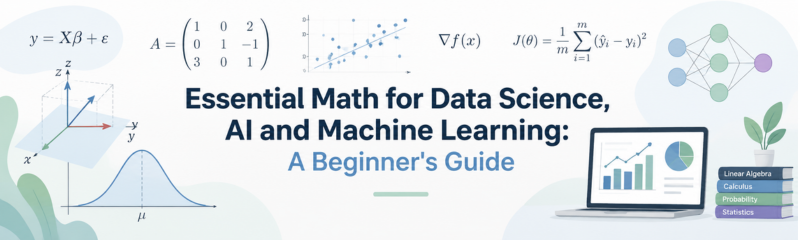
Data science and machine learning don't require the full breadth of a mathematics degree, they require depth in four specific, connected areas: linear algebra, probability and statistics, calculus, and optimization. Each one answers a different practical question. Linear algebra explains how data is represented and transformed. Probability and statistics explain how to reason about uncertainty and evaluate whether a result is meaningful.
Calculus explains how a model adjusts itself during training. Optimization explains how that adjustment process actually finds a good solution.
Skipping any one of these doesn't make the others unnecessary, it just means you'll eventually hit a wall where a concept doesn't make sense because it depends on something you skipped. This is exactly what happened to the student in the introduction: she could run the code, but debugging why a model failed needed math intuition the tutorial never covered.
Every dataset you'll work with, a spreadsheet, an image, a batch of text, ends up represented as vectors and matrices once it reaches a model. A single row of customer data is a vector. An entire dataset is a matrix. An image is a matrix of pixel values. Understanding this representation is what makes concepts like "feature," "dimension," and "batch" concrete rather than abstract jargon.
The specific pieces worth knowing: vectors and how to measure distance between them (this is literally how many clustering and recommendation algorithms decide what's "similar"), matrix multiplication (the operation running underneath nearly every layer of a neural network), and the general idea of dimensionality, why a dataset with a thousand columns behaves differently than one with ten.
python
import numpy as np

# A dataset of 3 customers, each with 2 features: age and spend
customers = np.array([[25, 200], [40, 150], [30, 400]])

# Euclidean distance between customer 0 and customer 2
distance = np.linalg.norm(customers[0] - customers[2])
print(distance)  # roughly measures how "similar" these two customers are
This small example is exactly the mechanism behind many recommendation systems and clustering algorithms, deciding which data points are close to each other in this vector space. Once that clicks, a lot of "black box" algorithm behavior stops feeling mysterious.
Machine learning models don't produce certainties, they produce estimates, and Probability and Statistics for Data Science give you the tools to reason about how much to trust those estimates. This covers distributions (why a histogram of your data's shape actually matters for which methods apply), expected value and variance, and the difference between correlation and causation, a distinction that gets ignored constantly and leads to genuinely bad business decisions when it is.
Statistics is also where you learn to evaluate whether a result is actually meaningful or just noise, through concepts like confidence intervals and statistical significance, and where you learn the evaluation metrics, precision, recall, and their tradeoffs, that determine whether a model is actually good for its intended purpose, not just accurate on paper.
This is the part that intimidates beginners most, and the part that actually needs the least depth to be useful. You don't need to solve complex integrals by hand. You need to understand what a derivative represents, the rate at which something changes, and by extension, what a gradient is: the direction and rate of steepest change for a function with multiple inputs.
That single concept, the gradient, is the entire mechanism behind how a neural network learns. Training a model means repeatedly adjusting its parameters in the direction that reduces error, and that direction comes directly from the gradient of the error with respect to each parameter. You'll likely never compute a gradient by hand in real work, libraries handle that, but understanding what it represents is what lets you reason about a stuck training run, a learning rate that's too high, or a model that isn't improving.

Optimization is the practical process of using those gradients to actually improve a model, step by step, and it's where a lot of the day-to-day tuning work in machine learning actually lives. Gradient descent, the most common optimization method, adjusts a model's parameters a small step at a time in the direction the gradient indicates will reduce error.
python
# A simplified gradient descent step, illustrating the core idea
def gradient_descent_step(weight, gradient, learning_rate=0.01):
    return weight - learning_rate * gradient

# If the current weight is too high and the gradient says "increase error further"
new_weight = gradient_descent_step(weight=2.5, gradient=0.8, learning_rate=0.1)
print(new_weight)  # weight nudged slightly in the direction that reduces error
Understanding this loop is what makes hyperparameters like learning rate stop feeling arbitrary. A learning rate too high can overshoot the best solution repeatedly; too low, and training crawls along so slowly it looks like the model isn't learning at all. Both are optimization problems, not bugs in your code.
Picture training a simple model to predict house prices from square footage and number of bedrooms. Linear algebra represents each house as a vector of features. The model makes a prediction, and probability and statistics help you understand how far off that prediction typically is and whether the error pattern looks random or systematic (a sign something's wrong with the model itself). Calculus computes the gradient, showing which direction to adjust the model's parameters to reduce that error. Optimization applies that gradient repeatedly, nudging the parameters closer to a good fit with each pass over the data.
None of these four areas work in isolation in a real project. They're a single connected process, and understanding all four is what turns "the model just works somehow" into "I know exactly what's happening and can fix it when it doesn't."
|
S.No |
Math Area |
What It Explains |
Where You'll See It Directly |
|
1 |
Linear Algebra |
How data is represented and transformed |
Feature vectors, image data, neural network layers |
|
2 |
Probability & Statistics |
How to reason about uncertainty and evaluate results |
Model evaluation metrics, A/B testing, hypothesis testing |
|
3 |
Calculus |
How a model's error connects to its parameters |
Backpropagation, understanding why training stalls |
|
4 |
Optimization |
How a model actually improves step by step |
Gradient descent, learning rate tuning, convergence issues |
For someone building this foundation from scratch alongside programming skills, the four areas don't need equal time. Probability and statistics tend to take the longest to build real intuition for, since the concepts are less mechanical than the other three:
A bar chart works better here than a pie chart since these four areas are studied somewhat independently rather than as parts of one fixed total, and comparing bar heights makes it easy to see that statistics, often treated as the "easy," non-mathematical topic by beginners, actually tends to take the longest to genuinely internalize.
The most common mistake is trying to master pure theory before touching any code, working through a full linear algebra textbook before ever building a model. Math for data science sticks far better when it's learned alongside application, seeing what a matrix multiplication actually does inside a working model teaches the concept faster than the abstract definition alone.
The second is skipping statistics because it feels less "technical" than calculus or linear algebra. This backfires constantly, since statistics is what lets you tell whether a model's result is actually meaningful or just noise, arguably the single most practically important skill in this entire list for avoiding bad conclusions from real data.
The third is treating optimization as something libraries handle so it doesn't need understanding. It's true that you rarely implement gradient descent from scratch in real work, but not understanding what it's doing makes debugging a model that won't train feel like guesswork instead of a diagnosable problem.
Math topics for Data Science Beginners land best when they're taught alongside the programming and modeling work they support, rather than as a separate, abstract unit completed before any real coding starts. A full stack data science course structured this way, linear algebra alongside your first data manipulation work, statistics alongside your first model evaluation, calculus and optimization alongside your first hands-on training loop, builds intuition through use rather than through memorization disconnected from any real project. That structure tends to produce the kind of understanding the student in the introduction was missing: not just code that runs, but the ability to explain why.
No. What matters is a willingness to learn applied math alongside real code, not prior mastery. Many of these concepts click faster when you see them working inside actual model code than when studied as pure theory first.
Enough to understand vectors, matrices, matrix multiplication, and basic distance measures. You generally won't need advanced topics like eigenvalue decomposition until you move into more specialized areas like dimensionality reduction or certain deep learning architectures.
Because it's what lets you judge whether a model's result, or a business metric's change, is actually meaningful or just random variation. Skipping this leads to confidently wrong conclusions drawn from noisy data, a mistake that's common and costly.
You won't compute gradients by hand in most real work, but understanding what a gradient represents is what lets you reason about training problems, a stuck loss value, an unstable learning rate, instead of treating the model as an unexplainable black box.
Start by experimenting with learning rate settings on a simple model you already understand, and observe what happens when it's too high versus too low. Seeing the effect directly builds far more intuition than reading the theory alone.

Mathematics for Data Science and Machine Learning isn't a barrier to get through before the real work starts, it's what makes the real work make sense. Linear algebra explains how your data is represented, statistics explains how to trust your results, calculus explains how a model learns, and optimization explains how that learning process actually converges on something useful.
If you're starting this path, the fastest way to build real understanding isn't a math textbook finished cover to cover, it's applying each concept inside a small project the moment you learn it, the same connected process this guide walked through with the house price example.
Which of these four areas do you currently trust the least when a model isn't behaving the way you expect?
Follow NareshIT for more practical insights on technology, skills, and career development.
 +91 8179191999

 +91
8179191999
+91
8179191999





.png)








.png)