A beginner learning Java can comfortably understand classes, objects, loops, and collections and then suddenly encounter code that looks completely different:
orders.stream()
      .filter(order -> order.getAmount() > 5000)
      .map(Order::getCustomerName)
      .forEach(System.out::println);
What exactly is happening here?
The program is still Java, but it uses a programming style that became much more common after Java 8. Instead of manually looping through every order, checking a condition, retrieving a customer name, and printing it, the code describes a sequence of operations.
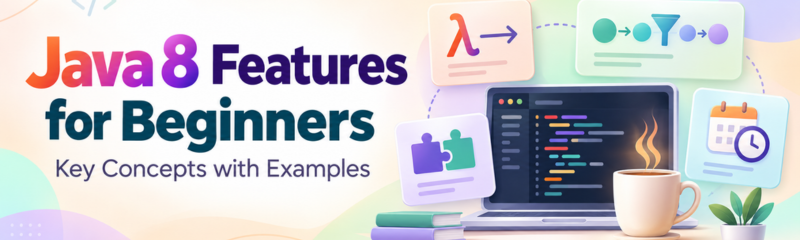
Java 8 introduced several features that made this possible, including lambda expressions, functional interfaces, method references, the Stream API, Optional, default methods, and the java.time API.
For beginners, the best way to learn these features is not to memorize definitions. It is to understand the problem each feature solves and then practice it with small examples.
Java existed long before Java 8, so many programming tasks already had solutions. The challenge was that some common operations required more code than necessary.
Imagine that an application contains a list of students and you need to find everyone who scored above 80.
A traditional solution might create a loop, inspect every student, apply an if condition, and store the matching records.
There is nothing wrong with that approach.
Java 8 simply introduced additional ways to express this kind of data-processing logic.
Developers gained tools for passing behavior into methods, building processing pipelines, working more clearly with potentially missing values, and handling dates and times through a modern API.
These ideas later became common across Java applications and frameworks, making Java 8 concepts valuable even when developers work with newer Java versions.
| Feature | Where It Helps |
|---|---|
| Lambda Expressions | Writing compact behavior that can be passed to another operation |
| Functional Interfaces | Providing a target type for lambda expressions |
| Method References | Reusing an existing method with concise syntax |
| Stream API | Processing data through filtering, mapping, sorting, and aggregation |
| Optional | Explicitly representing a result that might not exist |
| Default Methods | Providing method implementations inside interfaces |
java.time |
Working with dates, times, periods, and time zones |
| Repeating Annotations | Applying an annotation type multiple times where supported |
| Type Annotations | Using annotations in additional type contexts |
The first seven are especially useful when learning practical Java development.
A lambda expression allows a small operation to be represented without creating a separate class or lengthy anonymous implementation.
Consider a list of course names:
List<String> courses =
        Arrays.asList("Java", "Python", "DevOps", "Data Science");
A normal loop can print them:
for (String course : courses) {
    System.out.println(course);
}
With Java 8, you can also write:
courses.forEach(course -> System.out.println(course));
The expression:
course -> System.out.println(course)
describes what should happen to each value.
The left side represents the input. The right side contains the operation.
A simple lambda can look like:
value -> value * 2
A lambda with two parameters might be:
(a, b) -> a + b
When several statements are necessary, a block can be used:
(a, b) -> {
    int total = a + b;
    return total;
}
The advantage is not simply fewer characters. Lambdas make it easier to supply behavior to APIs designed to accept it.
This becomes particularly important with functional interfaces and streams.
A lambda needs a compatible target type.
This is where a functional interface becomes important.
A functional interface has one abstract method.
Suppose we create:
@FunctionalInterface
interface FeeCalculator {
    double calculate(double amount);
}
We can provide its behavior through a lambda:
FeeCalculator discount =
        amount -> amount - (amount * 0.10);
Now:
double finalFee = discount.calculate(20000);
uses the behavior supplied by the lambda.
Java also provides useful functional interfaces through the java.util.function package.
Common examples include:
Predicate<T> - tests a condition
Function<T, R> - converts one value into another
Consumer<T> - accepts a value and performs an action
Supplier<T> - provides a value
These names become much easier to understand once you connect them to real tasks.
For example, checking whether a student's score is above 70 can be represented by a Predicate.
Transforming a student's name to uppercase can be represented by a Function.
Sometimes a lambda contains no new logic. It simply calls an existing method.
For example:
courses.forEach(course -> System.out.println(course));
Since println() already performs the required action, Java allows this:
courses.forEach(System.out::println);
The :: notation is called a method reference.
Another example is:
names.stream()
     .map(String::toUpperCase)
     .forEach(System.out::println);
Here, String::toUpperCase refers to an existing method rather than defining a separate conversion operation.
Method references are most useful when they make the intention of the code easier to read. They should not be used simply because the syntax looks shorter.
The Stream API in Java 8 is one of the most useful concepts for working with collections.
Suppose an application stores student scores:
List<Integer> scores =
        Arrays.asList(62, 91, 48, 76, 88, 55);
You want to display only scores of 75 or above.
A stream solution could be:
scores.stream()
      .filter(score -> score >= 75)
      .forEach(System.out::println);
Read the code from top to bottom:
Take the scores → keep scores of 75 or higher → print them.
This is called a processing pipeline.
This distinction is important.
A List stores elements.
A stream processes elements obtained from a source.
Creating a stream does not mean creating another collection containing the same values.
Intermediate operations return another stream and allow processing to continue.
Common examples include:
filter()
map()
sorted()
distinct()
limit()
A terminal operation completes the stream pipeline.
Examples include:
forEach()
collect()
count()
reduce()
Consider this example:
List<String> names =
        Arrays.asList("Asha", "Karthik", "Ravi", "Meghana");
Suppose we need names longer than five characters:
List<String> selectedNames =
        names.stream()
             .filter(name -> name.length() > 5)
             .sorted()
             .collect(Collectors.toList());
The stream filters the data, sorts the remaining names, and creates a result list.
This approach becomes useful when applications work with employees, orders, products, transactions, students, or other structured data.
Applications frequently search for information that may not exist.
Suppose a student-management system searches for registration number 105.
If no student has that number, what should the method return?
Traditionally, applications might return null, requiring calling code to remember to perform a null check.
Java 8 introduced Optional as another way to represent a potentially absent result.
For example:
Optional<String> trainer =
        Optional.of("Venkat");
If a value exists, an operation can be performed:
trainer.ifPresent(System.out::println);
A fallback can also be supplied:
String name =
        trainer.orElse("Trainer not assigned");
A repository method might therefore be designed as:
Optional<Student> findStudentById(int id)
The method signature itself communicates that a matching student might not exist.
This does not mean Optional should replace every nullable variable. It is useful when explicitly representing the absence of a result makes the code or API clearer.
Interfaces are fundamental to Java programming.
Before Java 8, adding a new abstract method to an existing interface could create problems because every implementing class might need to provide that method.
Java 8 introduced default methods, allowing an interface to contain an implementation.
Consider:
interface CourseService {

    void enroll(String student);

    default void showMessage() {
        System.out.println("Enrollment service ready");
    }
}
A class implementing CourseService must implement enroll().
However, it can inherit showMessage() without defining it again.
This capability became useful when existing interfaces needed new functionality without forcing every existing implementation to change immediately.
Java 8 also introduced support for static methods in interfaces.
For beginners, the important lesson is that modern Java interfaces can contain more than abstract method declarations.
Dates appear everywhere in software.
A learning platform may store course start dates. An HR application records joining dates. An e-commerce system handles delivery dates. A banking system processes transaction timestamps.
Java 8 introduced the java.time package to provide a modern API for these requirements.
LocalDate batchStart =
        LocalDate.of(2026, 10, 12);
To obtain today's date:
LocalDate today = LocalDate.now();
LocalTime classTime =
        LocalTime.of(10, 30);
LocalDateTime session =
        LocalDateTime.of(2026, 10, 12, 10, 30);
Useful classes include:
LocalDate
LocalTime
LocalDateTime
Instant
ZonedDateTime
Duration
Period
Choosing the correct class depends on what the application needs.
A birthday may require only LocalDate.
An online meeting involving people in multiple countries may require time-zone-aware handling.
The API also uses immutable date-time objects, which helps make operations more predictable.
Java 8 introduced additional language enhancements that beginners may encounter less frequently.
In supported situations, the same annotation type can be applied more than once.
This provides additional flexibility when metadata needs to be associated repeatedly with a declaration or type.
Java 8 expanded the places where annotations could appear, including type-related contexts.
Framework developers, analysis tools, and libraries can make use of this additional metadata.
These topics may not require the same amount of beginner practice as streams or lambdas, but they belong to the broader set of Java 8 features.
The real benefit appears when several features solve one practical problem.
Imagine a training application containing course objects. Each course has a title, category, fee, and duration.
You need to find Java courses costing less than ₹20,000 and display their titles alphabetically.
A stream pipeline could be:
courses.stream()
       .filter(course -> course.getCategory().equals("Java"))
       .filter(course -> course.getFee() < 20000)
       .map(Course::getTitle)
       .sorted()
       .forEach(System.out::println);
Notice what is happening:
stream() begins the pipeline.
The two filter() operations apply conditions.
The lambda expressions describe those conditions.
Course::getTitle uses a method reference.
sorted() arranges the resulting titles.
forEach() produces the final output.
Instead of treating each Java 8 feature as an isolated interview question, this example shows how the concepts cooperate in an application.
Reading syntax is only the first stage.
A beginner should create a small project and gradually improve it.
Consider building a Course Registration Application.
Create course records containing:
Course ID
Course name
Technology
Trainer
Fee
Start date
Begin with ordinary Java collections and loops.
Then add Java 8 features.
Use a lambda to define a filtering condition.
Use streams to retrieve courses belonging to a particular technology.
Use map() to extract course names.
Use sorted() to arrange results.
Use Optional when searching by course ID.
Use LocalDate to store batch dates.
Use functional interfaces to create reusable conditions.
This approach helps answer the most important learning question:
Why am I using this feature?
Once you know the answer, remembering the syntax becomes easier.
Beginners sometimes assume modern syntax automatically means better code.
That is not always true.
Avoid turning a simple operation into a complicated stream pipeline just to demonstrate Stream API knowledge.
Do not create a large lambda containing many lines of business logic when a clearly named method would be easier to understand.
Do not use Optional everywhere simply because it exists.
Do not replace every traditional loop without considering readability.
And do not memorize functional interfaces only for interview questions.
A feature is useful when it makes the program easier to understand, maintain, or express—not merely when it reduces the number of lines.
Java development has moved far beyond Java 8, and learners should also become familiar with the newer Java versions used in current projects.
Still, Java 8 introduced programming concepts that became deeply established in the Java ecosystem.
Streams, lambdas, functional interfaces, method references, and the java.time API can appear in enterprise applications, backend services, frameworks, libraries, and existing codebases.
Understanding them also prepares learners for more advanced Java programming because they teach a different way of thinking about operations and data.
For students preparing for Java development careers, Java 8 should therefore be treated as a foundation rather than a final destination.
Java 8 introduced important capabilities including lambda expressions, functional interfaces, method references, the Stream API, Optional, default and static interface methods, the java.time API, repeating annotations, and expanded type annotations.
A lambda provides an implementation of behavior expected by a compatible functional interface. For example, value -> value > 100 represents a condition that checks whether a supplied value is greater than 100.
Stream API provides a pipeline-based approach for processing data from sources such as collections. Operations such as filter(), map(), sorted(), collect(), and reduce() can be combined to express data-processing requirements.
Optional represents a result that may contain a value or may be empty. It can make the possibility of a missing result explicit instead of requiring an API to communicate absence only through null.
They are an important foundation, but Java has continued evolving. Learners should understand Java 8 concepts and then progress to the newer Java versions, development practices, frameworks, and tools relevant to the projects they want to build.
Learning Java 8 becomes easier when each feature is connected to a real programming requirement.
Use lambda expressions when behavior needs to be supplied concisely. Understand functional interfaces because they provide the foundation for those lambdas. Use method references when an existing method already expresses the required action. Explore streams when data needs to move through filtering, transformation, sorting, or aggregation steps.
Learn Optional to understand explicit handling of potentially absent results. Practice default methods to see how interfaces can provide behavior. Use the java.time API for realistic date and time requirements.
Most importantly, avoid learning Java 8 as a list of interview definitions.
Build something.
Create a student application, course-management system, employee directory, or simple order-processing project. Write the first version using familiar Java concepts and then identify places where Java 8 features make the solution clearer.
That practical comparison helps beginners understand not only what Java 8 features are, but why Java developers use them.
For learners building their Java programming foundation, this understanding provides a useful bridge from Core Java concepts to modern application development, backend technologies, and advanced Java frameworks.
 +91 8179191999

 +91
8179191999
+91
8179191999







.png)