.png)
Next Batch : Invalid Date
A data scientist on a retail analytics team once told me she spent the first day of nearly every new project doing the same thing: loading a raw CSV, checking for missing values, plotting distributions, flagging outliers, before she'd even started thinking about which model made sense. Different dataset each time, same repetitive first day, every time.
That's exactly the kind of work AI Agents in Data Science are starting to take over, not the judgment calls about which model fits a business problem, but the repetitive, pattern-based groundwork that eats up time before the actual analysis begins. An AI agent, in this context, isn't just a chatbot that answers questions about your data. It's a system that can look at a dataset, decide what needs to happen next, take that action using real tools, and adjust based on what it finds, in a loop, with much less hand-holding than a single prompt-response exchange.
This piece breaks down how that actually works: the workflow an agent follows, how it learns from data along the way, and where it realistically fits into a data science pipeline today.
A traditional data science script runs a fixed sequence: load data, clean it a specific way, run a specific model, output specific metrics. Change the dataset's structure even slightly, and the script often breaks or produces something misleading, because it has no way to notice the data doesn't match what it expected.
An AI agent, by contrast, can inspect the actual data first, decide what cleaning steps are appropriate given what it finds, and adjust its plan if something unexpected shows up, a column that's mostly null, a date field stored as text, a target variable that's heavily imbalanced. The difference isn't that the agent is smarter in some abstract sense, it's that it reasons about the specific input in front of it rather than executing a fixed sequence blindly.

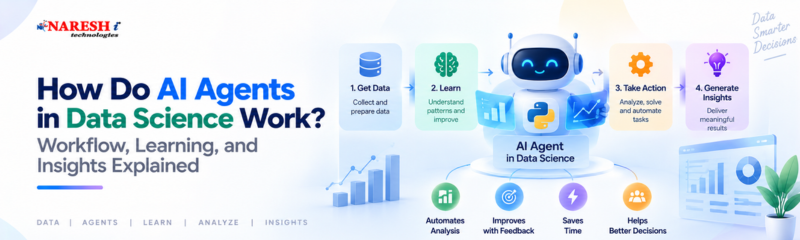
Most AI Agent Workflow in data science follows a version of the same loop, regardless of the specific task:
Perceive: The agent gathers information about the current state, the shape of a dataset, the result of a query, the output of a model run. This is its equivalent of looking before acting.
Reason: Based on what it perceives, the agent decides what to do next. This is where the underlying language model does most of its work, weighing what it observed against the goal it was given.
Act: The agent executes an action using an actual tool, running a Python function, querying a database, calling a plotting library, not just generating a description of what it would do.
Learn: The agent observes the result of that action and feeds it back into the next reasoning step. If a cleaning step didn't fully resolve a data quality issue, the agent sees that in the next perception step and adjusts.
This loop repeats until the task is complete or the agent determines it needs human input, for instance, when a decision genuinely requires business context the data alone can't provide.
It's worth being precise about what "learning" means here, since it's easy to conflate with how the underlying model was originally trained. An agent built on a large language model isn't retraining itself mid-task the way a machine learning model updates its weights during training. What it's doing is closer to reasoning with fresh evidence at each step: it observes the actual result of an action, compares that to what it expected, and adjusts its next decision accordingly, within that one session.
Where genuine learning over time comes in is through feedback loops built around the agent, not inside the underlying model itself. If a data scientist corrects an agent's suggested imputation strategy for missing values, and that correction gets logged and referenced in future prompts or fine-tuning data, the agent's behavior on similar situations can improve over time. This is closer to how a human analyst improves through experience and feedback than to a model literally retraining itself after each session.
Consider an agent whose job is to take a raw CSV and produce a data quality summary before any modeling starts, exactly the kind of task from the introduction. A simplified version of that loop in Python looks like this:
python
import pandas as pd

def profile_dataset(path: str) -> dict:
    df = pd.read_csv(path)
    return {
        "shape": df.shape,
        "missing_by_column": df.isnull().sum().to_dict(),
        "dtypes": df.dtypes.astype(str).to_dict(),
        "numeric_summary": df.describe().to_dict(),
    }

tools = [{
    "name": "profile_dataset",
    "description": "Load a CSV and return missing values, dtypes, and summary stats",
    "input_schema": {
        "type": "object",
        "properties": {"path": {"type": "string"}},
        "required": ["path"]
    }
}]

response = client.messages.create(
    model="claude-sonnet-4-6",
    max_tokens=500,
    tools=tools,
    messages=[{"role": "user", "content": "Profile sales_data.csv and flag any data quality issues."}]
)

if response.stop_reason == "tool_use":
    tool_call = response.content[-1]
    result = profile_dataset(tool_call.input["path"])
    # result gets sent back to the model, which reasons about what it found
The key detail is what happens after profile_dataset runs: the raw output, missing value counts, dtype mismatches, gets handed back to the model, which then reasons about it, "this date column is stored as a string, this column is 40% missing and might need dropping rather than imputing," rather than a human manually interpreting a wall of .describe() output. That interpretation step is where the agent adds value beyond what a plain script already does.
Agents aren't equally useful at every stage of a typical project. Some stages are largely mechanical and pattern-based, where an agent genuinely saves time. Others require judgment that's still best left with a person.
|
S.No |
Pipeline Stage |
Agent's Role |
Human's Role |
|
1 |
Data collection & ingestion |
Pull from APIs, check schema consistency |
Decide which sources are actually relevant |
|
2 |
Data cleaning |
Detect missing values, suggest imputation strategies |
Approve strategy for business-critical fields |
|
3 |
Exploratory analysis |
Generate summary stats, flag anomalies and correlations |
Decide which patterns matter to the business question |
|
4 |
Model selection & training |
Try multiple model types, compare metrics |
Choose based on interpretability and deployment constraints |
|
5 |
Reporting & insights |
Draft plain-language summaries of findings |
Validate conclusions and add business context |
The consistent theme: agents handle the volume and pattern-matching, humans handle the judgment calls that depend on context an agent doesn't have access to, what the business actually cares about, what risk is acceptable, what a stakeholder will trust.
Looking at a typical exploratory data analysis phase, the time split between agent-assisted and manual work tends to look something like this:

A grouped bar chart works well here since it's a direct before-and-after comparison across categories, exactly the kind of contrast a pie chart can't show at all, since pie charts only represent parts of one single total, not two workflows being compared side by side. Worth noticing in the numbers: the time saved shrinks a lot in the "interpreting findings" stage, which tracks with the earlier point that agents handle pattern detection well but still lean on a human for judgment about what a finding actually means for the business.
The most frequent mistake is giving an agent an open-ended goal, "clean this dataset," without specifying constraints on what "clean" means for this particular project. An agent might drop a column with 30% missing values when that column actually matters enough to warrant careful imputation instead, simply because it wasn't told the difference.
The second is treating an agent's output as final rather than as a draft to review. An agent's suggested model might have strong accuracy but rely on a feature that leaks information from the future, something a script running the same steps wouldn't catch either, but a careful human reviewer would.
The third is skipping logging and traceability. When an agent makes a sequence of decisions, dropping rows, choosing an imputation method, selecting a model, not recording that sequence makes it much harder to debug later when someone asks "why does this pipeline behave this way."

Strong data science fundamentals come first, since an agent is only as useful as the judgment applied to review its output. From there, practice building a simple tool-calling loop in Python, something like the profiling example above, to understand the perceive-reason-act cycle firsthand rather than just reading about it. A Full Stack Data Science AI program that combines statistics and modeling with hands-on agent-building exercises, rather than treating agents as a separate advanced topic bolted on at the end, reflects how this work actually gets structured on real teams.
Not quite. AutoML typically automates model selection and hyperparameter tuning within a fixed pipeline. AI agents can reason across a broader workflow, deciding what cleaning is needed, what to investigate, and when to ask for human input, rather than just optimizing within a predefined step.
No. If anything, it matters more, since someone needs to recognize when an agent's suggestion is statistically unsound, like a model relying on a leaky feature, that the agent itself might not catch.
Within a single task, they reason using each new observation as it comes in, adjusting the next step based on results. Genuine improvement over time comes from feedback loops built around the agent, corrections and outcomes get logged and referenced in future tasks, closer to institutional learning than the model retraining itself mid-task.
Giving an agent too much autonomy on decisions that need business context it doesn't have, like which missing data is safe to drop versus which represents something meaningful. Scoping tasks with clear constraints and reviewing output addresses most of this risk.
A data profiling and cleaning suggestion agent, similar to the example in this article, is a manageable starting point. It touches the full perceive-reason-act loop without the added complexity of a multi-model pipeline or production deployment.
AI Agents in Data Science aren't replacing the judgment that makes a data scientist valuable, they're taking over the repetitive, pattern-based groundwork that used to eat up the first day of every project. The workflow underneath, perceive, reason, act, and adjust based on results, is what lets an agent handle a messy, unfamiliar dataset instead of breaking the moment reality doesn't match a fixed script.
If you're building toward a full stack data science AI role, understanding that workflow, and knowing exactly where to draw the line between what an agent can decide and what still needs a person, is worth more than knowing any single framework.

Which part of your current data science workflow, profiling, cleaning, or interpreting results, still eats the most time that an agent could reasonably take off your plate?
Follow NareshIT for more practical insights on technology, skills, and career development.
 +91 8179191999

 +91
8179191999
+91
8179191999



.png)
.png)
.png)