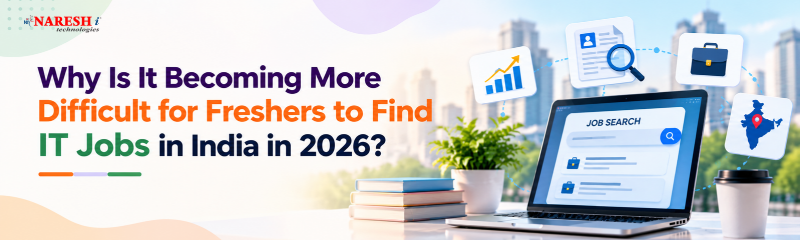
An engineering qualification by itself may not be sufficient to launch a career in India's IT industry. Many graduates find it difficult to land their first role because companies increasingly value practical knowledge, strong technical skills, and the ability to solve real-world problems. While some candidates receive no response to their applications, others who are selected through campus placements are left waiting for their joining dates.
The market for IT Jobs for Freshers in India 2026 is becoming more competitive because companies are hiring selectively, technology requirements are evolving, and graduates are competing for fewer conventional entry-level opportunities.
However, IT hiring has not stopped. Identifying the key reasons behind these difficulties can help fresh graduates develop the right skills and improve their chances of entering the IT industry.
India adds a significant number of engineering and technology graduates to the workforce each year, but the growth in IT job openings does not always keep pace with the rising number of applicants.
A September 2026 foundit report indicated that professionals with up to three years of experience represented 45% of active engineering candidates but only 28% of available opportunities.
This imbalance makes IT Jobs for Freshers particularly competitive.
Employers increasingly assess whether applicants can contribute to real projects.
A candidate who understands Java syntax but cannot build a functioning application may struggle during practical interviews.
Recruiters may evaluate:
Academic qualifications remain useful, but practical skills help candidates demonstrate job readiness.

Many employers have moved away from large, generalised recruitment drives toward hiring based on specific project requirements.
This can mean fewer openings for general trainee positions, more technical assessments and uncertainty around joining schedules.
As AI becomes more widely adopted across the IT industry, developers' roles are evolving, and employers are looking for candidates with a broader range of technical skills.
AI tools can assist with code generation, documentation, test creation and debugging. As repetitive tasks become easier to automate, employers may place greater emphasis on architecture, verification and problem-solving.
However, AI is also creating opportunities in application development, data engineering and intelligent automation.
For better career opportunities, freshers should develop strong programming fundamentals while also learning how to use AI tools effectively, rather than relying solely on one skill set.
For example, a Java developer who understands APIs, databases and AI-assisted coding can build applications more effectively than someone who only copies generated code.
Fresh graduates should choose a skill-development path based on what interests them, what they already know, and where they want their careers to go in the future.
|
Career Path |
Important Skills |
Beginner Project |
|
Java Developer |
Java, SQL, Spring Boot |
Employee management application |
|
Software Tester |
Manual testing, Selenium, APIs |
E-commerce testing project |
|
Python Developer |
Python, SQL, REST APIs |
Task management application |
|
Data Analyst |
SQL, Python, Power BI |
Sales performance dashboard |
|
DevOps Engineer |
Linux, Git, Docker, CI/CD |
Automated deployment pipeline |
|
AI Application Developer |
Python, APIs, LLM basics |
Document-based chatbot |
Learning pathways such as Full Stack Java Training, a Software Testing Course, Java Programming Course or Python Programming Course can help learners build foundational skills.
Students who want to build careers in advanced technology fields can consider a Data Science Course, Generative AI & Agentic AI with Python, or DevOps with Multi-Cloud Training, provided they have the necessary foundational knowledge.
Starting a career in IT does not necessarily mean taking up a software development role.
Graduates who prefer non-IT professions can explore opportunities in customer service, digital marketing, recruitment, business operations, and business development, depending on their skills and interests.
These roles require different combinations of communication, analytical and digital skills.
Likewise, fresh graduates can look for work-from-home IT jobs in software development, software testing, and technical support, although securing remote roles as a beginner can be challenging due to strong competition.
Applicants should verify employers carefully and avoid recruitment offers demanding payment for interviews or job confirmation.
Instead of trying to learn several technologies at once without putting them into practice, freshers should focus on a specific career goal and strengthen their knowledge by working on real projects.
Following a step-by-step plan can help them prepare for job opportunities:
Identify a Suitable Role → Build Core Knowledge → Work on Hands-On Projects → Share Your Code on GitHub → Practise for Interviews → Apply for Relevant Positions
When preparing a resume, highlight the results of your projects, the problems you solved, and the skills you applied rather than mentioning only the tools and technologies you know.
For instance, explain how the application manages information, responds to errors, and addresses a real-world need.
Explore internships, trainee positions, startups and graduate opportunities beyond major IT service companies.
Above all, use feedback from interviews to identify areas for improvement and update your job search strategy instead of sending out the same resume without making changes.
Increasing applicant numbers, higher employer expectations, rapidly changing technical skills, and limited real-world experience are creating additional hurdles for graduates seeking their first job in the IT sector.
AI is automating some routine tasks while creating demand for new skills. Its effect differs across companies and job roles.
Based on their interests and professional plans, graduates can build their skills in fields like Java, Python, software quality testing, data analysis, or the fundamentals of cloud technology.
Yes, but opportunities depend on employers, job requirements and competition. Remote positions are not guaranteed.
Yes. Graduates from different backgrounds can pursue suitable entry-level roles by developing technical foundations and demonstrating practical skills.

Getting an IT job in India has become more demanding, but career opportunities have not disappeared.
Freshers who understand fundamentals, build meaningful projects and adapt to changing technologies can improve their competitiveness.
A degree can open the door to job opportunities, but your hands-on skills and ability to apply what you have learned help demonstrate your suitability for the role.
Discussion Question: What do you think is the biggest hurdle for freshers entering the IT industry today: fewer job openings, insufficient practical experience, challenging interviews, or increasing competition?
 +91 8179191999

 +91
8179191999