.png)
Next Batch : Invalid Date
A working model is not a working product. Here's why the gap between the two is exactly where MLOps comes in.
A data scientist spends weeks cleaning data, testing algorithms, and finally lands on a model that performs well in a notebook. Then comes the question that quietly derails a lot of projects: how does this actually get into the hands of real users, stay accurate over time, and not break the moment traffic increases?
That gap between "the model works" and "the model works in production, reliably, every day" is one of the most common reasons promising AI projects never ship. It's also exactly the gap that MLOps exists to close. Understanding how data science and MLOps work together isn't just useful for engineers. It's becoming essential knowledge for anyone building a career around data science and AI, whether you're a student, a working professional, or switching careers into tech.
This article walks through what each discipline actually contributes, where they overlap, and how a real production AI system gets built from both sides working in sync.
It's tempting to think of data science as the "creative, analytical" half of AI and MLOps as the "boring, operational" half. That framing undersells both. Data science answers the question of what to build and whether it works. MLOps answers the question of how to keep it working, at scale, for real users, month after month.
Neither one produces a finished, production-ready AI system on its own. A brilliant model that nobody can reliably deploy is a research project, not a product. A perfectly automated deployment pipeline running a poorly validated model just ships bad predictions faster.
Data science is the discipline of turning raw data into a validated, working model. In a production context, that typically includes:
This is where the core intelligence of an AI system comes from. It's also, on its own, where a lot of projects stop, sitting in a notebook, tested against a fixed dataset, with no defined path to becoming a live system.
MLOps (Machine Learning Operations) applies software engineering and DevOps discipline to the lifecycle of a machine learning model. Its focus areas typically include:
Where data science asks "does this model work," MLOps asks "will this model keep working, and will we know the moment it stops."
A model trained once on historical data doesn't stay accurate forever. User behavior shifts, data patterns change, and business conditions evolve. Without a system in place to monitor, retrain, and safely redeploy models, even a well-built AI system quietly degrades over time.
|
S.No |
Without MLOps |
With Data Science + MLOps Combined |
|
1 |
Models deployed manually, inconsistently |
Deployment is automated and repeatable |
|
2 |
Performance decay goes unnoticed |
Monitoring flags drift and accuracy drops |
|
3 |
Retraining is a manual, occasional scramble |
Retraining pipelines run on a defined schedule or trigger |
|
4 |
Hard to trace which data or code produced a result |
Versioning makes every model result reproducible |
This is the real value of combining the two disciplines: data science builds something that works today, and MLOps makes sure it keeps working tomorrow.
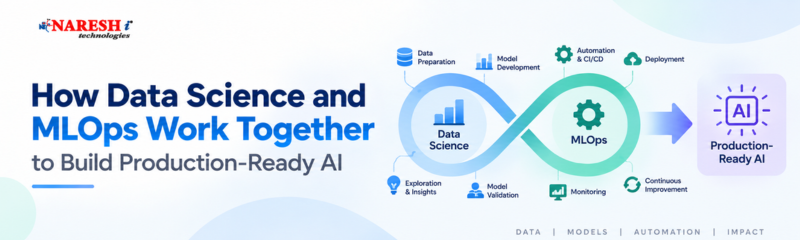
A production-ready AI system generally moves through a cycle where data science and MLOps hand off to each other repeatedly, not just once at the end:
This cycle repeats continuously. Production-ready AI isn't a single deployment event, it's an ongoing loop that both disciplines maintain together.

A simplified but realistic MLOps pipeline configuration might look like this:
yaml
pipeline:
stages:
- name: data_validation
checks: [schema_match, missing_values, drift_detection]
- name: train_model
script: train.py
metrics_threshold:
accuracy: 0.85
- name: model_testing
script: evaluate.py
compare_to: production_model
- name: deploy
condition: metrics_threshold_passed AND approved_by_reviewer
target: production
- name: monitor
alerts:
- drift_detected
- accuracy_below_threshold
Notice that deployment is conditional, not automatic the moment a new model is trained. This is where data science judgment (setting the right metrics threshold) and MLOps automation (enforcing that threshold consistently) work together directly in the same pipeline.
Common tools associated with each side include:
Consider a retail company using a model to predict product demand. A data scientist builds and validates the model using historical sales data, achieving strong accuracy in testing. MLOps then deploys it into the inventory system through an automated pipeline, with monitoring in place to track prediction accuracy against actual sales weekly.
Three months later, a shift in customer buying patterns causes accuracy to drop below the defined threshold. The monitoring system flags this automatically. The data scientist investigates, retrains the model with fresh data, and the MLOps pipeline redeploys the updated version, running automated tests before it goes live.
Neither discipline could have handled this scenario alone. Data science provided the judgment to fix the underlying model; MLOps provided the infrastructure to detect the problem and roll out the fix safely.

Benefits:
Limitations:
"MLOps is just DevOps for machine learning." It borrows DevOps principles, but it also has to handle challenges DevOps doesn't, like data drift, model versioning, and retraining triggers that traditional software deployment never has to account for.
"Once a model is deployed, the job is done." A deployed model is the start of an ongoing responsibility, not the finish line. Without monitoring and retraining plans, performance decay is a matter of when, not if.
"Data scientists don't need to understand deployment, and MLOps engineers don't need to understand modeling." In practice, the most effective professionals in this space understand both sides well enough to communicate clearly and make joint decisions about thresholds, retraining triggers, and rollback plans.
For students and freshers exploring data science and AI, it's worth learning both sides early rather than treating them as separate tracks. Understanding how a model you build will actually be deployed and monitored changes how you approach model design from the start.
For working professionals and career switchers, the practical skill path typically includes:
This combined skill set is exactly what's often described as Full Stack Data Science & AI, capable of contributing across the entire lifecycle rather than only one stage of it. For learners looking to build this breadth intentionally, a structured data science and AI course that covers both statistical modeling and deployment practices in one curriculum can shorten the path considerably compared to learning each side in isolation.
Job postings increasingly describe roles that blend both disciplines, sometimes labeled AI with data science, sometimes as "ML engineer," sometimes simply as "data scientist" with deployment responsibilities folded in. Employers are looking for people who can take a project from raw data to a reliably running system, not just from raw data to a validated notebook.
For freshers: this is a strong argument for learning deployment and monitoring concepts early, even at a basic level, rather than treating them as something you'll pick up "later" on the job.
Expect the line between "data scientist" and "MLOps engineer" to keep blurring at the individual level, even as both remain distinct disciplines at the team level. Automated retraining, drift detection, and deployment pipelines are becoming standard expectations for any serious AI project, not optional extras reserved for large tech companies.
Where do you see this heading in your own organization or field, are data science and MLOps already working closely together, or still operating as separate silos?
Data science focuses on building and validating models from data. MLOps focuses on deploying, monitoring, and maintaining those models reliably in production.
Not necessarily to an expert level, but understanding the basics helps you build models that are easier to deploy and maintain, and makes you more valuable on a team.
It's related but not identical. MLOps includes DevOps-style automation plus challenges specific to machine learning, like data drift and model retraining.
It refers to being able to contribute across the entire lifecycle, from data exploration and modeling to deployment and monitoring, rather than specializing in only one stage.
Real-world data patterns shift over time, which can cause a model's accuracy to decline even if nothing about the model itself changed.
It depends on your goal. If you already have programming skills but lack structured exposure to deployment and monitoring practices, a course covering both sides can fill that specific gap efficiently.
Yes, at a proportional scale. Basic version control, simple monitoring, and a repeatable deployment process provide real value even without a large dedicated MLOps team.
Production-ready AI isn't the result of a great model or a great deployment pipeline alone, it's the result of data science and MLOps working together continuously, not just at launch. One discipline builds the intelligence, the other keeps it reliable, and real production systems depend on both operating in sync.
Takeaway: If you're building a career in data science and AI, don't treat modeling and deployment as separate specialties to choose between. Learn enough of both to understand how your work fits into the full lifecycle, that combination is exactly what makes someone valuable on a real production team.

Follow NareshIT for more practical insights on technology, skills, and career development.
 +91 8179191999

 +91
8179191999
+91
8179191999



.png)








.png)