.png)
Next Batch : Invalid Date
For the last few years, "AI" has largely meant one thing: type a prompt, get text, an image, or a snippet of code back. That was genuinely useful, but it was also a fairly narrow definition of what these systems could do. A model that only responds when prompted, with no memory of what came before and no ability to check its own work, has clear limits.
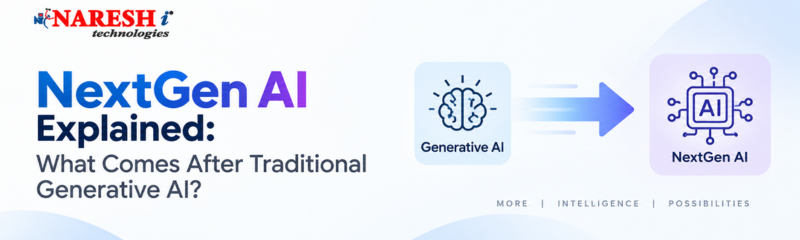
That narrow definition is already starting to expand. The systems being built and deployed now don't just generate a single output they reason through problems in multiple steps, use external tools, retain context across a task, and in some cases operate with a degree of independence. This next phase doesn't have one universally agreed-upon name yet, but it's commonly referred to as NextGen AI or post-generative AI.
If you learned "Generative AI" as your reference point for what AI can do, it's worth updating that picture. Let's go through what's actually different, why it matters, and what's genuinely useful to learn versus what's just noise.
What Is "Traditional" Generative AI?
What Does "NextGen AI" Actually Mean?
Why This Shift Matters Now
The Real Problem NextGen AI Solves
How NextGen AI Systems Work
Key Technologies and Concepts Involved
Practical Example: Generative AI vs. NextGen AI on the Same Task
Benefits and Limitations
Common Mistakes and Misconceptions
What Should You Learn?
Career and Industry Relevance
Future Outlook
Practical Next Steps
FAQs
Generative AI refers to models trained to produce new content text, images, audio, or code based on patterns learned from large datasets. You give it a prompt, and it generates a single, self-contained response.
This is powerful for content creation, summarization, and first-draft work, but it has a defining limitation: it only responds once per prompt. It doesn't independently verify its own output, doesn't take real-world actions, and doesn't retain a working memory of an ongoing task unless you manually feed that context back in each time.
NextGen AI isn't a single product or model it's a description of a set of capabilities that go beyond one-shot generation:
Reasoning models that work through a problem in multiple internal steps before answering, rather than producing a response in one pass
Agentic behavior the ability to plan a multi-step task, use tools (a browser, code execution, an API), check results, and adjust
Persistent memory across a session or even across multiple sessions, so context doesn't have to be repeated
Multimodal understanding that combines text, images, audio, and sometimes video within a single reasoning process, rather than handling each separately
In short: traditional generative AI answers a prompt. NextGen AI works through a problem.
Generative AI proved that machines could produce convincing, useful content. But content generation alone doesn't complete a task someone still has to verify it, act on it, and connect it to the next step.
NextGen AI closes that gap. Instead of "here's a draft, you take it from here," these systems increasingly handle the follow-through: checking their own output, retrying when something fails, and connecting multiple steps into a finished result.
Think about a task you've handed to a generative AI tool recently. How much of your own time went into re-prompting, correcting, or manually stitching outputs together? That overhead is exactly what NextGen AI is designed to reduce.
Pure Generative AI is excellent at producing a plausible-sounding answer instantly, but "plausible" and "correct" aren't the same thing and it has no built-in way to tell the difference. Reasoning and agentic capabilities exist specifically to address that gap.
|
S.No |
Capability |
Traditional Generative AI |
NextGen AI |
|
1 |
Produces content from a prompt |
Yes |
Yes |
|
2 |
Verifies its own output |
No |
Often, through internal checks or tool use |
|
3 |
Retains context automatically |
No (needs re-prompting) |
Yes, within and sometimes across sessions |
|
4 |
Takes multi-step action |
No |
Yes, via planning and tool use |
|
5 |
Combines multiple data types in one reasoning pass |
Limited |
Increasingly, yes |
This isn't a case of one replacing the other generative capability is still the foundation. NextGen AI builds reasoning, memory, and action on top of it.
A simplified way to think about the difference: a traditional generative model runs once per prompt, while a NextGen system runs a loop.
python
# Traditional generative AI: single pass

def generate_response(prompt):

    return model.generate(prompt)


# NextGen AI: reasoning + verification loop

def solve_with_reasoning(problem, tools, max_steps=8):

    working_memory = []


    for step in range(max_steps):

        thought = model.reason(problem, working_memory)


        if thought.needs_tool:

            result = use_tool(thought.tool_call, tools)

            working_memory.append(result)

            continue


        if thought.is_final_answer and verify(thought.answer, problem):

            return thought.answer


        working_memory.append(thought)


    return "Needs human review"
The key difference isn't the model underneath it's the loop wrapped around it: reason, check, use a tool if needed, verify, and only then respond.
Chain-of-thought and reasoning steps the model works through intermediate steps rather than jumping straight to an answer
Tool use / function calling the ability to query a database, run code, or call an API mid-task
Retrieval-augmented generation (RAG) pulling in relevant external information instead of relying only on trained knowledge
Memory systems short-term (within a task) and long-term (across sessions) context retention
Multimodal processing handling text, images, and audio within one unified reasoning process
Verification and self-correction loops checking output against the original goal before finalizing it
You don't need deep expertise in all of these to work effectively with NextGen tools, but recognizing them helps you understand what a tool can and can't reliably do.
Say the task is: "Analyze last quarter's sales data and tell me which product line is underperforming, then draft an email to the team about it."
With traditional Generative AI: You'd need to manually extract the data, ask the model to summarize it, review the summary yourself, then separately ask it to draft the email checking and connecting each step yourself.
With a NextGen, agentic approach: The system reads the data directly, reasons through the comparison across product lines, verifies its own calculation, and then drafts the email referencing the specific figures presenting you with a finished draft to review rather than a raw summary to assemble.
The underlying model may be similar; what changed is the reasoning, tool use, and verification wrapped around it.

Benefits:
Reduces manual back-and-forth prompting for multi-step tasks
Better accuracy on complex problems due to built-in reasoning and verification steps
Can combine information from multiple sources or formats in a single workflow
Limitations worth understanding:
More reasoning steps generally mean more computation and slower responses than a single-pass generation
Verification loops reduce errors but don't eliminate them human review still matters for high-stakes decisions
Agentic behavior requires careful guardrails, since more autonomy also means more room for a flawed plan to run further before anyone notices
Not every task needs this simple content generation is still often faster and sufficient with traditional generative AI
"NextGen AI means generative AI is obsolete." Not accurate generation is still the foundation. NextGen AI adds reasoning, memory, and action on top of it.
"More reasoning steps always mean a better answer." Not necessarily. For simple, well-defined tasks, added reasoning can be unnecessary overhead without improving the result.
"If it can use tools and plan, it doesn't need supervision." Autonomy reduces manual effort, not accountability. Review and checkpoints still matter, especially for consequential decisions.
For students and freshers, the priority is understanding the reasoning behind these systems, not just how to write a prompt. Learn how retrieval, tool use, and memory work conceptually these ideas show up across nearly every modern AI product.
For working professionals and career switchers, focus on:
Evaluating when a task genuinely needs multi-step reasoning versus a simple, single-pass generation
Understanding retrieval-augmented generation (RAG) at a practical level
Learning to design clear verification checkpoints when integrating AI into a workflow
Getting hands-on with at least one tool that demonstrates agentic or reasoning capabilities, rather than just chatbot-style interaction
Roles are starting to distinguish between "prompting" as a basic skill and "AI workflow design" as a more advanced one understanding how to structure a task so an AI system can reason through it, verify its work, and hand back a usable result. That distinction is becoming relevant across product, data, and engineering roles, not just for AI specialists.
For freshers: expect coursework and interviews to increasingly probe whether you understand why a system produced an answer, not just whether you can get one.
It's reasonable to expect the line between "generative AI" and "NextGen AI" to blur over time, the same way "mobile app" stopped being a distinct category as smartphones simply became the default computing device. Reasoning, memory, and tool use are likely to become standard features rather than a separate class of product.
What's less certain is how much autonomy will be considered acceptable by default, versus something that always requires a human checkpoint. That's likely to be shaped as much by real-world outcomes and regulation as by the technology itself.
Where do you think that boundary should sit how much should these systems be allowed to do without a human checking in first?
Try a task that requires multiple steps (research, then analysis, then drafting) using a tool with reasoning or agentic capabilities, and compare it to doing the same task with a basic chatbot
Read up on retrieval-augmented generation and tool use conceptually you don't need to build one to understand how it works
Practice identifying which of your own tasks genuinely need multi-step reasoning versus a quick, single-pass generation
Keep building core problem-solving skills they're what let you judge whether an AI's reasoning actually makes sense
1. What is NextGen AI in simple terms?
AI that reasons through a problem in steps, uses tools, and checks its own work instead of just generating one response per prompt.
2. Is NextGen AI the same as agentic AI?
Agentic AI is one major part of it the ability to plan and act. NextGen AI also includes reasoning models, memory, and multimodal understanding.
3. Does NextGen AI replace generative AI?
No. Generation is still the foundation; reasoning, memory, and action are built on top of it.
4. Why does reasoning make responses slower?
Because the system works through intermediate steps and verification before answering, instead of producing output in a single pass.
5. Do I need to learn new tools to use NextGen AI?
Not necessarily new tools, but a different mindset designing tasks with verification steps rather than expecting one perfect response.
6. Is this relevant if I'm not going into an AI-specific role?
Yes. Understanding how to structure tasks for reasoning-based AI is becoming relevant across many roles, not just AI engineering.
7. How can I start learning about this shift?
Use a tool with reasoning or agentic features on a real multi-step task and compare the process to a standard chatbot interaction.
Traditional Generative AI proved machines could create convincing content. NextGen AI is about what happens next reasoning through a problem, checking the work, and following through on a task rather than stopping at a single response. The shift isn't about one technology replacing another; it's about generation becoming the foundation for something more complete.
Takeaway: Next time you use an AI tool for a multi-step task, notice how much manual checking and re-prompting you're still doing. That gap is exactly where reasoning and agentic capabilities are headed next and understanding it now puts you ahead of the curve.

Follow NareshIT for more practical insights on technology, skills, and career development.
 +91 8179191999

 +91
8179191999
+91
8179191999




.png)





.png)