.png)
Next Batch : Invalid Date
Imagine you work at a food delivery app. Your manager gives you three jobs. First, guess which orders will arrive late. Second, check photos of damaged food sent by customers. Third, write friendly replies to complaints. All three get called “Artificial Intelligence (AI)” but each one needs a different method.
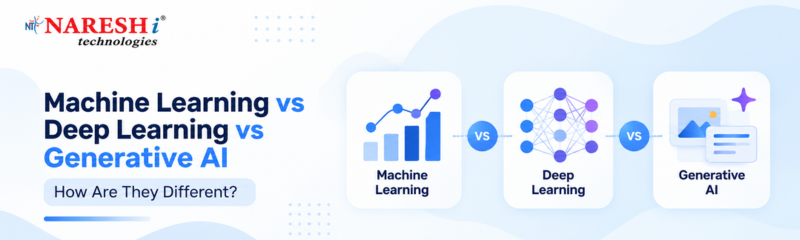
That is why people get confused by Machine Learning vs Deep Learning vs Generative AI. The names sound alike, but they do different jobs. This guide breaks down each concept in simple terms, explores its practical applications, and helps you decide which course best matches your learning goals.
Picture three circles, one inside the other. The biggest circle is artificial intelligence, which means teaching computers to do smart tasks. Inside it is machine learning, where computers learn from examples instead of following fixed rules. Inside that is deep learning, a kind of machine learning that uses neural networks with many layers. Generative AI uses deep learning to create new things, like text, pictures or code.
So they are not competitors. Generative AI is a part of deep learning, and deep learning is a part of machine learning.
Machine learning works best when your data fits in a table, with rows and columns. Think of past orders, customer details or sales numbers. The computer studies these examples and finds patterns.
For the late-delivery problem, you would feed in distance, weather, restaurant name and time of day. The model identifies patterns in the data to understand which combinations are most likely to lead to delays. Common methods include linear regression, decision trees and random forests.
These models are fast and light. A normal laptop can train one in minutes, and you can explain the result to a non-technical person. Banks use them to spot fraud, shops use them to forecast demand, and lenders use them to judge risk. Python tools like pandas and scikit-learn are the usual choice.

Deep learning is useful when the data is messy and not in a neat table: photos, voice recordings, videos or long pieces of text. The network learns what to look for by itself. In a photo, the first layers notice simple lines and edges, and later layers put them together to recognise a damaged burger box.
The price is higher. Deep learning needs lots of examples and often a powerful graphics card (GPU). You will also see it in voice assistants, medical scan analysis and quality checks on factory lines. Popular tools are PyTorch and TensorFlow.
Generative AI does not just label or predict. It makes something new. Chatbots write answers, tools write code, and image models draw pictures. Most of them are built on a design called the transformer and trained on huge amounts of data.
Most developers use existing pre-trained models instead of building and training new ones from the beginning. They use them through an API and add a few extras:
For the complaint replies, a system could find the refund policy and draft a polite answer for a person to check before sending.
Be careful, though. Generative AI can sound sure while being wrong, it costs money each time you use it, and it needs privacy care. It is also more difficult to evaluate than a single numerical score.
|
Machine learning |
Deep learning |
Generative AI |
|
|
Best data |
Tables |
Images, audio, long text |
Huge text, image or code collections |
|
What it gives you |
A label or a number |
Predictions from raw data |
New text, images or code |
|
Power needed |
A laptop is often enough |
Often a GPU |
Usually used through an API |
|
Python tools |
pandas, scikit-learn |
PyTorch, TensorFlow |
LLM APIs, Hugging Face |
|
Delivery app example |
Predict late orders |
Check damaged-food photos |
Write complaint replies |
First, determine what data is available to you and what outcome you expect from analyzing it.
You can also mix them. A machine learning model finds customers who may leave, and a generative model writes a personal message for each one. Just don’t use a big language model for a job that a small, simple model can do faster, cheaper and more reliably.
For most beginners, this order works well:
The skills build on each other. Cleaning data and testing results matter just as much in generative AI as in classic machine learning. If you prefer one combined program, a Generative AI and Machine Learning Course is fine, as long as it teaches the basics and not just prompts.
Before enrolling in a paid course, make sure to review the following factors:
No course can guarantee a job. Roles like machine learning engineer, data analyst and generative AI developer exist, but demand and pay depend on the company and your skills.
Yes, because most generative AI models are deep learning models.
It helps, since data and testing skills carry over, but you can begin with basic Python.
No, because simple machine learning is often better for table data.
Start with a Machine Learning with Python Course, then move to a Generative AI Course.
Not for machine learning or for using generative AI through APIs.

Machine Learning vs Deep Learning vs Generative AI is really about picking the right tool for your data and your goal. For your next step, choose one small problem you care about, decide which of the three fits it, and write one line explaining why before you write any code.
If you were starting from zero, would you begin with a Machine Learning with Python Course or go straight to a Generative AI Course, and why?
Follow NareshIT for more practical insights on technology, skills, and career development.
 +91 8179191999

 +91
8179191999
+91
8179191999


.png)





.png)
.png)