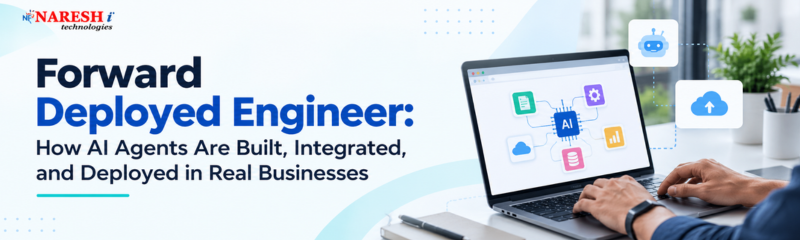
Building an AI agent involves more than connecting a language model to an application. Businesses need solutions that work with existing software, protect sensitive information, and complete tasks accurately. A Forward Deployed Engineer (FDE) helps organizations turn AI concepts into practical applications that address real business challenges.
These engineers collaborate with customers, developers, and business teams to build customized solutions. Their work may include Large Language Model Integration, application development, system connectivity, testing, and deployment. As companies adopt AI Agent Deployment and workflow automation, Forward Deployed Engineering is gaining attention as a specialized engineering role.
A Forward Deployed Engineer develops and implements software solutions for specific customer requirements. Unlike engineers who focus primarily on developing general-purpose products, FDEs work closely with users to understand their challenges and adapt technology to existing business environments.
For example, a company might need an AI assistant that answers employee questions using internal documents. An FDE could connect the documents to an AI model, configure information retrieval, establish access permissions, and test the assistant against real questions.
The role combines programming, problem-solving, system integration, and communication. Its primary objective is to deliver software that works reliably in practical business situations.
AI applications often face unexpected problems when introduced into production environments. Company information may be stored across different systems, APIs may fail, and employees may have different access permissions.
Forward Deployed Engineers identify these challenges and develop solutions that fit the organization's requirements. They also evaluate whether the application improves the workflow it was designed to support.
For example, a customer support agent might retrieve order information, check product policies, and prepare a response. The engineer must ensure that the agent accesses authorized records and handles incomplete information appropriately.
This makes Forward Deployed Engineering valuable for Enterprise AI Implementation, particularly when applications must interact with multiple business systems.
The engineer studies the existing workflow and identifies repetitive tasks suitable for automation. For example, an operations team might manually collect data from several applications to prepare daily reports.
The engineer determines which activities can be automated and which require human approval.
The appropriate model depends on accuracy requirements, response speed, operating costs, and data privacy.
Large Language Model Integration can involve connecting a hosted model through an API or deploying a model within controlled infrastructure. The choice should match the application's actual requirements.
Engineers connect AI applications to business software using APIs, databases, and authentication mechanisms.
For instance, an AI support assistant could retrieve troubleshooting instructions from a knowledge base and use relevant details from a support ticket. Access controls ensure that users cannot retrieve unauthorized information.
The engineer defines how the agent processes requests, selects tools, and responds to unexpected situations.
A sales assistant might summarize customer interactions and prepare follow-up emails for employee review. Requiring approval before sending messages can reduce the risk of unintended actions.
Before launch, engineers test realistic scenarios, including incorrect inputs, missing data, and integration failures. They evaluate accuracy, security, response time, and task completion.
After deployment, monitoring and user feedback help identify problems. Successful AI Workflow Automation requires continued testing and maintenance as business requirements change.
|
Skill |
Why It Matters |
|
Python |
Develops AI applications and backend services |
|
REST APIs |
Connects AI models with business software |
|
LLM fundamentals |
Explains model capabilities and limitations |
|
Retrieval-Augmented Generation (RAG) |
Retrieves relevant information from documents |
|
AI agent frameworks |
Supports tool-based workflows |
|
SQL and databases |
Accesses and organizes business information |
|
Cloud and DevOps |
Supports deployment and monitoring |
|
Communication |
Converts business requirements into technical solutions |
Beginners should start with Python, SQL, Git, and REST APIs. They can then learn LLM integration, RAG, AI agent frameworks, and cloud deployment.
|
Area |
Forward Deployed Engineer |
AI Engineer |
|
Primary focus |
Customer-specific implementation |
AI application development |
|
Common tasks |
Integration, deployment, troubleshooting |
Model integration, pipelines, evaluation |
|
Customer interaction |
Often extensive |
Depends on the role |
|
Main objective |
Make solutions work in customer environments |
Build effective and reliable AI systems |
These roles can overlap. Some FDEs develop complex AI applications, while AI engineers may also handle deployment and system integration.
Forward Deployed Engineering may suit professionals who enjoy programming, solving technical problems, and collaborating with business users.
Related opportunities include AI implementation engineering, solutions engineering, applied AI development, enterprise integration, and AI consulting.
Aspiring professionals can build practical projects such as a document-search assistant, an AI customer support workflow, or an application that retrieves data through APIs and prepares reports.
A strong portfolio should explain the problem, technical design, integrations, security measures, and testing process. Demonstrating how an application handles real-world failures can make a project more valuable than a basic demonstration.
An FDE builds and implements software solutions tailored to business requirements, including AI integration and deployment.
FDEs can develop agents, connect them to enterprise systems, configure their actions, and test their performance.
Python is a practical starting point for AI development, backend services, and LLM integration.
Cloud skills are valuable for deploying, monitoring, and maintaining production applications.
Yes. Entry-level opportunities depend on employer requirements. Beginners should develop programming fundamentals and demonstrate their skills through practical projects.
.png)
Forward Deployed Engineers connect AI capabilities with real business requirements. Their work combines programming, AI Systems Integration, workflow design, deployment, and collaboration with customers.
Learning Python, APIs, databases, language models, and cloud technologies provides a useful foundation for aspiring professionals.
Key takeaway: An AI agent delivers business value when it connects to the right systems, protects information, and completes useful tasks reliably.
 +91 8179191999

 +91
8179191999
+91
8179191999

_online_training.jpg)