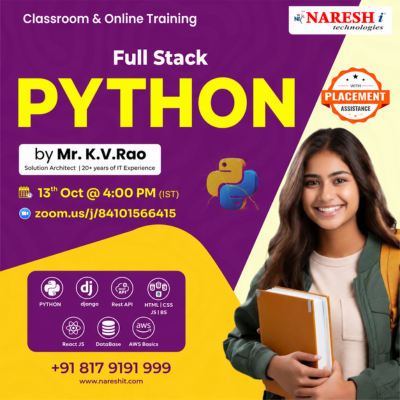
Many students want to enter the IT industry, but they are confused about where to start. Some hear about Java. Some hear about cloud. Some hear about AI, data science, DevOps, and full stack development. The confusion is real because the job market is changing very fast.
In India, fresher hiring is still active, but companies are becoming selective. They no longer want only degree holders. They want candidates who can solve problems, build projects, understand tools, and adapt to AI-driven work. This is where Python becomes a smart starting point for beginners.
Python is simple enough for freshers to learn and powerful enough for real software development. It is used in web development, automation, artificial intelligence, machine learning, data analytics, backend development, testing, cloud scripting, and GenAI applications. For a beginner entering IT, Python gives both confidence and career flexibility.
Python is a high-level programming language used to build software applications, websites, automation scripts, AI tools, data applications, and backend systems. It is known for clean syntax, simple readability, and wide industry usage.
For beginners, the first challenge is fear. Many students think programming is difficult because they imagine complex code, confusing symbols, and long logic. Python reduces that fear. Its syntax is closer to normal English compared to many other programming languages.
This helps learners understand programming fundamentals faster. They can learn variables, conditions, loops, functions, object-oriented programming, file handling, and databases without feeling overloaded at the beginning.
Python is not just easy. It is also practical. Once a learner understands the basics, they can move into multiple career paths. This is one reason many students now search for a Full-Stack Python with Artificial Intelligence for Beginners program instead of learning only basic programming.
Python has remained popular because it fits many business needs. Companies use Python to build backend applications, automate internal tasks, analyze data, create machine learning models, develop AI-powered tools, and connect APIs.
The biggest advantage is versatility. A learner who starts with Python does not get locked into one narrow career path. The same language can support careers in full stack development, AI, data science, automation testing, DevOps scripting, cloud operations, and analytics.
In 2026, this matters more because companies are not hiring only for routine coding. They are hiring people who can work with AI tools, understand business problems, and build complete solutions. Python supports this shift because it connects easily with AI libraries, web frameworks, databases, and cloud platforms.
For example, a beginner can first build a basic web application using Python. Later, the same learner can add an AI chatbot, resume analyzer, recommendation engine, or report automation feature. This journey makes Python a strong career-building language.
A beginner needs three things in the early stage: clarity, confidence, and career direction. Python supports all three.
First, Python gives clarity because its learning path is easy to understand. Students can begin with programming basics and slowly move toward real projects.
Second, Python builds confidence because learners can see quick results. They can create small programs, calculators, automation tasks, data reports, and simple web applications within a short time.
Third, Python gives career direction because it connects with many modern technologies. A learner does not have to stop at basic programming. They can move into Python Full Stack with GenAI, AI application development, automation, data analytics, or backend development.
This is important for freshers from engineering, degree, BCA, MCA, B.Sc, commerce, and non-IT backgrounds. Many beginners do not know which technology will suit them. Python gives them a safe and practical entry point.
India’s IT industry is growing, but the hiring pattern is changing. Companies are not simply increasing headcount for every role. They are looking for candidates who can bring useful digital skills from day one.
The rise of AI has also changed entry-level expectations. Routine tasks are getting automated. Basic coding alone may not be enough. Freshers who can combine Python with web development, databases, APIs, and AI tools will have a stronger advantage.
This is why delaying skill development can be risky. While one student is still thinking about which course to join, another student may already be building projects, preparing a GitHub portfolio, attending mock interviews, and learning AI-integrated development.
The competition is not only between degree holders. It is between job-ready candidates and certificate-only learners. Python helps beginners move into the job-ready category when learned with practical projects and industry use cases.
Artificial intelligence is no longer a future topic. It is already part of software products, hiring tools, customer support systems, education platforms, banking applications, marketing tools, healthcare solutions, and business dashboards.
Python is one of the most commonly used languages for AI and machine learning because of its rich ecosystem. It supports AI libraries, data handling, model integration, API development, and automation.
For beginners, this does not mean they must become AI researchers immediately. They can start by learning how to use AI in applications. For example, they can build an AI chatbot, AI resume screening tool, AI interview preparation system, AI content generator, or AI-powered learning assistant.
This is where Python Full Stack with GenAI becomes valuable. It helps learners understand how web development and AI can work together in one real-world application.
A Gen AI Python Full Stack Course with Real-World Projects can give learners a stronger portfolio because recruiters can see what the candidate has actually built.
Recruiters do not expect freshers to know everything. But they do expect strong fundamentals and practical exposure. A beginner who knows only definitions may struggle in interviews.
Companies usually test whether a candidate can write basic logic, explain code clearly, work with databases, understand APIs, and describe project flow. For Python-based roles, recruiters may ask about programming basics, object-oriented concepts, exception handling, file handling, SQL, backend frameworks, and project architecture.
For AI-integrated roles, they may also check whether the candidate understands prompt usage, API integration, input-output handling, basic data processing, and how AI features are connected inside an application.
This is the difference between a course learner and a job-ready candidate. A course learner completes topics. A job-ready candidate can explain how those topics solve a real problem.
Many colleges teach programming theory, but companies need practical implementation. This gap is one of the biggest reasons freshers struggle during interviews.
Colleges may cover syntax, basic lab programs, and semester exams. Companies expect candidates to understand real application flow. They want to see whether the learner can create a login system, connect a database, build APIs, handle errors, deploy a project, and explain the business purpose of the application.
Another common gap is project quality. Many students show copied mini projects or outdated academic projects. Recruiters quickly identify them. They prefer projects that solve practical problems and show the learner’s own understanding.
This is why practical training matters. Beginners should not learn Python only for exams. They should learn it to build applications.
A beginner can follow a simple but strong roadmap.
Start with syntax, variables, data types, conditions, loops, functions, strings, lists, dictionaries, file handling, and exception handling. This stage builds logical thinking.
Every real application needs data. Learn SQL, tables, queries, joins, constraints, and database design basics. This helps in backend and full stack roles.
Learn HTML, CSS, JavaScript basics, and frontend structure. Even if the learner wants to become a backend developer, understanding the frontend helps in full stack application development.
Learn Django, Flask, or FastAPI. Understand routing, models, templates, authentication, APIs, and database connectivity.
Build projects that combine frontend, backend, database, and APIs. This is where learning becomes job-oriented.
Learn how to integrate AI APIs, build prompts, process user inputs, manage responses, and create AI-powered features.
Deploy projects, prepare resumes, practice mock interviews, and learn how to explain project architecture confidently.
This roadmap gives beginners a clear direction instead of random learning.
Python salary depends on skills, projects, location, company type, and interview performance. Freshers with only basic Python may start at entry-level packages. Candidates with full stack, database, API, and AI project exposure can aim for better opportunities.
In India, Python developer salaries commonly start around entry-level brackets and grow with experience. Hyderabad, Bengaluru, Pune, Chennai, Mumbai, and Delhi NCR are strong markets for Python-related roles.
Hyderabad is especially important because of its IT ecosystem, training culture, and hiring activity. For students around Ameerpet and nearby areas, Python full stack training can create a practical route into software development, AI-integrated applications, and backend roles.
The key point is simple. Salary growth does not come from Python alone. It comes from Python plus problem-solving, full stack knowledge, database skills, AI exposure, real projects, communication, and interview readiness.
Recruiters prefer projects that look realistic and useful. A beginner should avoid showing only basic calculator or copied student management projects. Instead, they should build projects that connect with current industry needs.
This project can analyze resumes, extract skills, compare them with job descriptions, and give improvement suggestions. It shows Python, file handling, AI integration, and web application skills.
This project can suggest jobs based on user skills, location, experience level, and interest. It shows database design, backend logic, frontend flow, and recommendation thinking.
This project can answer course-related questions, guide users, and store chat history. It shows GenAI integration, prompt handling, backend development, and user experience thinking.
This project can track lessons, assignments, quizzes, progress, and weak areas. It is useful for edtech, training, and LMS-related roles.
This project can collect data, process it, and generate reports automatically. It shows Python automation, data handling, and business productivity skills.
These projects are useful because they help candidates explain the problem, solution, tools used, process followed, and business value.
Many Python beginners get rejected not because Python has no demand, but because their preparation is incomplete.
Some candidates know syntax but cannot solve simple logic questions. Some complete a course but cannot explain their project. Some add AI and full stack keywords to resumes but cannot describe how the application works. Some use copied projects without understanding the code flow.
Recruiters usually shortlist resumes that show clarity. A good resume should include relevant skills, project titles, tools used, clear descriptions, GitHub links, deployment links if available, and measurable project outcomes.
During interviews, candidates should explain what they built, why they built it, which problem it solves, how data flows, what challenges they faced, and what improvements they can add.
A Full stack python with gen AI certification can support the resume, but only when the learner also has strong projects and practical understanding.
Python is suitable for many learner groups.
Freshers can learn it to enter software development. Engineering students can use it to strengthen coding and project skills. Non-IT graduates can use it as a beginner-friendly entry into technology. Working professionals can use it to move into automation, AI tools, backend development, or full stack roles.
Career switchers can also benefit because Python has a smoother learning curve. It allows them to build practical skills without getting stuck in complex syntax at the beginning.
A Full Stack Python with Gen AI Online Training program can be helpful for learners who need flexibility but still want structured guidance, live practice, mentor support, and placement-focused preparation.
Python is used across multiple industries in India. IT services companies use it for backend development, automation, testing, and internal tools. Startups use it for fast product development. Banks and finance companies use it for data processing, automation, fraud detection, and analytics. Edtech companies use it for learning platforms, AI tutors, dashboards, and student analytics.
Healthcare firms use Python for data systems, AI support tools, and automation. E-commerce companies use it for recommendation systems, inventory tools, pricing systems, and customer insights. Digital businesses use it for reporting, analytics, workflow automation, and AI-based customer interaction.
This wide industry usage makes Python a safe and future-ready choice for beginners.
Naresh i Technologies provides software training with 23+ years of experience in online and offline IT education. For beginners, the biggest need is structured learning. Random videos may teach topics, but they may not build career direction.
NareshIT focuses on practical training through experienced real-time trainers, industry-specific scenarios, dedicated mentor support, digital laboratories, and placement-focused guidance. This helps learners move from basic understanding to project-based confidence.
For learners interested in Python Full Stack with GenAI, the right training approach should include Python fundamentals, web development, backend frameworks, databases, APIs, AI integration, real-world projects, resume preparation, and interview practice.
The aim is not just to complete a syllabus. The aim is to help learners become confident enough to face interviews and explain their skills clearly.
The IT market is moving toward skills-first hiring. AI is changing job roles. Automation is reducing repetitive work. Companies are looking for freshers who can learn fast and work on practical tasks.
Students who delay learning may face stronger competition later. Others may already be building projects, earning certifications, attending interviews, and improving their portfolios.
Python gives beginners a strong starting point today. When combined with full stack development and GenAI, it creates a career path that is practical, flexible, and future-ready.
Python is one of the best programming languages for beginners entering IT because it is simple, powerful, and connected to many modern career paths. It helps learners start with programming basics and grow into web development, AI, automation, backend development, data applications, and full stack roles.
But the real career advantage comes when Python is learned practically. Beginners should focus on logic, SQL, frontend basics, backend frameworks, APIs, GenAI integration, real-world projects, deployment, and interview preparation.
A structured path like Python Full Stack with GenAI can help learners move beyond basic coding and prepare for modern software roles. For students, freshers, and career switchers, this is the right time to build practical Python skills and enter the IT industry with confidence.
Yes. Python is one of the best languages for beginners because it has simple syntax, strong industry usage, and career scope in web development, AI, automation, and data-related roles.
Yes. Non-IT students can learn Python if they follow a step-by-step roadmap. They should start with programming basics and slowly move toward projects, databases, web development, and AI tools.
The learning time depends on practice and consistency. With structured training, beginners can build strong fundamentals and real-world projects within a few months.
Basic Python alone may not be enough. Learners should also learn SQL, web development, backend frameworks, APIs, projects, communication, and interview preparation.
A certification helps prove structured learning. It becomes more valuable when supported by real-world projects, practical assignments, and interview-ready skills.
Beginners can build an AI resume analyzer, job recommendation portal, AI chatbot, online learning dashboard, automation reporting tool, or full stack web application with database integration.
NareshIT provides dedicated placement batches, job assistance, mentor support, practical training, and interview-focused guidance to help learners prepare for IT career opportunities.
Your IT career should not start with confusion. It should start with the right skill, the right roadmap, and the right guidance.
If you want to enter software development, AI-integrated applications, or full stack careers, Python is a smart place to begin. With NareshIT’s practical training approach, real-time trainers, mentor support, digital labs, and placement-focused preparation, you can build skills that recruiters actually value.
Seats for career-focused training batches are limited. Start your Python learning journey today and move one step closer to becoming a job-ready IT professional.
 +91 8179191999

 +91
8179191999
+91
8179191999

.png)
.png)