.png)
Next Batch : Invalid Date
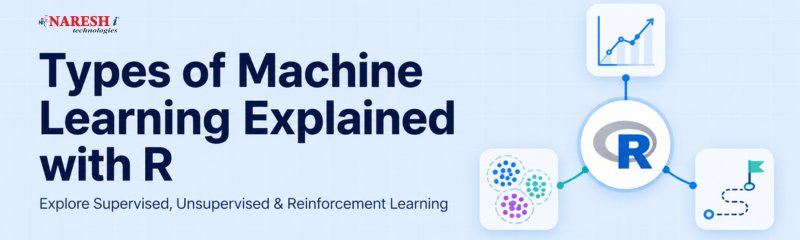
Machine learning is used in applications that detect spam, recommend products, forecast sales and recognise images. However, these systems do not all learn in the same way. The method used depends on the available data, the problem being solved and the result the system needs to produce.
Understanding the different types of machine learning helps students and developers choose suitable algorithms instead of applying the same approach to every problem.
The main types of machine learning are supervised learning, unsupervised learning and reinforcement learning. Semi-supervised learning and self-supervised learning are also important approaches. They differ in how training information is provided and how a model learns to make predictions, discover patterns or select actions.
Supervised learning trains a model using examples that include both input data and the expected answer. The model studies these examples and learns to predict outcomes for new data.
For example, a bank could train a model using historical transactions labelled as fraudulent or legitimate. After training, the model can estimate whether a new transaction appears suspicious. Its predictions still require evaluation because legitimate transactions can be flagged incorrectly.
Supervised learning includes two major problem types:
When should you use it? Choose supervised learning when you have reliable historical examples with known outcomes and want to predict an outcome for new cases.
Unsupervised learning works with data that does not have predefined target labels. Instead of learning from known answers, the model searches for patterns, similarities or structures in the dataset.
Consider an online store with thousands of customers. The business may not have predefined customer categories, but it can analyse purchase frequency, spending and product preferences to identify groups with similar behaviour.
Common approaches include:
Unsupervised learning is useful for customer segmentation, exploratory data analysis and identifying unusual patterns. However, the patterns it discovers are not automatically meaningful; people must interpret and validate them.
Reinforcement learning trains an agent to make decisions by interacting with an environment. The agent receives rewards or penalties based on its actions and learns a strategy intended to maximise long-term rewards.
Imagine a robot learning to navigate a warehouse. It receives positive feedback for reaching a destination efficiently and negative feedback for collisions or unnecessary movement. Through repeated training, it can learn a more effective route.
Important concepts include:
Q-learning is a well-known reinforcement learning algorithm. More advanced methods combine reinforcement learning with neural networks.
This approach is useful in robotics, game-playing systems and certain resource-allocation problems. Training can require substantial computation and carefully designed rewards. A poorly designed reward may encourage behaviour that meets the measured target but fails to achieve the real objective.
These approaches help models learn when manually labelled data is limited or expensive to produce.
Semi-supervised learning uses a small labelled dataset alongside a larger collection of unlabelled data. For example, a company might have labels for a limited number of product images but thousands of additional images without labels.
Self-supervised learning creates training signals from the data itself. A language model, for example, can learn by predicting missing or subsequent words in text. This allows it to learn useful patterns without requiring people to label every training example manually.
The distinction matters: semi-supervised learning combines labelled and unlabelled examples, while self-supervised learning derives its learning targets from the data.
Both approaches are useful in areas such as image recognition, language processing and speech technology. Their effectiveness depends on data quality, training design and how well the learned representations transfer to the intended task.
The right approach depends on the question you want to answer, not simply on which algorithm is popular.
|
Learning type |
Training information |
Main goal |
Example |
|
Supervised |
Inputs with known answers |
Predict an outcome |
Forecast sales |
|
Unsupervised |
Unlabelled data |
Discover patterns |
Group customers |
|
Reinforcement |
Actions and reward feedback |
Improve decisions |
Train a game-playing agent |
|
Semi-supervised |
A small labelled set plus unlabelled data |
Learn with fewer manual labels |
Classify product images |
|
Self-supervised |
Targets derived from the data |
Learn useful representations |
Pre-train a language model |
Suppose you have a dataset containing customer age, purchase history and monthly spending.
If you want to predict how much a customer will spend next month, supervised regression may be appropriate. If you want to discover groups of customers with similar shopping habits, clustering may be more suitable. If you are developing a system that learns which recommendation to display through feedback over time, a reinforcement learning approach may be worth investigating.
The dataset alone does not determine the method. You must also define the objective, check data quality and evaluate the results against an appropriate measure.
For beginners, a practical starting point is Python, basic statistics, data cleaning and data visualisation. Next, practise supervised learning with classification and regression before exploring clustering and dimensionality reduction. Reinforcement learning can follow once you understand the fundamentals.
Build small projects and evaluate models on data they have not seen during training. This helps you understand whether a model has learned useful patterns rather than simply memorising examples.
Learners looking for structured instruction can also explore machine learning training in Hyderabad, provided the course includes hands-on projects, model evaluation and practical Python work.
The three main types are supervised learning, unsupervised learning and reinforcement learning. They learn from labelled examples, unlabelled data and reward-based interaction, respectively.
Supervised learning uses known target answers to make predictions, while unsupervised learning analyses unlabelled data to identify patterns or groups.
Python is not the only option, but it is a practical choice because libraries such as scikit-learn provide tools for training, testing and evaluating machine learning models.
Semi-supervised learning combines labelled and unlabelled data. Self-supervised learning generates training targets from the data itself rather than relying on manually assigned labels for every example.
Supervised learning is often a good starting point because classification and regression projects provide clear objectives and measurable results. Beginners should also learn data preparation and model evaluation.
The different types of machine learning solve different problems: supervised learning predicts known outcomes, unsupervised learning finds patterns, and reinforcement learning improves decisions through feedback. Semi-supervised and self-supervised methods provide additional ways to learn from data.
Start by defining a practical problem, then select the learning approach that matches your data and goal.
Discussion question: Which machine learning approach would you choose for a first Python project: predicting sales, grouping customers or training an agent to make decisions?
 +91 8179191999

 +91
8179191999
+91
8179191999





.png)



.png)
.png)