Many learners start Python programming with random tutorials. They watch one video on Python basics, another on Django, another on APIs, then jump to Gen AI, GitHub, or interview questions. At first, it feels productive. But after a few weeks, many learners feel confused.
They know small pieces of many topics but cannot build a complete project. They may understand syntax but struggle with backend logic. They may watch project videos but cannot explain the project in interviews.
This is the main problem with unstructured learning.
A structured Full Stack PYTHON Training program gives learners a clear path. It teaches what to learn first, what to practice next, which projects to build, how to prepare for interviews, and how to become placement-ready. In today's competitive job market, structure can save time, reduce confusion, and improve career confidence.
Random tutorials are learning resources selected without a proper roadmap. They may be free videos, blogs, short clips, coding snippets, or disconnected online lessons.
Random tutorials are not always bad. Many of them can explain one topic well. The problem starts when learners depend only on scattered resources without understanding the correct order.
For example, a beginner may learn Python variables today, Django tomorrow, APIs next week, and Gen AI after that. But without enough practice, the learner may not understand how these topics connect.
Random learning often gives information, but not direction.
A structured Full Stack Python program is a planned learning journey. It starts from the basics and slowly moves toward practical development, projects, interview preparation, and placement readiness.
A good structured program includes:
● Python programming foundation
● OOP concepts
● HTML, CSS, and JavaScript basics
● Backend development
● Django or FastAPI concepts
● Database connectivity
● APIs
● Authentication
● Git and GitHub
● Real-time projects
● Full Stack PYTHON with Gen AI exposure
● Resume preparation
● Mock interviews
● Placement assistance
The biggest advantage is sequence. Learners do not have to guess what to learn next. They follow a guided path.
Beginners need clarity more than content. Today, content is available everywhere. But too much content can create confusion.
A learner may ask:
● Should I learn Django first or FastAPI?
● Should I learn frontend before backend?
● When should I start projects?
● How much SQL is enough?
● Should I learn Gen AI now?
● What should I write in my resume?
● What will recruiters ask?
A structured program answers these questions step by step.
It helps learners avoid wasted effort. Instead of jumping between topics, they build skills in the correct order. This is especially important for freshers who want jobs within a limited time.
One major problem with random tutorials is half-knowledge. Learners may know definitions but not application.
For example, they may know what a function is, but they may not know how functions organize backend logic. They may know what HTML forms are, but they may not know how form data reaches the Python backend. They may know what SQL is, but they may not know how database records are used in a project.
This gap becomes visible during interviews.
Recruiters do not ask only, "What is Python?" They ask, "How did you use Python in your project?" That is where half-knowledge fails.
A structured program reduces this problem by connecting concepts with practical tasks.
Full Stack Python development is not one topic. It is a combination of multiple skills.
Learners need:
● Python programming for logic
● Frontend basics for user interface
● Backend frameworks for server-side development
● Databases for storing information
● APIs for communication
● GitHub for project proof
● Projects for practical learning
● Interview practice for placement readiness
Random tutorials usually teach these skills separately. A structured program connects them.
For example, learners understand how HTML collects user input, how Python processes it, how the database stores it, and how the result appears on the frontend. This complete flow is what companies expect from job-ready candidates.
Python programming is the foundation. Without basics, learners struggle in frameworks and projects.
A structured program usually starts with:
● Variables
● Data types
● Operators
● Conditions
● Loops
● Functions
● Strings
● Lists
● Dictionaries
● File handling
● Exception handling
● OOP concepts
● Modules
These basics are not just academic topics. They are used in real projects.
Conditions are used in login checks. Loops are used to display records. Functions organize reusable logic. Dictionaries help manage key-value data. Exception handling prevents application failure.
Random tutorials may skip fundamentals too quickly. A structured program gives enough practice before moving ahead.
Backend development is where many freshers struggle. They may understand Python syntax but not know how backend logic works.
Backend logic includes:
● Receiving user requests
● Validating input
● Processing data
● Connecting with databases
● Managing login
● Handling errors
● Creating APIs
● Sending responses
This cannot be mastered by watching disconnected videos. Learners need guided practice and projects.
A structured Full Stack Python program helps students understand request-response flow, routing, database operations, authentication, and API usage through practical examples.
This makes learners more confident during interviews.
Projects are the biggest proof of learning. But copied or poorly understood projects do not help in interviews.
Random tutorials often encourage learners to copy a project from start to end. The project may run, but the learner may not know how it works.
A structured program helps learners build projects step by step.
First, they practice mini projects. Then they move to database-connected projects. Later, they build real-time projects with frontend, backend, database, authentication, and APIs.
Good project examples include:
● Student Management System
● Job Portal Application
● E-Commerce Application
● Online Learning Platform
● Expense Tracker
● Login and Registration System
● AI-Based FAQ System
● Resume Analyzer
● Course Recommendation System
These projects become useful only when learners can explain them clearly.
Gen AI is becoming important in modern development. But beginners should not jump into Gen AI without understanding Python, backend logic, and APIs.
A structured Full Stack PYTHON with Gen AI path helps learners understand how AI features fit inside real applications.
For example, an AI-based FAQ system needs:
● Frontend input form
● Python backend logic
● AI processing flow
● API communication
● Database storage
● User interface response
This is very different from simply using an AI tool.
Random tutorials may show one AI demo, but a structured program helps learners connect AI with full stack development. This makes the project stronger and more interview-ready.
Recruiters do not shortlist candidates only because they watched tutorials. They check whether the candidate can explain skills and projects.
They may ask:
● How does your project work?
● Where did you use Python?
● How does frontend connect with backend?
● Where is the database used?
● How does login work?
● Did you use APIs?
● What challenges did you face?
● Is your project on GitHub?
● What did you personally build?
A learner who followed random tutorials may struggle to answer these questions. A learner who followed structured training and practiced projects can answer with more clarity.
This is why structure matters for placements.
Learning technical skills is one part. Presenting them properly is another.
Many freshers have weak resumes because they write generic objectives, unclear project descriptions, and long skill lists. Some add tools they cannot explain. Some do not upload projects to GitHub.
A structured program usually includes guidance on resume and GitHub presentation.
A good resume should show:
● Python programming skills
● Frontend basics
● Backend knowledge
● Database exposure
● Project details
● GitHub link
● Gen AI project exposure if relevant
A good GitHub project should include a clear README, organized folders, features list, technologies used, and setup steps.
Random tutorials usually do not provide this career-focused guidance.
Watching tutorials does not prepare learners for interview pressure. Mock interviews do.
Mock interviews help learners practice:
● Self-introduction
● Python answers
● Coding questions
● Project explanation
● Database questions
● API questions
● HR questions
● Resume-based questions
● Full Stack PYTHON with Gen AI questions
They also help learners identify weak areas before real interviews.
A structured Full Stack Python program with mock interview support can improve confidence. Learners learn how to answer clearly, handle unknown questions, and explain their work professionally.
This is difficult to achieve through random tutorials alone.
Random tutorials often focus on "how to do" a task. Job readiness requires understanding "why" and "where" the task is used.
For example, a tutorial may show how to create a login page. But interviews may ask why authentication is needed, how user data is stored, what happens after login fails, and how user roles are managed.
This is the skill gap.
Companies expect:
● Strong basics
● Practical coding
● Backend understanding
● Database clarity
● Project explanation
● GitHub proof
● Communication skills
● Problem-solving ability
● Learning attitude
A structured program is better aligned with these expectations.
Random tutorials are not useless. They are useful for revision, quick doubt clarification, and exploring extra topics.
For example, after learning Python basics in a structured way, a learner can watch a short tutorial to revise list methods or file handling. After building a project, they can explore additional features through tutorials.
But random tutorials should support learning. They should not replace a roadmap.
The best approach is structured learning first and selective self-learning later.
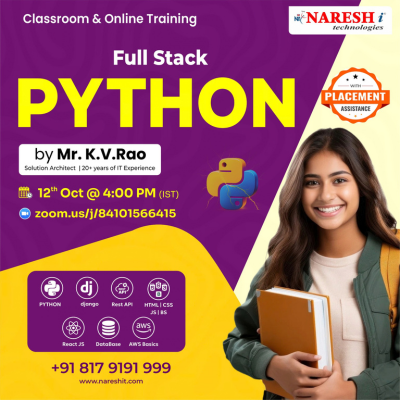
NareshIT helps learners follow a structured path from Python basics to placement readiness. Freshers need more than scattered videos. They need trainer guidance, mentor support, lab practice, real-time projects, resume preparation, mock interviews, and placement assistance.
NareshIT Full Stack PYTHON Training supports learners through Python programming foundation, frontend basics, backend development, database connectivity, API learning, authentication concepts, Git and GitHub practice, real-time projects, interview preparation, placement assistance, and Full Stack PYTHON with Gen AI exposure.
This structured approach helps learners build clarity, confidence, and job readiness.
1. Are random tutorials enough to learn Full Stack Python?
Random tutorials can help with individual topics, but they are usually not enough for complete job readiness because they lack structure, projects, feedback, and placement direction.
2. Why is a structured Full Stack Python program better?
A structured program gives a clear roadmap, trainer guidance, projects, doubt support, GitHub practice, mock interviews, resume support, and placement assistance.
3. Can beginners learn Python through random tutorials?
Yes, beginners can learn basics through tutorials, but many struggle to connect topics and build complete applications without guidance.
4. What should a Full Stack Python program include?
It should include Python programming, frontend basics, backend development, databases, APIs, authentication, GitHub, projects, interview preparation, and placement support.
5. Is Full Stack PYTHON with Gen AI useful for freshers?
Yes. Gen AI exposure is useful when learners build practical projects like AI FAQ systems, chatbots, resume analyzers, or recommendation systems.
6. Do structured programs help with interviews?
Yes. Structured programs often include mock interviews, project explanation practice, resume guidance, and technical preparation.
7. Should learners stop using tutorials completely?
No. Tutorials are useful for revision and extra practice. But learners should follow a structured roadmap instead of depending only on random content.
Random tutorials can teach small topics, but they often create confusion when learners need complete job readiness. Full Stack Python development requires connected learning across Python programming, frontend, backend, databases, APIs, GitHub, projects, interviews, and Gen AI exposure.
A structured Full Stack Python program gives direction. It helps learners understand what to learn first, how to practice, which projects to build, how to explain them, and how to prepare for placements.
A good PYTHON Course should not only teach syntax. It should guide learners toward practical confidence and career readiness.
If your goal is only to explore Python, random tutorials may help. But if your goal is to become a job-ready Full Stack Python Developer, structured Full Stack PYTHON Training is the better path.
 +91 8179191999

 +91
8179191999
+91
8179191999