Suppose two freshers apply for the same Python developer role and attend the interview.
The first candidate knows Python syntax, loops, functions, and basic programs. The second candidate knows Python too, but has also developed a working application using Django, SQL, and REST APIs.
Both have completed Python Training. Yet the second candidate has more practical experience to discuss during the interview.
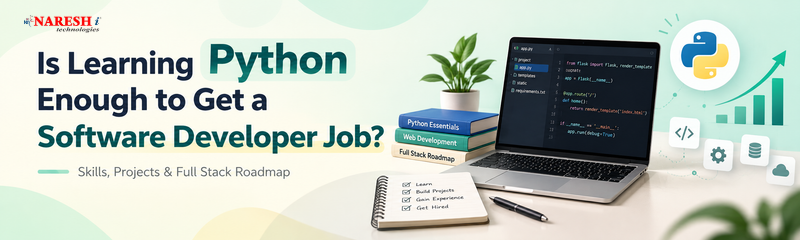
This raises an important question: Is learning Python enough to get a software developer job?
Students preparing for Python developer roles should explore the skills recruiters expect beyond basic programming to improve their job readiness.
Python provides a strong programming foundation, but knowing Python syntax alone is generally not enough for a software developer job.
Python developers handle more than coding; their work also involves database management, API integration, user authentication, software testing, debugging, and deploying applications.
For example, writing a calculator demonstrates basic programming knowledge. Creating an expense-tracking application with secure login, database storage, and reporting features demonstrates broader software development abilities.
Recruiters assess candidates based on their ability to use technical knowledge to solve real-world problems.

Python remains useful across backend development, automation, Data Science, Artificial Intelligence, and machine learning.
Its readable syntax makes learning Python for beginners approachable, even for students without previous coding experience.
Frameworks like Django and FastAPI enable developers to build web applications and backend systems.
Python is also popular in artificial intelligence development, offering students opportunities to explore modern technologies.
However, Python skills become more useful when students apply their knowledge through problem-solving and hands-on application development.
Becoming a professional developer requires more than basic programming knowledge; it involves building a range of additional technical skills.
|
Basic Python Knowledge |
Additional Developer Skills |
|
Variables and loops |
Problem-solving and DSA |
|
Functions and modules |
Object-Oriented Programming |
|
Lists and dictionaries |
SQL and databases |
|
Basic Python scripts |
Django or FastAPI |
|
Running programs |
REST APIs and Git |
|
Identifying syntax errors |
Testing and deployment |
These Python developer skills help learners build, maintain, and troubleshoot complete applications.
A Python developer focus on backend logic, automation, APIs, or data processing.
A full stack developer works across both frontend and backend components.
|
Python Developer |
Full Stack Developer |
|
Python programming |
Frontend and backend |
|
Django or FastAPI |
JavaScript and backend frameworks |
|
APIs and database operations |
Complete application integration |
|
Backend functionality |
User interface and server-side logic |
Both career paths require programming knowledge, debugging abilities, and practical experience.
A structured full stack software developer roadmap helps beginners understand what to learn next.
Understand variables, conditions, loops, functions, collections, exception handling, and OOP.
Work on strings, arrays, searching, sorting, and introductory Data Structures and Algorithms.
Understand queries, joins, relationships, and how applications store information.
Build applications using Django or FastAPI. Learn REST APIs and authentication.
Study HTML, CSS, JavaScript, and basic user-interface development.
Use GitHub, write tests, deploy applications, and document your development process.
Python Developer Roadmap Flowchart

Imagine building an application that allows users to track their monthly expenses.
Start by recording expenses using Python. Then introduce user accounts, database connectivity, expense categories, and monthly reports.
Deploy the application and store its source code in a GitHub repository for version control.
This project highlights how programming, database management, backend development, and deployment come together to create a functional application.
During interviews, you can explain the technical challenges encountered and how you solved them.
A Python course for beginners teaches programming fundamentals, while full stack development introduces complete application-building skills.
A Full Stack Python with Gen AI learning path can combine Python, Django, databases, REST APIs, frontend technologies, and Generative AI integration.
For example, developers can build a customer-support application that uses AI to summarize service requests.
The best Python course for beginners should emphasize clear explanations, practical assignments, and independent project development.
Yes. Freshers can apply for Python-related roles, but practical projects, database knowledge, and problem-solving skills strengthen their preparation.
Python’s simple, easy-to-understand syntax makes it a beginner-friendly choice for students learning to code.
Learning data structures and algorithms strengthens logical thinking and prepares students to tackle technical interview questions.Requirements vary by employer.
Django is well suited for building full-featured web applications, whereas FastAPI is often chosen to develop APIs efficiently.
Yes. Python developers can integrate language models, AI APIs, and automation features into applications.

Knowing Python syntax is only the first step toward a career in software development; developers also need a broader set of technical skills.
Gaining hands-on experience with databases, API integration, frameworks, software testing, and deployment enables beginners to build job-ready development skills.
Instead of collecting certificates, focus on building applications that demonstrate what you can accomplish.
Discussion Question: When recruiting entry-level Python developers, which skill carries the most weight programming fundamentals, DSA, or practical project experience?
 +91 8179191999

 +91
8179191999