Many freshers learn Python programming and start applying for jobs immediately. But during interviews, they realize one important truth: knowing Python syntax is not enough. Recruiters want to see coding confidence, project understanding, problem-solving ability, and clear communication.
A Python developer interview usually checks two things. First, can you solve coding questions using Python? Second, can you explain your project like someone who actually built it?
This is why interview preparation should include both coding practice and project preparation. A good Full Stack PYTHON Training program helps learners prepare in this balanced way. It teaches Python programming, fro ntend basics, backend development, databases, APIs, GitHub, projects, and interview explanation.
For freshers, the right preparation can save time and reduce interview fear.
Python is beginner-friendly, but interviews are not only about beginner-level answers. Companies want candidates who can apply Python in practical work.
Freshers should be ready for questions from:
● Python programming basics
● OOP concepts
● Data structures
● Problem-solving
● Frontend basics
● Backend logic
● Database connectivity
● APIs
● Git and GitHub
● Project explanation
● Full Stack PYTHON with Gen AI basics
● HR and resume-based questions
Recruiters do not expect freshers to be experts. But they do expect clarity. If a candidate says they know Python, they should be able to solve basic problems. If they mention a project, they should explain how it works.
Python programming is the foundation of every Python developer interview. Freshers should revise the basics before applying.
Important topics include:
● Variables
● Data types
● Operators
● Conditional statements
● Loops
● Functions
● Strings
● Lists
● Tuples
● Sets
● Dictionaries
● File handling
● Exception handling
● Modules
● OOP concepts
Many freshers make the mistake of learning advanced topics without mastering basics. This creates problems in interviews.
For example, if a recruiter asks the difference between list and tuple, the answer should be clear. If they ask how exception handling is useful, the candidate should explain it with a real use case.
Strong basics create confidence.
Coding practice is very important for Python developer interviews. Freshers should not only read answers. They should write code regularly.
Begin with simple problems such as:
● Reverse a string
● Count vowels in a string
● Find the largest number in a list
● Remove duplicates from a list
● Check whether a number is prime
● Find factorial of a number
● Count word frequency
● Sort a list
● Find common elements between two lists
● Read and write files
After basic practice, move to slightly practical problems:
● Validate user input
● Search student records
● Calculate total cart amount
● Filter data from a list
● Build a simple login validation
● Handle wrong input using exceptions
● Store records in a dictionary
Coding practice improves thinking speed. It also helps freshers explain logic during interviews.
Object-oriented programming is commonly asked in Python interviews. Freshers should not memorize only definitions. They should understand where OOP is used.
Important questions include:
● What is a class?
● What is an object?
● What is inheritance?
● What is encapsulation?
● What is polymorphism?
● What is abstraction?
● What is a constructor?
● Why is OOP useful?
A practical answer is always better than a textbook answer.
For example, in a student management system, Student, Course, Trainer, and Admin can be treated as different objects. This helps organize project logic.
OOP is important because backend applications often use structured code. It helps developers build cleaner and reusable logic.
Projects are the biggest proof of practical learning. A fresher who has only practiced coding questions may struggle to show real application knowledge. A fresher who has projects can explain how Python is used in development.
Good beginner projects include:
● Student management system
● Job portal application
● E-commerce application
● Online learning platform
● Expense tracker
● Contact management system
● Login and registration system
● AI-based FAQ system
Projects should not be copied blindly. Students should understand every module.
A strong project should include:
● Clear purpose
● Frontend screens
● Backend logic
● Database connection
● Login or user flow
● Error handling
● GitHub documentation
This makes the project useful for interviews.
Project explanation is one of the most important interview skills. Many freshers lose opportunities because they cannot explain their own project properly.
Use this simple format:
Project name
Problem it solves
Technologies used
Main modules
Frontend-backend flow
Database usage
Your contribution
Challenges faced
What you learned
For example:
"My project is a job portal application. It helps candidates register, search jobs, apply for openings, and track application status. I used Python for backend logic, HTML, CSS, and JavaScript for frontend, and a database to store candidate and job details. The main modules are candidate registration, recruiter login, job posting, job search, and application tracking."
This answer sounds practical and confident.
Python developer interviews often include backend questions, especially for Full Stack Python roles.
Freshers should prepare:
● What is backend development?
● What is request and response?
● How does a form send data to backend?
● What happens after clicking submit?
● How does login work?
● How does backend connect with database?
● What is validation?
● What is error handling?
● What is routing?
● What is an API?
Backend answers should be connected with projects.
For example, when a user submits a registration form, the backend receives the data, validates it, stores it in the database, and sends a response. This shows real understanding.
Almost every real application uses data. Python developers should know database basics.
Prepare topics like:
● Tables
● Rows and columns
● Primary key
● Foreign key
● CRUD operations
● SELECT query
● INSERT query
● UPDATE query
● DELETE query
● Joins
● Database relationships
● Python database connectivity
In interviews, recruiters may ask how your project stores data. Be ready to explain table structure and database flow.
For example, in a student management system, the database stores student name, email, mobile number, course, and status. The backend inserts, updates, deletes, and displays records based on user actions.
This explanation shows practical knowledge.
GitHub is useful for freshers because it works like a technical portfolio. Recruiters may check whether the candidate has uploaded projects properly.
A good GitHub repository should include:
● Clear project name
● Organized folders
● README file
● Technologies used
● Features list
● Setup steps
● Screenshots if possible
● Clean commit history
Freshers should not keep projects only on their laptop. Uploading projects to GitHub shows seriousness.
A resume with GitHub links creates more trust than a resume with only project names.
AI skills are becoming useful for modern developers. But freshers should not use Gen AI terms only for attraction. They should understand how Gen AI connects with Python projects.
In Full Stack PYTHON with Gen AI, learners can prepare projects such as:
● AI-based FAQ system
● Chatbot
● Resume analyzer
● Course recommendation system
● Smart search tool
● Interview question generator
A simple explanation can be:
"The user enters a question on the frontend. The Python backend receives it, sends it to the AI logic, gets the response, and displays it on the screen."
This explanation is enough for fresher-level interviews. It shows that the learner understands the flow.
Some freshers focus only on coding questions. Others focus only on projects. Both approaches are incomplete.
Coding practice improves logic.
Project practice improves application understanding.
Interview practice improves communication.
A good preparation plan should include all three.
Daily practice can look like this:
● 45 minutes Python coding problems
● 30 minutes concept revision
● 45 minutes project improvement
● 20 minutes project explanation practice
● 15 minutes GitHub or resume update
This routine helps freshers build confidence step by step.
Recruiters usually check whether the candidate can think, build, and explain.
They may check:
● Python basics
● Coding logic
● OOP understanding
● Database knowledge
● Backend flow
● API awareness
● Project explanation
● GitHub proof
● Communication skills
● Problem-solving attitude
● Learning mindset
Many freshers fail because they add too many skills to the resume without practice. A recruiter may ask one simple question and identify weak preparation.
It is better to mention fewer skills and explain them confidently.
Freshers should avoid memorizing answers without understanding them. Interviewers can ask follow-up questions.
They should avoid copying projects without knowing the flow.
They should avoid skipping coding practice. Even simple Python roles may include logic-based questions.
They should avoid ignoring databases. Most backend projects need database knowledge.
They should avoid mentioning Django, FastAPI, Gen AI, or GitHub without practical exposure.
They should avoid weak project explanations. Saying "I built this project using Python" is not enough.
They should avoid applying before preparing their resume, GitHub, projects, and basic interview answers.
NareshIT helps learners prepare for Python developer interviews through a structured learning path. Freshers need more than random videos or notes. They need guided practice, projects, doubt support, resume preparation, and mock interviews.
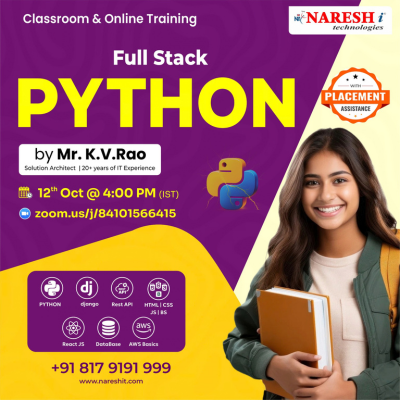
NareshIT Full Stack PYTHON Training supports learners through Python programming foundation, frontend basics, backend development, database connectivity, API learning, authentication concepts, Git and GitHub practice, coding practice, real-time projects, mentor support, lab practice, resume preparation, mock interview support, placement assistance, and Full Stack PYTHON with Gen AI exposure.
This approach helps learners prepare both technical skills and interview communication.
1. How should freshers prepare for Python developer interviews?
Freshers should revise Python basics, practice coding questions, build projects, prepare GitHub, understand databases, and practice explaining project flow.
2. Is coding practice enough for Python interviews?
No. Coding practice is important, but freshers also need project explanation, database knowledge, backend understanding, GitHub, and communication skills.
3. What Python coding questions should freshers practice?
Freshers should practice strings, lists, dictionaries, loops, functions, file handling, OOP, exception handling, and basic problem-solving questions.
4. Why are projects important for Python developer interviews?
Projects prove practical learning. They show how the candidate uses Python programming, frontend, backend, databases, APIs, and real application logic.
5. Should freshers upload projects to GitHub?
Yes. GitHub helps recruiters see project proof, code structure, README files, and practical learning seriousness.
6. Is Full Stack PYTHON with Gen AI useful for interviews?
Yes. Gen AI use cases like chatbots, AI FAQ systems, resume analyzers, and smart search tools can improve project value if explained clearly.
7. What is the best way to explain a Python project?
Explain the project name, purpose, technologies, modules, frontend-backend flow, database usage, your contribution, challenges, and learning outcome.
Preparing for Python developer interviews needs more than reading questions. Freshers must practice coding, build projects, revise concepts, improve GitHub, and prepare clear project explanations.
Python programming gives the foundation. Projects show practical ability. Coding practice builds logic. GitHub creates proof. Mock interviews improve confidence.
A strong PYTHON Course should help learners connect all these areas. With structured Full Stack PYTHON Training, backend practice, database knowledge, real-time projects, and Full Stack PYTHON with Gen AI exposure, freshers can become more interview-ready.
If you are planning to apply for Python developer jobs, start preparing before sending resumes. Practice coding daily. Build projects honestly. Upload them to GitHub. Explain your work clearly. That is how freshers move closer to becoming job-ready Python Developers.
 +91 8179191999

 +91
8179191999
+91
8179191999