.png)
Next Batch : Invalid Date
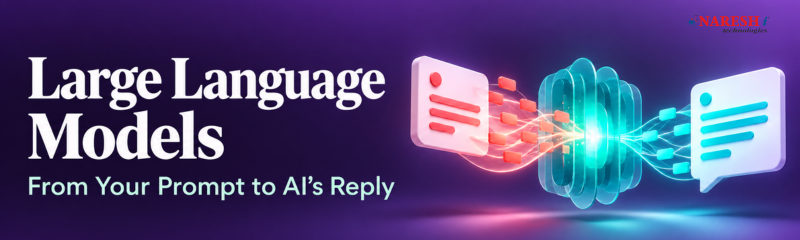
When you ask an AI assistant to explain a programming error, summarize a lengthy document, or draft a response to an email, the system must do more than match your question with a stored answer. It processes your input, uses patterns learned during training, and generates a response one piece at a time.
The technology behind many of these applications is called a Large Language Model (LLM). Understanding how LLMs work helps students and developers distinguish what these systems can do from what they merely appear to understand.
A large language model is an AI system trained on large amounts of data to process and generate language. Most modern LLMs use Transformer-based neural networks to analyze relationships between tokens and predict suitable continuations. They power applications such as AI assistants, document summarization, code generation, translation, and question answering.
Large Language Models are machine-learning systems designed to work with human language by learning statistical patterns from training data. They can generate text, answer questions, summarize documents, translate languages and assist with programming.
The term large generally refers to the scale of the model, its parameters and the data and computation used to develop it. A parameter is a numerical value adjusted during training. The learned parameters influence how the model processes input and produces output.
Popular examples include GPT models, Google's Gemini, Anthropic's Claude and Meta's Llama. They differ in architecture, training methods, capabilities, licensing and deployment options.
LLMs are a major part of generative AI, but the terms are not interchangeable. Generative AI also includes systems that create images, audio, video and other forms of content.
Most modern text-generating LLMs use the Transformer architecture, introduced in the 2017 research paper Attention Is All You Need. Its attention mechanism helps a model identify relationships between different parts of an input.
The process typically involves four stages.
1. Tokenization: The model converts text into tokens. A token may represent a complete word, part of a word or punctuation.
2. Embeddings: Tokens are represented as numerical vectors that the neural network can process. Positional information helps the model account for token order.
3. Attention and neural network layers: Self-attention calculates how tokens relate to other tokens in the available context. Multiple layers process these relationships to build useful representations of the input.

4. Token generation: A generative LLM estimates possible next tokens and selects one according to its decoding strategy. It repeats this process until it produces a response or reaches a stopping condition.
Different Transformer designs serve different purposes.
|
Architecture |
Typical purpose |
Example use |
|
Encoder-only |
Represent and analyze input text |
Text classification |
|
Decoder-only |
Generate text sequentially |
Conversational AI and code generation |
|
Encoder-decoder |
Transform input into output |
Translation and text transformation |
These are common patterns, not strict limits on what a model can do. Actual capabilities depend on training, model design and the surrounding application.
Training teaches a model to recognize patterns in data and produce useful predictions. It generally involves several stages, although the exact process varies between models.
Pre-training: The model learns from large collections of text, code and, in some cases, other data types. A common objective is predicting the next token in a sequence. Repeated prediction errors guide adjustments to the model's parameters.
Post-training: Additional training can improve instruction following, response quality and safety. Methods may include supervised examples and preference-based optimization.
Evaluation: Developers test the model against relevant tasks and assess issues such as factual accuracy, bias, safety and instruction following before deployment.
Training data preparation also matters. Poor-quality, duplicated or biased data can affect model behavior. Developing a large model requires substantial computing resources, and training from scratch is usually beyond the needs of an individual learner.
LLM applications range from simple text assistance to systems connected with databases and business software.
Consider a student building a college helpdesk application. The application could retrieve answers from official college notices and pass relevant passages to an LLM to generate a concise response.
This approach is called retrieval-augmented generation (RAG). Rather than relying entirely on information learned during training, the system retrieves external information at query time and supplies it as context. The developer must still check document permissions, retrieval quality and whether the generated response accurately reflects the source.
An LLM can produce a confident, grammatically correct answer that contains incorrect information. This is commonly called a hallucination.
The reason is that generating plausible text is not the same as verifying facts. A model may misunderstand a question, lack current information, reproduce biases or invent details when the context is insufficient.
Other limitations include:
Developers can reduce some risks through retrieval, validation, access controls, testing and human review. None of these measures guarantees that every answer will be correct.
No. Large Language Models are a category of AI model focused primarily on language, while generative AI also includes systems that create images, audio, video and other content.
No. A basic LLM can generate responses using patterns learned during training and the context supplied in a prompt. Internet search must be provided through a connected search or retrieval tool.
Yes. Beginners can use Python and a model API to create a question-answering application without training a model from scratch. Basic programming, API handling and testing skills are useful starting points.
Fine-tuning updates a model's parameters using additional training data, while RAG retrieves relevant external information and supplies it to the model at query time. RAG is often useful when answers must reflect changing documents.
LLMs can generate incorrect answers because their text predictions do not guarantee factual verification. Ambiguous prompts, missing context, unreliable learned patterns and outdated information can contribute to mistakes.
Large Language Models combine learned language patterns, neural networks and token prediction to generate useful responses across many applications. Their value depends on more than model size: data quality, architecture, evaluation and application design all matter.
A practical starting point for learners is to build a small Python application using an LLM API, then add document retrieval and test how it handles incorrect or incomplete information.
If you were building your first LLM application, would you start with a coding assistant, a document-based chatbot or an AI-powered study tool and why?
 +91 8179191999

 +91
8179191999
+91
8179191999



.png)



.png)
.png)