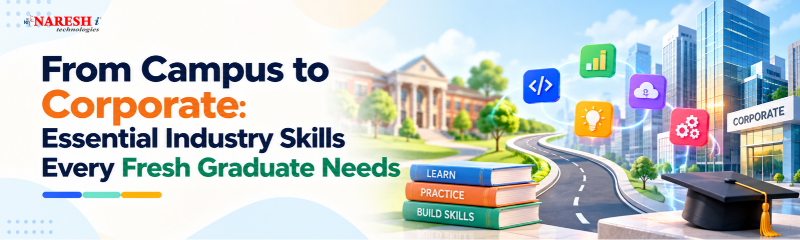
Graduating from college is an important milestone, but entering the workplace introduces a different kind of challenge. Academic knowledge may help a student understand concepts, while employers often want evidence that a candidate can apply those concepts to real problems.
For freshers, becoming employable is therefore not only about learning another programming language or adding certificates to a resume. The most valuable industry skills for fresh graduates combine technical ability, problem-solving, communication, practical exposure, and the willingness to keep learning.
The World Economic Forum identifies analytical thinking as one of the most important workforce skills, while AI, big data, cybersecurity, and technological literacy are among the areas expected to grow rapidly in importance.
College assignments usually have defined questions, deadlines, and expected outcomes. Workplace problems are rarely that predictable.
A developer may receive an incomplete requirement. A Data Analyst may discover missing records. A tester may need to reproduce an issue reported by a customer. A DevOps engineer may investigate why an application works locally but fails after deployment.
Industry readiness means being able to examine such situations, ask useful questions, choose appropriate tools, and work toward a solution.
This is also why employers increasingly evaluate candidates by what they can demonstrate rather than relying entirely on qualifications or job titles.
LinkedIn's 2026 skills research points to rising demand for AI-related capabilities alongside collaboration, stakeholder communication, and leadership-oriented skills.

The exact technical stack depends on the role, but several foundations are useful across software careers.
Freshers should understand at least one programming language, databases, Git, basic APIs, debugging, operating systems, and fundamental software development concepts.
For example, someone preparing for development roles through a Java Full Stack Developer Course or Python Full Stack Developer Course should go beyond syntax. They should know how the frontend communicates with the backend, how data is stored, how APIs work, and how an application can be tested and deployed.
Similarly, a learner exploring Generative AI & Agentic AI with Python should understand Python fundamentals, APIs, data handling, prompts, model limitations, and basic application architecture rather than depending entirely on generated code.
Knowing commands is useful. Knowing when and why to use them is more valuable.
Suppose a Python program produces incorrect customer totals. A job-ready fresher should be able to inspect the input, trace the logic, test edge cases, identify the error, and explain the correction.
That process demonstrates analytical thinking, debugging, attention to detail, and communication at the same time.
Freshers can strengthen these abilities through:
A project does not need to be large. A working application that you understand completely is usually more useful for interviews than a complex project copied without understanding.
|
Academic or Basic Skill |
Industry-Ready Application |
|
Learning Python syntax |
Building and debugging an application |
|
Writing SQL queries |
Analysing real datasets and validating results |
|
Learning Java |
Developing APIs and database-connected applications |
|
Studying testing concepts |
Writing test cases and reporting defects |
|
Learning cloud concepts |
Deploying and monitoring an application |
|
Studying AI models |
Building responsible AI-assisted workflows |
The skills required for a data analyst fresher commonly include Excel, SQL, data cleaning, visualisation, basic statistics, and tools such as Power BI or Python. Data storytelling is also becoming increasingly relevant in India's skills landscape.
Important skills required for a data scientist fresher include Python, statistics, SQL, data preprocessing, machine learning fundamentals, model evaluation, and clear communication of findings.
A structured Data Science Course can provide direction, but practical notebooks, datasets, experiments, and projects are what demonstrate understanding.
Freshers considering a Full Stack Software Testing Course should learn manual testing, test-case design, SQL, APIs, defect tracking, automation fundamentals, and the software development lifecycle.
For learners considering DevOps with Multicloud Training, useful foundations include Linux, Git, networking, CI/CD, containers, cloud platforms, monitoring, and automation.
Technical knowledge alone does not make someone effective at work.
Fresh graduates should learn to explain a problem clearly, write useful emails and documentation, participate in team discussions, accept feedback, and communicate progress.
These abilities become especially important when developers, testers, analysts, designers, and business teams work together.
Resilience, flexibility, curiosity, creative thinking, and lifelong learning are also expected to remain increasingly important as technology continues to change.
When adding technical skills in a resume for freshers, avoid creating a long list of tools you have barely used.
Instead, connect skills to evidence.
For example:
Whether you learn through a Python Programming Course or independent practice, recruiters should be able to see what you can actually do with the skill.

Technical fundamentals, problem-solving, communication, teamwork, adaptability, project experience, and continuous learning are among the most valuable skills.
Add only skills you can demonstrate, such as Python, Java, SQL, Git, APIs, cloud tools, testing, data analysis, or relevant frameworks.
Yes. Projects provide practical evidence that you can apply concepts, solve problems, use tools, and explain your work.
SQL, Excel, data cleaning, visualisation, basic statistics, Power BI or similar BI tools, and communication are useful starting skills.
Yes. Technical professionals regularly explain problems, discuss requirements, document work, collaborate with teams, and communicate solutions.
The transition from campus to corporate is not about knowing everything before your first job. It is about proving that you can learn, apply knowledge, solve unfamiliar problems, communicate clearly, and improve through feedback.
Fresh graduates who combine technical foundations with projects, problem-solving, communication, and adaptability are better prepared for changing technology roles.
Discussion Question: Which skill do you think fresh graduates struggle with most technical knowledge, practical experience, problem-solving, or communication?
 +91 8179191999

 +91
8179191999