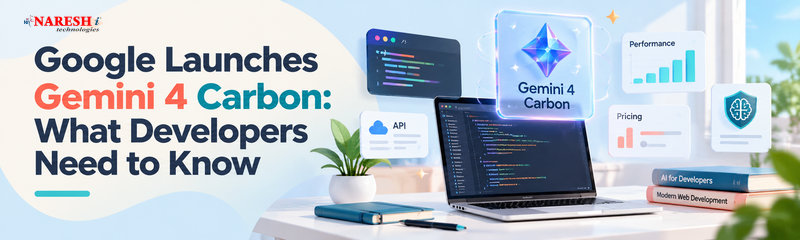
Google has unveiled Gemini 4 Carbon, an AI model developed to address demanding software development tasks and advanced cybersecurity problems.Announced on October 28, 2026, the model focuses on tasks that require more than generating a short code snippet, including identifying software vulnerabilities, fixing bugs, and managing lengthy engineering workflows.
For students, freshers, and experienced developers, this announcement raises an important question: Will AI models like Gemini 4 Carbon change how software is developed, tested, and secured? As artificial intelligence reshapes software development, staying informed about new technologies can help aspiring developers identify and learn the technical skills relevant to evolving industry requirements.
Google DeepMind developed Gemini 4 Carbon to assist with sophisticated software engineering, demanding programming challenges, and cybersecurity tasks. According to the announcement, the AI model is built to work through complex assignments that require a series of actions, careful evaluation, and repeated improvements before reaching a solution.
Unlike a coding assistant used mainly to generate functions or explain syntax, Carbon is designed to work through difficult engineering problems over extended periods. According to Google, internal teams have used it to investigate subtle bugs across large codebases and develop fixes for underlying problems.
However, there is an important limitation. At launch, Google is providing access to a selected group of cybersecurity defenders through its Fairwind Program. Wider availability to developers, businesses, and consumers is planned for a later stage.

Gemini 4 Carbon can analyze challenging software issues, identify their underlying causes, and suggest possible solutions to resolve them. For example, a developer working on a large Python application could use an AI model to investigate why an API request fails under certain conditions.
Instead of offering only a code modification, the model is designed to assess the entire issue, determine what is causing it, and propose an appropriate way to fix it.
Cybersecurity is one of Carbon's main areas of focus. Google reports improvements in finding vulnerabilities, evaluating whether they can be exploited, and creating patches to address them.
For security teams, such capabilities could support code reviews, vulnerability assessments, and remediation workflows. Specialists should carefully review and authorize security-related modifications before those changes are applied to production systems.
Carbon is built to handle tasks involving multiple stages rather than stopping after one response. This process may involve identifying a software defect, reviewing connected modules, developing a suitable correction, and testing the changes to ensure they do not create additional issues.
This capability benefits AI agents by enabling them to perform a series of coordinated tasks in a structured manner to reach a specific outcome. Developers must still establish permissions, testing procedures, and checkpoints to keep automated work within acceptable boundaries.
Google introduced Gemini 4 Carbon after launching Gemini 4 Argon earlier in October 2026. Both target demanding tasks, but Carbon places particular emphasis on cybersecurity and sustained engineering work.
|
Feature |
Gemini 4 Carbon |
Gemini 4 Argon |
|
Main emphasis |
Advanced coding and cybersecurity |
Complex coding, reasoning, and broader professional tasks |
|
Vulnerability analysis |
A major focus |
General frontier-model capabilities |
|
Long-running tasks |
Designed for sustained engineering workflows |
Built for complex, multi-step tasks |
|
Initial access |
Selected cybersecurity defenders |
Available through supported Google AI platforms |
|
Developer availability |
Wider access planned |
API access announced as generally available |
The main distinction lies in their primary focus, rather than any inability of Argon to handle programming or cybersecurity-related tasks. Developers should evaluate both models against their own requirements when access to Carbon becomes available.
Although general access remains limited, developers can prepare for similar AI-assisted workflows through practical projects.
Useful tools to explore include Git, GitHub, pytest, SonarQube, and dependency-scanning tools. These technologies help developers understand the software development and testing processes that advanced AI models may assist with.
Students do not need to wait for Gemini 4 Carbon to become widely available before preparing for AI-assisted software development.
Start with programming fundamentals in Python, Java, or JavaScript. Learn data structures, algorithms, databases, APIs, Git, debugging, and software testing. For cybersecurity-oriented roles, add secure coding practices, authentication, access control, and vulnerability assessment.
Most importantly, learn to verify AI-generated code. A solution that appears correct may contain hidden bugs, insecure assumptions, or performance problems. Developers who can explain, test, and maintain their code will be better prepared to work with increasingly capable AI systems.
Gemini 4 Carbon is Google's AI model announced on October 28, 2026, with a focus on complex coding, long-running engineering tasks, and cybersecurity.
No. Its initial rollout is limited to selected cybersecurity defenders through Google's Fairwind Program. Broader developer access is planned.
Carbon places greater emphasis on cybersecurity and sustained engineering workflows, while Argon supports a broader range of complex coding, reasoning, and professional tasks.
Google reports that Carbon can identify vulnerabilities, evaluate exploitability, and generate patches. Developers must still validate findings and test fixes before deployment.
Students should build strong programming, debugging, testing, database, Git, and secure coding skills. Understanding how to verify AI-generated solutions is equally important.

Gemini 4 Carbon signals Google's continued investment in AI systems that can contribute to complex engineering and cybersecurity work. Its focus extends beyond code generation to investigating problems, proposing fixes, and supporting extended workflows.
For students and developers, the practical takeaway is straightforward: strengthen programming fundamentals, gain project experience, and learn to test AI-generated solutions carefully. AI tools can accelerate parts of development, but sound engineering judgment remains essential.
Discussion question: Do you think AI coding models will become essential tools for freshers entering the software industry, or will employers place even greater importance on independent coding skills?
 +91 8179191999

 +91
8179191999