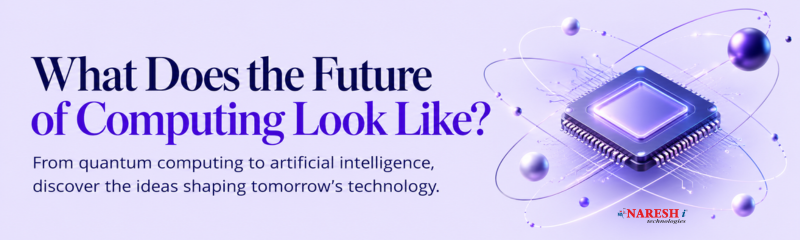
What is quantum computing? It's a way of processing information using the unusual behaviour of tiny physical systems, such as atoms and superconducting circuits. Instead of relying entirely on ordinary binary bits, quantum computers use qubits. These machines could eventually tackle certain scientific and mathematical problems that are extremely difficult for conventional computers.
That sounds exciting. But does it mean your laptop will soon become outdated? Not quite.
Most things we do on computers don't need quantum technology. Sending emails, watching videos, developing websites, and running business software are jobs conventional machines already handle well.
The interesting question is what happens when even powerful supercomputers struggle with a particular calculation.
Imagine trying to predict how a new molecule will behave.
For a small molecular system, researchers can often perform detailed calculations using existing computers. As the system becomes more complicated, accurately describing the interactions between its electrons can demand enormous computing resources.
There's a reason scientists are interested in quantum machines: molecules themselves obey quantum physics.
A computer built around quantum principles may be better suited to simulating certain quantum systems.
That doesn't guarantee every chemistry problem will become easy. Researchers still have to develop suitable algorithms and machines capable of running them accurately.
Still, molecular simulation offers a useful explanation of why this field exists. Quantum computers aren't being developed merely to make ordinary programs run faster.
To understand the basics, start with something familiar: the bit.
Your computer stores information using bits represented by either 0 or 1.
A quantum computer uses a different unit called a qubit.
A qubit can be prepared in a superposition involving the states labelled 0 and 1.
Here's the important detail: measuring a qubit produces a definite outcome. You don't receive both values on your screen.
What makes quantum computation interesting is how qubits behave before measurement.
Quantum operations manipulate their probability amplitudes, allowing carefully designed algorithms to produce useful results.
Superposition makes it possible to prepare quantum states that differ from ordinary binary states.
Entanglement introduces another property. Two or more qubits can share a joint quantum state that cannot be described by assigning each qubit a separate independent state.
Quantum algorithms can use these relationships, together with interference, to change the probabilities of measurement outcomes.
For beginners, it's enough to understand that quantum superposition and entanglement are physical properties, not shortcuts that magically solve every calculation.
The distinction becomes easier when you compare how each machine operates.
|
Question |
Classical Computer |
Quantum Computer |
|
What stores information? |
Bits |
Qubits |
|
How are calculations performed? |
Classical logic operations |
Quantum gates and measurements |
|
What hardware is used? |
Conventional electronic processors |
Specialized quantum devices |
|
What is it useful for? |
General-purpose computing |
Selected research and computational problems |
|
How mature is the technology? |
Widely deployed and reliable |
Still developing, with substantial engineering challenges |
The quantum computing vs classical computing debate often creates the wrong impression.
A quantum processor isn't a direct replacement for your CPU.
In fact, quantum systems rely heavily on classical computers to prepare instructions, control hardware, and interpret results.
The two approaches are expected to work together.
Some quantum computing applications are easier to understand through practical problems.
Drug researchers study how molecules interact with biological targets.
Quantum simulation could eventually improve calculations involving molecular behaviour. That might support certain stages of drug and materials research.
However, discovering a useful molecule still requires laboratory experiments, clinical evaluation, and extensive testing.
Transport companies regularly face difficult scheduling and routing decisions.
Researchers are investigating quantum approaches to optimization, but there's no general proof that today's quantum computers outperform established classical optimization methods.
This is one area where preparation is already underway.
Large, fault-tolerant quantum computers could threaten certain public-key encryption methods used to protect digital communications.
That's why organizations are preparing for post-quantum cryptography.
The National Institute of Standards and Technology finalized its first three principal post-quantum cryptography standards in 2024. These standards are intended to protect information against future quantum attacks.
One of the toughest problems in this field is keeping quantum information reliable.
Qubits are sensitive to noise. A small disturbance can introduce errors into a calculation.
Google's Willow processor provided an important example of research progress.
In research published in Nature in 2025, the team demonstrated improved logical error suppression as the size of a quantum error-correcting code increased. The reported suppression factor was approximately 2.14 for each increase of two in code distance.
That result concerned quantum error correction. It didn't mean the processor could suddenly run every useful quantum application.
IBM, meanwhile, continued developing its quantum computing roadmap.
Its March 2026 roadmap included a target for the Starling system in 2029, with 200 logical qubits and the ability to execute circuits containing 100 million quantum gates.
Those figures are planned capabilities, not proof that the system has already been delivered.
The larger story from 2025 - 2026 is about improving error correction, hardware, and the ability to run increasingly demanding quantum circuits.
Building a qubit is one challenge. Keeping many qubits working together accurately is another.
Some quantum processors operate at temperatures close to absolute zero. Other approaches use trapped ions or neutral atoms controlled through specialized equipment.
Engineers also have to address unwanted interactions, imperfect quantum gates, and measurement errors.
Quantum error correction can protect information by encoding logical qubits across multiple physical qubits. But that protection requires additional resources.
These limitations explain why promising laboratory results don't immediately become commercial applications.
The future of quantum computing depends on whether researchers can scale reliable systems and demonstrate advantages on useful, real-world workloads.
You don't need a laboratory or expensive hardware to explore the subject.
For quantum computing for beginners, a sensible learning plan looks like this:
Qiskit is one option for experimenting with quantum circuits in Python.
As you progress, you can explore quantum algorithms, simulation, and error correction.
For software developers, this is a useful way to investigate a research-oriented field without committing immediately to specialized hardware engineering.
No. Quantum computers offer theoretical or demonstrated advantages for particular tasks, not universal speed improvements across all software.
No. You can begin with introductory concepts, but linear algebra, complex numbers, and probability become important as you study circuits and algorithms.
Yes. Students can practise using quantum simulators and explore cloud-accessible quantum computing platforms, subject to provider availability and access conditions.
Yes, researchers are exploring quantum machine learning, although broad practical improvements over classical AI methods remain unproven.
Quantum computing already supports specialized research and engineering work, but the pace of career growth remains uncertain. Students can prepare through programming, mathematics, and quantum computing fundamentals.
Quantum computing deserves attention because it offers a different way to approach problems that challenge conventional computing.
But its potential shouldn't be confused with what today's hardware can reliably deliver.
If you're curious about the field, start by building a simple quantum circuit. Seeing how qubits behave in a simulator will teach you more than memorizing predictions about the next breakthrough.
Discussion Question: If you could use quantum computing for one serious problem, would you explore molecular research, cybersecurity, or complex optimization and why?
Follow NareshIT for practical insights on technology, skills, and career development.
 +91 8179191999

 +91
8179191999