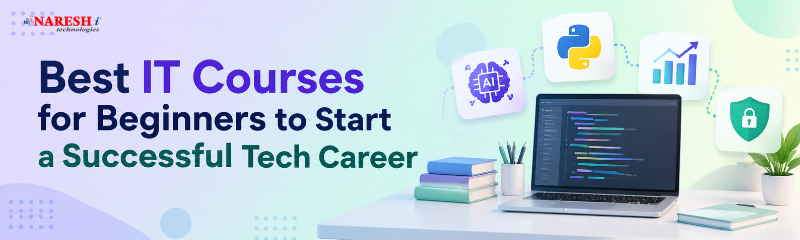
Starting a technology career can be confusing when numerous courses promise exciting opportunities. Should you learn Python, explore Artificial Intelligence, study Cyber Security, or choose software development?
The best IT courses for beginners help students develop technical knowledge, practical skills, and confidence. Whether you come from an IT or non-IT background, selecting a course based on your interests and career goals can make your learning journey more effective.
Before enrolling, identify your interests and strengths. Programming suits logical thinkers, Data Science appeals to analytical learners, and Cyber Security attracts those interested in protecting digital systems.
The most useful job oriented IT courses combine foundational knowledge, practical assignments, industry tools, and real-world projects.

Python is an accessible programming language for beginners because of its readable syntax and broad applications.
A Python Programming Course covers variables, loops, functions, object-oriented programming, file handling, and database fundamentals.
Students can create calculators, expense trackers, or automation scripts.
Python also supports career development in backend programming, Data Science, Artificial Intelligence, and automation.
Generative AI creates text, code, and other content, while Agentic AI can plan tasks, use tools, and execute workflows within defined boundaries.
A Generative AI & Agentic AI with Python course may cover language models, prompt engineering, APIs, Retrieval-Augmented Generation (RAG), and AI agents.
For example, learners can develop an intelligent document assistant that retrieves information and answers questions.
Basic Python knowledge is recommended before attempting advanced AI development.
Full Stack Data Science focuses on collecting, processing, analysing, and interpreting information.
Beginners learn Python, SQL, statistics, data visualization, machine learning, and model deployment.
A practical project might involve analysing sales records to identify purchasing trends.
This learning path suits students interested in data analysis, predictive modelling, and evidence-based decision-making.
Cyber Security involves protecting computers, applications, networks, and information from unauthorized access and digital threats.
Beginner courses typically introduce networking, Linux, security fundamentals, vulnerability assessment, and incident response.
Students can practise analysing network traffic, identifying suspicious activity, and examining security weaknesses in authorized environments.
Cyber Security offers pathways into security operations, network security, and ethical hacking.
Beginner software development courses teach students to create functional websites and applications.
Common subjects include HTML, CSS, JavaScript, frontend frameworks, backend programming, databases, and APIs.
Students might develop an online shopping website or student management application.
Building complete projects strengthens coding, debugging, database integration, and problem-solving abilities.
A Forward Deployed Engineer (FDE) Course introduces learners to developing and implementing software solutions for specific business challenges.
Forward Deployed Engineers work with customers to understand requirements, integrate applications, and deploy technical solutions.
Important skills include Python, SQL, APIs, cloud computing, system integration, and communication.
For example, an FDE may connect an AI assistant with a company's internal customer database.
Since FDE roles often require substantial engineering knowledge, beginners should first develop programming fundamentals and practical project experience.
|
Course |
Key Skills |
Career Direction |
|
Python |
Programming, APIs |
Software Developer |
|
Generative AI & Agentic AI |
Python, LLMs, RAG |
AI Developer |
|
Full Stack Data Science |
SQL, Python, ML |
Data Analyst |
|
Cyber Security |
Networking, Linux |
Security Analyst |
|
Full Stack Development |
JavaScript, databases |
Web Developer |
|
FDE |
APIs, cloud, integration |
Forward Deployed Engineer |
Students exploring IT courses online for beginners can consider foundational certifications such as Microsoft Azure Fundamentals or AWS Certified Cloud Practitioner.
However, IT certifications for beginners cannot replace practical experience.
For students researching IT courses for non IT students, Python programming and introductory computing courses provide useful starting points.
Building projects, practising technical interviews, and maintaining a GitHub portfolio can strengthen career preparation.
Python Programming is a practical choice because it introduces coding fundamentals and supports multiple technology career paths.
Yes. Students from non-IT backgrounds can learn programming through structured lessons, regular practice, and beginner-friendly projects.
Yes. Beginners can study AI fundamentals, but developing AI applications requires programming knowledge and practical experience.
FDE roles commonly require programming, APIs, databases, cloud computing, software integration, and strong communication skills.
Career opportunities depend on market demand, individual skills, project experience, and interests rather than the course title alone.

Choosing the right IT course begins with understanding your interests and learning goals.
Python develops programming skills, Data Science builds analytical abilities, Cyber Security introduces digital protection, and Generative AI supports intelligent application development. Full Stack Development strengthens application-building skills, while Forward Deployed Engineering connects software expertise with business requirements.
Focus on mastering fundamentals, completing meaningful projects, and developing practical skills instead of collecting certificates without experience.
Discussion Question: Which IT career path interests you most Python, Generative AI, Data Science, Cyber Security, Full Stack Development, or FDE?
 +91 8179191999

 +91
8179191999