.png)
Next Batch : Invalid Date
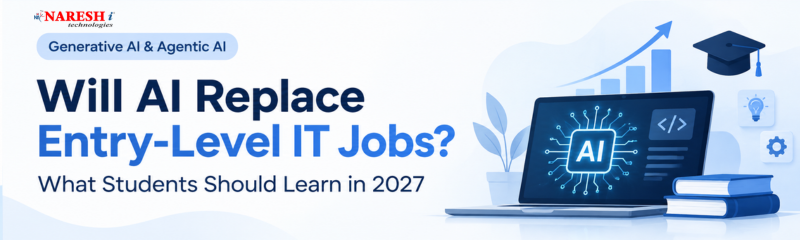
A final-year student scrolls through news about Indian IT hiring and sees two stories. One company is pausing fresher targets. Another is reaffirming 20,000 campus hires. Both are real, and the gap between them is exactly what students need to understand before choosing what to learn.
The practical question is not whether AI will “replace IT jobs.” It is which entry-level work is shrinking, where new openings are appearing, and which Generative AI & Agentic AI skills make a fresher useful from the first week. The figures below come from recent company statements and industry reports as of October 2026, and they should be read as signals, not forecasts.
The picture for the future of IT jobs in India is uneven. Infosys has said it will keep its campus target of roughly 20,000 freshers for FY27, and its CEO described AI as a productivity tool, not a replacement for engineers. Wipro’s HR head said the company has no fresher hiring target for FY27 and will decide based on demand. TCS has reportedly issued about 25,000 fresher offers for the year, described as a slow start.
Industry-wide data leans cautious. An IT-BPM workforce outlook projects net additions below 70,000 in the first half of FY27, down from roughly 95,000 a year earlier, and expects hiring to stay subdued through 2027 unless technology spending rebounds. The same report notes that employers increasingly expect graduates to show practical experience with AI-assisted development before they join. Meanwhile, another report cites AI hiring in India up about 59.5% year on year.
In short, volume hiring is under pressure, and AI-skilled hiring is growing.
AI tools now draft boilerplate code, simple tests, documentation and first-line support replies. Those tasks once trained freshers, and companies need fewer people doing them manually. The AI impact on entry-level IT jobs shows up less as layoffs and more as higher expectations and tighter selection.
The task that remains valuable is verification. Someone has to confirm that generated code is correct, tests reflect real behaviour, and answers sent to customers are accurate. The entry-level role is moving from writing first drafts to checking and improving them.

Large IT services firms are shifting toward specialised hiring. According to a hiring-platform executive, specialised roles in AI, cybersecurity, cloud and data engineering make up about 30–40% of campus hiring and may rise to 45–55% in FY27. The same source says select AI-focused skill sets now command ₹15–16 LPA, compared with around ₹6 LPA for earlier “digital” tracks, though pay claims like these vary by employer.
Forward Deployed Engineer roles are also in the news. TCS and Infosys have reportedly spoken of hiring thousands of them over the next few years, meaning developers who solve client problems using AI. Generative AI careers at entry level include AI application development, ML engineering and AI-assisted data analysis, and Agentic AI skills matter wherever teams deploy agents that call tools and finish multi-step tasks.
|
Skill |
Why it matters |
Starter project |
|
Python and SQL |
Base for data and AI work |
Clean a messy dataset and query it |
|
Git, testing and code review |
Someone must verify AI-written code |
Add tests to code an AI generated |
|
LLM APIs and RAG |
Core of most Generative AI applications |
A question-answering app over your notes |
|
Tool calling and agents |
How agentic systems take actions |
A small agent with step limits and logs |
|
Evaluation and guardrails |
Shows whether AI output can be trusted |
A 30-question scored test set |
|
Cloud and deployment basics |
Employers want production-ready skills |
Deploy your app in a container |
|
Communication |
Explains decisions to non-engineers |
A README and a short demo video |
AI skills for freshers sit on top of fundamentals, not instead of them. Data structures, databases and basic networking help you notice when a tool gives a wrong answer.
Interviewers increasingly ask you to walk through a project. Describing what broke, how you measured it and what you changed carries more weight than a list of tool names.
No, but it is shrinking routine tasks and making hiring more selective and skills-focused.
It is mixed, with Infosys planning about 20,000 freshers for FY27, Wipro holding no fixed target, and an industry outlook expecting subdued net hiring through 2027.
Python, SQL, Git and testing, followed by LLM APIs and retrieval-based applications.
They are not required everywhere, but they are increasingly relevant as firms plan large intakes for AI-focused deployment roles.
No, because employers look for projects that prove you can build, test and explain working systems.

AI is not erasing entry-level IT work so much as raising its floor. Students who can build, verify and explain AI-assisted systems will stand out in a selective market. For your next step, build a small question-answering app over your own notes this month and write a one-page report on how you tested it.
If you were graduating in 2027, would you spend the next six months deepening core coding skills or building an AI agent project, and why?
Follow NareshIT for more practical insights on technology, skills, and career development.
 +91 8179191999

 +91
8179191999
+91
8179191999



.png)

.png)
.png)