.png)
Next Batch : Invalid Date
Picture two friends who graduate together. The first joins the first AI program that shows up in her feed, pays a hefty fee, and ends up with a certificate but no projects. The second reads the admission rules, compares prices, and builds a small application while he studies. A year on, only one of them has something real to put in front of an interviewer.
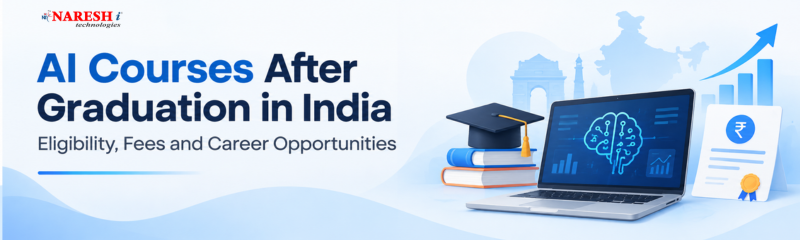
The market for AI courses after Graduation in India is wide, with options from free online classes to postgraduate programs costing several lakh rupees. This guide covers who qualifies, what the programs typically cost, which skills lead to work, and how to pick wisely. Rules and prices change often, so check current details with each institute before applying.
|
Route |
Who usually qualifies |
Length |
Reported fees |
|
Free or low-cost online courses (NPTEL, NIELIT and similar) |
Most graduates; basic maths helps |
Weeks to months |
Free to a few thousand rupees |
|
PG diploma or certificate (online or hybrid) |
A bachelor’s degree; some programs ask for about 55% in engineering, science, economics or related fields |
6 to 24 months |
Roughly ₹75,000 to ₹3.25 lakh |
|
IIT and IIIT executive programs |
A degree, sometimes plus an entrance test |
Several months to two years |
From about ₹2 lakh upward |
|
M.Tech in AI |
An engineering degree, usually with an entrance exam |
Two years |
Differs by institute |
Eligibility depends on the specific program, not on the words “AI course” in its name. IIT Kanpur’s online PG diploma, for instance, admits students through an entrance test or particular degree routes, while many other online PG programs welcome graduates from different fields. A commerce or arts graduate has choices, but should plan to learn Python first.
Prices span a wide range. An eight-month executive certificate from IIT Kharagpur is listed at ₹1,99,000, and IIT Kanpur’s online PG diploma is priced per credit at ₹5,000. Some short diplomas cost only a few thousand rupees, while premium business-school certificates in AI strategy can reach several lakh for a few months of study.
A higher price does not guarantee a better result. Before paying, confirm:

Many AI job descriptions in 2026 look for people who can build applications on top of language models, not only train classical models. Generative AI & Agentic AI with Python suits that demand for three reasons.
Python is the field’s working language. Libraries for language models, retrieval and agents arrive for Python first, so a single language carries you from data handling to a deployed application.
It welcomes varied backgrounds. You can build something useful, such as a tool that answers questions from documents, without a research background. Graduates in business, commerce and science can combine it with their own subject knowledge.
It creates visible proof of skill. A small agent that reads a spreadsheet, calls a tool and writes a summary is simple to demonstrate and easy to discuss in an interview.
A solid syllabus covers Python and data handling, LLM APIs and prompting, retrieval-based applications, tool calling and agents, evaluation, and basic deployment. If a course lists tool names but no projects, ask how you will practise.
Graduates commonly aim for roles such as:
Hiring in this area is uneven. Reports show rising demand for AI and ML positions alongside weaker routine IT hiring, so your skills and projects count for more than a course title. Pay differs by employer and experience, and no program can guarantee a specific package or placement.
Yes, many online programs accept graduates from varied backgrounds, though most expect you to learn basic Python.
Prices run from free to several lakh rupees, with PG diplomas commonly quoted between ₹75,000 and ₹3.25 lakh.
No, because employers look for projects and proof that you can build and test working systems.
In practice yes, since most frameworks and learning material for these areas are Python-based.
It depends on where you start, but several months of steady project work is a reasonable aim for a basic portfolio.

The best AI course after graduation is the one that fits your background and budget and leaves you with working projects. Generative AI & Agentic AI with Python is a practical focus because it turns study into applications you can demonstrate. For your next step, shortlist three courses, compare their syllabi with the skills above, and build a small Python project before paying for any of them.
If you were choosing today, would you pick a lower-cost course and spend the savings on your own projects, or a premium program with a well-known name, and why?
Follow NareshIT for more practical insights on technology, skills, and career development.
 +91 8179191999

 +91
8179191999
+91
8179191999

.png)
.png)
.png)