.png)
Next Batch : Invalid Date
From answering questions to actually finishing the task what every developer, fresher, and career switcher needs to understand about the next phase of AI in software.
A few years ago, "using AI in development" meant pasting an error message into a chatbot and copying back a fix. That workflow is already starting to look outdated. Developers today are working alongside systems that don't just answer questions they plan a task, write code, run it, check the output, and fix their own mistakes without being asked twice.
This shift has a name: Agentic AI. It's not a rebrand of the chatbot you already know. It's a different way of building software, and it's changing what "knowing how to code" actually means for students, freshers, and working professionals alike.
If you've felt like the ground keeps shifting under the "learn to code" advice you got a year ago, you're not imagining it. In this article, we'll break down what agentic AI really is, how it works, where it fits into real development workflows, and what you should actually do about it.
Table of Contents
1. What Does "Agentic AI" Actually Mean?
A chatbot answers. An agent acts.
When you ask a chatbot a question, it gives you a response and stops. It has no memory of what happened after, no ability to check if its answer worked, and no way to take a next step on its own. You are the one connecting the dots copying code, running it, reporting the error back, and asking again.
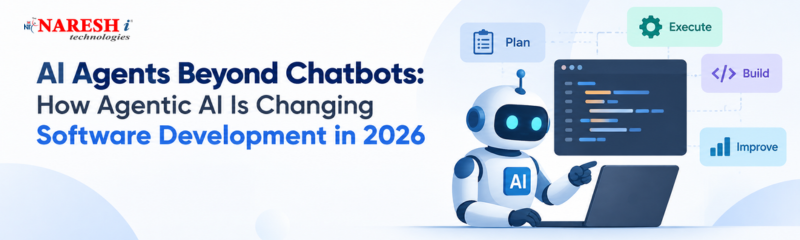
An AI agent is built differently. It's given a goal, not just a question, and it has access to tools a code editor, a terminal, a browser, a database, an API. It breaks the goal into steps, uses tools to complete each step, observes the result, and adjusts its plan if something fails. It keeps going until the goal is met or it needs your input.
In short:
This loop plan, act, observe, adjust is the core idea behind almost every agentic system you'll encounter, whether it's an AI coding assistant, a customer-support agent, or a research tool.
Software teams have always had more work than hands to do it. Writing boilerplate, fixing repetitive bugs, writing tests, updating documentation, migrating old code none of it is exciting, but all of it has to happen before the interesting work can start.
Agentic AI is being adopted specifically to absorb that category of work. Not because it "writes code," but because it can carry out a multi-step task from start to finish with far less hand-holding than a simple autocomplete or chatbot.
Ask yourself: how much of your last coding task was actually hard, versus how much was mechanical renaming variables across files, writing similar test cases, wiring up a new API endpoint the same way you wired up the last five? That mechanical layer is exactly where agents are proving useful.
3. The Real Problem Agentic AI Solves
Traditional automation (scripts, CI/CD pipelines, macros) is fast but rigid it only works when the situation matches exactly what it was programmed for. Chatbots are flexible but passive they can reason about almost anything, but they can't act on their own.
Agentic AI sits in between: it has the flexibility to reason about a novel situation, and the ability to actually carry out actions using real tools. That combination solves a problem neither older approach could:
| S.No | Approach | Can reason about new situations | Can take multi-step action | Needs constant supervision |
| 1 | Traditional scripts/automation | No | Yes (fixed steps only) | No, but breaks on change |
| 2 | Chatbot (Q&A style) | Yes | No | Yes, for every step |
| 3 | Agentic AI | Yes | Yes | Only at checkpoints |
This is why agentic AI is being discussed as a shift in how software gets built, not just another tool added to the stack.
4. How an AI Coding Agent Actually Works
Here's a simplified version of the loop running behind tools like autonomous coding assistants:
Python:
def run_agent(goal, tools, max_steps=10):
    plan = create_initial_plan(goal)
    memory = []

    for step in range(max_steps):
        action = decide_next_action(plan, memory)

        if action.type == "ask_human":
            return request_clarification(action)

        result = execute(action, tools)      # e.g. run_code(), edit_file(), call_api()
        memory.append((action, result))

        if goal_achieved(memory, goal):
            return "Goal completed", memory

        plan = revise_plan(plan, memory)      # adjust if something failed

    return "Max steps reached, needs review", memory
Notice what's happening: the agent doesn't just generate an answer once. It executes, checks the result, and revises the same debugging instinct a human developer uses, just automated and repeated quickly. This is why an agent can, for example, write a function, run the test suite, see two tests fail, read the error, patch the code, and re-run all before a human even looks at it.
5. Key Components Behind Agentic Systems
To actually understand and work with these systems, a few building blocks matter:
You don't need to master all of these overnight, but recognizing them will help you evaluate any "AI agent" tool you come across including the ones your company might adopt this year.

6. A Realistic Workplace Scenario
Imagine a mid-level developer is asked to add a "password reset" feature to an existing web app. With an agentic setup, the workflow might look like this:
The developer's job shifts from typing every line to reviewing, guiding, and approving closer to being a technical lead for a very fast, very literal junior engineer.
7. Benefits and Limitations
Benefits:
Limitations worth taking seriously:
Agentic AI reduces manual effort; it does not remove the need for engineering judgment.
8. Common Mistakes and Misconceptions
"Agents will replace developers." What they replace is a category of tasks, not the role. Someone still has to define the goal correctly, review the output, and own the outcome.
"You can just give it a vague instruction and walk away." Agents perform in proportion to how clearly the goal and constraints are defined. A vague prompt produces a vague sometimes wrong result.
"It's the same as using a chatbot, just faster." The difference isn't speed; it's the ability to act, observe results, and self-correct without you relaying every step manually.
9. What Should You Actually Learn?
For students and freshers, the fundamentals haven't changed you still need to understand data structures, how APIs work, and how to read and reason about code, because you'll be reviewing agent-generated output, not just writing everything yourself.
For working professionals and career switchers, the additional skills worth building are:
10. Career and Industry Relevance
Job descriptions are already starting to mention comfort with "AI-assisted development" or "working alongside AI agents" as a practical skill, not a novelty. This doesn't replace core computer science knowledge it sits on top of it. A developer who understands both the fundamentals and how to direct an agent effectively is more valuable than either skill alone.
For freshers entering the market: expect interviews and take-home tasks to increasingly assess how well you review and reason about code, not just how fast you can produce it from scratch.
11. Future Outlook
It's reasonable to expect agentic AI to become a standard part of the development toolchain the way version control or CI/CD pipelines did not something separate you "use sometimes," but a default part of how work gets done. What's harder to predict is exactly which tasks stay firmly human. Architecture decisions, security judgment calls, and understanding business context are likely to remain squarely in human hands for the foreseeable future.
Where do you think the line will land which parts of development do you believe should always stay human-led?
12. Practical Next Steps
13. Frequently Asked Questions
1. What's the difference between AI agents and chatbots?
A chatbot only answers; an agent plans, acts, checks results, and adjusts until the task is done.
2. Will agentic AI replace developers?
No. It replaces repetitive tasks, not the need for judgment, review, and ownership.
3. Do I need to learn a new language for this?
No. Focus on strong fundamentals plus clear task-writing and code review skills.
4. Is this only for experienced developers?
No. Freshers benefit by learning to review and reason about AI-generated code early.
5. What tasks can AI agents actually handle?
Boilerplate code, tests, debugging, documentation, and small well-defined features.
6. Can agents safely touch production code alone?
Not without human checkpoints risky actions still need review and approval.
7. How do I start learning this?
Try one agentic tool on a real small task and review its output carefully.
Conclusion
Agentic AI isn't just a smarter chatbot it's a shift from AI that answers to AI that acts, plans, and adjusts. The developers who benefit most won't be the ones who avoid it or the ones who blindly trust it, but the ones who learn to direct it clearly and review it critically.
Takeaway: Start small. Give an agentic tool one real, well-defined task this week, and pay close attention to where it succeeds and where it needs your judgment. That's the fastest way to actually understand this shift instead of just reading about it.

Follow NareshIT for more practical insights on technology, skills, and career development.
 +91 8179191999

 +91
8179191999
+91
8179191999



.png)






.png)