Next Batch : Invalid Date
Generative AI can write code, create images, summarize documents, and answer questions within seconds. With these capabilities becoming part of everyday technology, students and developers are beginning to wonder whether learning traditional machine learning is still worth their time.
The answer is yes. Traditional machine learning remains valuable because businesses still need accurate predictions, fraud detection, customer analysis, and automated decisions. Generative AI introduces new possibilities, but it doesn't eliminate the need for established machine learning methods.
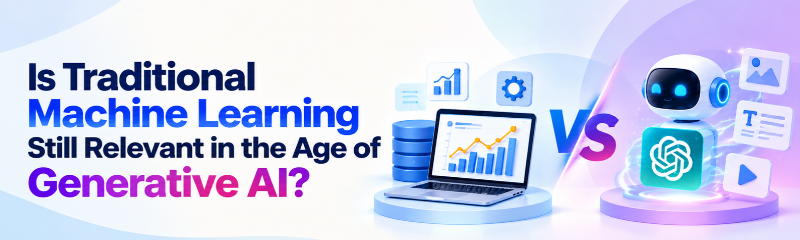
Understanding Traditional Machine Learning vs Generative AI helps learners identify which technology solves a particular problem and which skills deserve attention.
Traditional machine learning involves training algorithms to identify patterns in data and make predictions or classifications.
Imagine an online shopping platform trying to identify customers who might stop purchasing. A machine learning model examines previous orders, customer activity, and buying patterns to estimate the likelihood of customer churn.
Common algorithms include:
These methods remain useful across banking, healthcare, retail, manufacturing, and marketing.

Generative AI focuses on producing content rather than primarily predicting predefined labels or numerical outcomes.
Large language models can create explanations, generate programming code, draft emails, and summarize lengthy reports.
For example, a traditional ML model might predict whether a customer will cancel a subscription. A generative AI application could explain that prediction in understandable language and suggest customer-retention messages.
Modern generative systems frequently use transformer architectures, while traditional ML includes statistical models, tree-based algorithms, and other established techniques.
Both belong to the broader machine learning ecosystem, but their applications and operating requirements differ.
|
Feature |
Traditional Machine Learning |
Generative AI |
|
Primary purpose |
Prediction and classification |
Content generation |
|
Common data |
Structured and labelled datasets |
Text, images, audio and other formats |
|
Typical models |
Regression, Random Forest, XGBoost |
GPT-style models, diffusion models |
|
Example |
Predicting loan default |
Explaining loan-related information |
|
Computing needs |
Often lower for simpler models |
Often higher for large models |
|
Main challenge |
Data quality and model accuracy |
Hallucinations, reliability and cost |
The comparison between generative AI vs predictive AI highlights an important point: neither approach automatically performs better in every situation.
The correct choice depends on the problem, available data, performance requirements, and implementation cost.
Consider a bank processing thousands of transactions.
Its fraud-detection system needs to identify suspicious activity quickly. A supervised learning model trained on transaction history can calculate fraud probabilities and support automated alerts.
Using a large generative model for every numerical prediction may introduce unnecessary cost and complexity.
Traditional ML remains particularly effective for:
Traditional models can also offer easier validation, lower latency, and greater interpretability for certain structured-data problems.
Absolutely. Combining both approaches often produces more practical business applications.
Consider an e-commerce company.
Its traditional machine learning model predicts which customers might abandon their shopping carts. A generative AI system then prepares personalized follow-up messages using those predictions.
The workflow looks like this:
Customer Data → ML Prediction → Generative AI Message → Marketing Action
Another example involves healthcare. Predictive models can estimate patient risks, while generative AI can help prepare readable summaries for medical professionals. Clinical use requires rigorous verification and appropriate safeguards.
This combination is also relevant to Generative AI & Agentic AI, where AI agents can use predictive models as tools while coordinating broader workflows.

The future of machine learning is likely to involve a combination of specialized prediction models, foundation models, and intelligent automation.
Businesses will continue choosing simpler algorithms when they deliver reliable results at reasonable cost.
At the same time, generative models may improve workflows involving documentation, data preparation, conversational analytics, and software development.
The future of AI and machine learning therefore depends less on replacing older methods and more on selecting and integrating suitable technologies.
Developers who understand both approaches will be better equipped to design dependable AI applications.
Start with Python Programming, statistics, probability, data preprocessing, SQL, and foundational ML algorithms.
Next, practice using Pandas, NumPy, Scikit-learn, and evaluation metrics such as precision, recall, and F1-score.
A structured Data Science Course can help learners develop these foundations through practical projects.
Afterward, a Generative AI Course can introduce large language models, prompt engineering, retrieval-augmented generation, and AI application development.
Projects combining prediction models with generative interfaces can demonstrate valuable problem-solving skills during technical interviews.
No. Traditional ML remains useful for forecasting, classification, anomaly detection, and structured-data analysis.
Neither is universally better. Traditional ML often suits specific prediction tasks, while generative AI is useful for creating and transforming content.
Learning Python, statistics, and ML fundamentals first provides a strong foundation, although beginners can also explore generative AI tools alongside their studies.
Generative AI can automate certain development tasks, but engineers are still needed for data preparation, model evaluation, deployment, monitoring, and system reliability.
Relevant roles include Machine Learning Engineer, Data Scientist, AI Engineer, MLOps Engineer, and Generative AI Application Developer.

Traditional machine learning is not disappearing simply because generative AI has become popular. Its ability to analyse data, recognize patterns, and support measurable predictions remains important to modern businesses.
For aspiring technology professionals, learning both approaches creates a stronger foundation than focusing exclusively on the latest AI tools. The real advantage comes from understanding when to predict, when to generate, and when to combine both methods.
What would you prefer to learn first: traditional machine learning algorithms or generative AI application development?
 +91 8179191999

 +91
8179191999