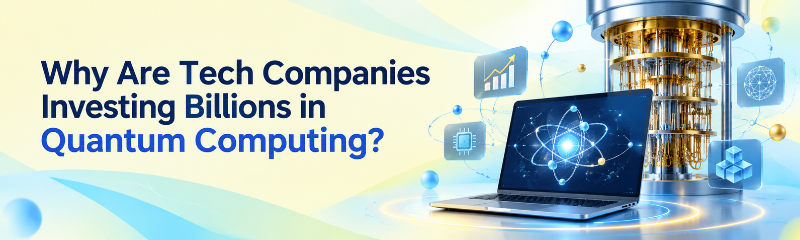
Quantum computing has spent years sounding like a technology that belongs in the distant future. That is changing. Major technology companies, governments, research laboratories, and startups are now committing billions of dollars to quantum research, hardware, software, manufacturing, and cloud infrastructure.
The reason behind this Quantum Computing Investment is not that quantum computers are ready to replace laptops or traditional data centers. Companies are investing because certain problems in chemistry, materials science, optimization, artificial intelligence, cybersecurity, and scientific research may eventually require computing approaches that classical machines struggle to handle efficiently.
IBM, for example, announced in June 2026 that it plans to invest more than $10 billion in quantum computing over five years across research, manufacturing, partnerships, infrastructure, and acquisitions.
Unlike conventional computers, which store data as binary bits (0 or 1), quantum computers use qubits that can take advantage of quantum properties, including superposition and entanglement, to process information in different ways.
That does not mean quantum computers are automatically faster at everything.
Their potential advantage appears in particular categories of complex problems where quantum algorithms could explore or represent possibilities differently from classical systems.
Researchers are particularly interested in applications such as:
Google's Willow quantum processor, for example, demonstrated important progress in quantum error correction. In October 2026, Google also reported a practical demonstration of "magic state cultivation," reducing errors significantly in an experiment on Willow hardware.
Breakthrough technologies often reward companies that develop expertise before widespread commercial adoption.
Building reliable Quantum Computing Technology requires specialised processors, cryogenic systems, control electronics, algorithms, software platforms, fabrication facilities, and highly skilled researchers.
Waiting until quantum computing becomes commercially mature could leave companies years behind competitors.

One of the strongest commercial arguments for quantum computers is simulation.
Understanding molecules and materials involves quantum mechanics. Classical computers can approximate many such systems, but complexity rises dramatically as systems become larger.
Future quantum machines could potentially help scientists study new batteries, catalysts, medicines, industrial materials, and chemical processes more effectively.
Microsoft is pursuing this direction through its quantum research and topological-qubit programme. Its Majorana platform is designed around a long-term goal of scalable, fault-tolerant quantum computing.
Quantum technology is also becoming part of national technology policy.
In May 2026, the U.S. Department of Commerce announced letters of intent covering more than $2 billion in incentives for quantum computing and manufacturing projects involving companies including IBM, Quantinuum, D-Wave, PsiQuantum, Rigetti, and Infleqtion.
This shows that quantum development is increasingly viewed not only as scientific research but also as strategic infrastructure.
The relationship between quantum computing and AI is often misunderstood.
Quantum computers are unlikely to simply replace GPUs used to train today's AI models. A more realistic future involves hybrid systems combining classical computing, AI, high-performance computing, and quantum processors.
AI can also help quantum researchers improve hardware, analyse experiments, discover materials, and develop error-correction techniques. Google has previously applied machine learning to quantum error decoding, while Microsoft says agentic AI contributed to work on its latest quantum hardware.
Therefore, quantum computing AI development may evolve as a partnership between technologies rather than a competition.
Most developers will never own a quantum computer.
That is why cloud quantum computing matters.
Cloud platforms allow researchers, students, and businesses to experiment with quantum processors remotely. AWS, for example, provides Amazon Braket for accessing quantum hardware and development tools through the cloud and is expanding work toward fault-tolerant systems.
This cloud model can help create a developer ecosystem before large-scale quantum systems become widely available.
|
Company |
Major Direction |
Why It Matters |
|
IBM |
Superconducting systems and fault tolerance |
Building a long-term quantum-centric computing ecosystem |
|
|
Quantum processors and error correction |
Researching practical quantum advantage |
|
Microsoft |
Topological qubits |
Pursuing scalable, highly reliable quantum hardware |
|
AWS |
Cloud quantum computing |
Giving developers access to different quantum systems |
|
Quantinuum |
Trapped-ion quantum computing |
Developing hardware, software and fault-tolerance technologies |
IBM's current roadmap targets the introduction of its fault-tolerant Starling system in 2029, although roadmaps remain development targets rather than guaranteed outcomes.
The growth of Quantum Computing Companies does not mean every software developer needs to become a quantum physicist.
Students interested in the field can begin with:
Python programming, linear algebra, probability, quantum computing fundamentals, quantum circuits, algorithms, cloud platforms, and basic machine-learning concepts.
Career opportunities may develop across quantum software engineering, algorithm research, hardware engineering, quantum-cloud platforms, cybersecurity, scientific computing, and quantum-AI research.
The most practical approach today is to build strong classical computing skills first and add quantum knowledge gradually.
Companies expect quantum technology to eventually solve specialised scientific, simulation, optimization, and computational problems that are difficult for conventional computers.
No. Quantum computers are expected to complement classical computers for specialised workloads rather than replace everyday computing systems.
AI can assist quantum research and error correction, while future quantum systems may support specialised AI or optimization workloads.
Yes. Cloud platforms and quantum-development services allow users to experiment with quantum hardware and simulators remotely.
It can be promising for people interested in mathematics, physics, programming, AI, cloud computing, algorithms, and scientific research, although the field remains specialised.

Billions are flowing into quantum computing because companies are preparing for a computing shift that could influence science, industry, national security, and advanced software development.
The technology still faces major challenges, especially error correction, scalability, cost, and fault tolerance. Yet recent investment suggests that leading organisations no longer view quantum computing simply as an academic experiment. They are building hardware, cloud platforms, developer ecosystems, manufacturing capability, and research teams for a future in which quantum processors could work alongside AI and classical supercomputers.
Discussion Question: If practical quantum computers become available within the next decade, which industry do you think will benefit first—healthcare, AI, cybersecurity, finance, or energy?
 +91 8179191999

 +91
8179191999