Next Batch : Invalid Date
Developers building AI applications now face a decision that did not feel as important a few years ago: should the project depend on a proprietary AI API, or should the team run an open model themselves?
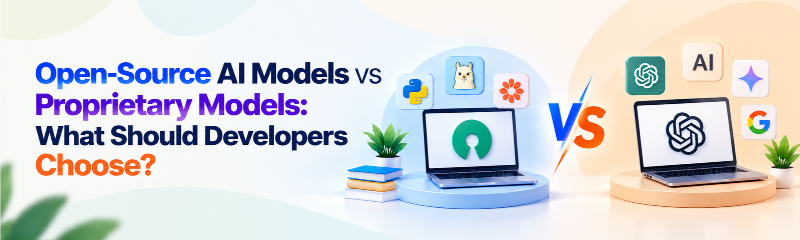
There is no universal winner in the Open-Source AI Models vs Proprietary Models debate. An API-based model may help a team launch quickly, while an open model can provide deeper control over deployment, customization, and data handling.
The right choice depends less on popularity and more on what you are actually building.
An open-source or open-weight AI model gives developers access to model weights and, depending on the project, additional code or training resources. Developers can often download the model, run it on their own infrastructure, fine-tune it, and integrate it into custom systems.
Popular model families include Llama, Mistral, Qwen, Gemma, DeepSeek and OLMo. Licensing varies considerably, however. For example, Meta's Llama models use a community licence rather than a standard open-source licence, while Mistral states that many of its open models use Apache 2.0. Developers should therefore check the licence of the exact model they plan to deploy.
Proprietary AI models, on the other hand, are owned and managed by companies that typically let developers use them through APIs or hosted services. Developers can build applications with them without receiving the underlying model weights.
Current examples include OpenAI's GPT family and Google's Gemini models, both offered through developer APIs and supporting capabilities ranging from reasoning to multimodal application development.

|
Factor |
Open/Open-Weight Models |
Proprietary Models |
|
Model access |
Weights often available |
Usually API access |
|
Deployment |
Cloud, private servers or local hardware |
Provider-managed |
|
Customization |
High |
Depends on provider |
|
Setup effort |
Usually higher |
Usually lower |
|
Infrastructure |
Developer manages it |
Provider manages it |
|
Data control |
Can remain inside private infrastructure |
Depends on API and provider policies |
|
Scaling |
Team manages capacity |
Often handled by provider |
|
Licensing |
Must inspect individual model licence |
Governed by service terms |
The comparison shows why benchmark scores alone are not enough to make a technology decision.
Open models become attractive when control matters more than convenience.
Imagine a company building an internal document assistant for confidential engineering files. Running the model within controlled infrastructure may help the organisation define exactly where inference takes place and how information moves through the system.
Open models are also useful for developers who want to experiment with:
Another advantage is flexibility. A team can change serving frameworks, optimise hardware usage or modify parts of its AI stack without depending entirely on one API provider.
However, “open” does not mean “free to operate.” GPU infrastructure, monitoring, engineering time, security and model maintenance can become significant responsibilities.
Proprietary models are often practical when a development team wants to move from an idea to a working application quickly.
Suppose a startup is creating an AI customer-support assistant. Instead of setting up GPU servers, inference engines and model monitoring, developers can integrate an API and concentrate on application logic, retrieval, workflows and user experience.
Managed AI platforms can be especially useful for:
The trade-off is dependency. Pricing changes, model updates, rate limits or API changes can affect an application, so developers should avoid designing systems that are unnecessarily tied to one provider.
Developers do not always have to choose one side.
A useful architecture might run a smaller open model for classification, extraction or routine requests while sending particularly difficult reasoning tasks to a proprietary model.
For example:
User Query → Router → Open Model for Simple Tasks → Proprietary Model for Complex Tasks
This approach can balance performance, infrastructure costs, privacy requirements and development speed.
The important lesson is to treat the model as one component of the application rather than the entire application.
Developers entering AI engineering should understand more than prompt writing. Useful skills include Python, APIs, Hugging Face, model inference, embeddings, RAG, vector databases, Docker, cloud platforms, model evaluation and basic MLOps.
Learning both ecosystems is particularly valuable. A developer who understands how to integrate a managed Generative AI API and deploy an open model has more architectural choices than someone familiar with only one platform.
These skills increasingly overlap with areas covered in Generative AI courses, Artificial Intelligence training, Python Programming and Data Science courses.
Not always. Open models provide greater deployment and customization control, while proprietary models often provide easier integration and managed infrastructure.
Downloading some models may be free, but deployment still involves infrastructure, GPU, storage, engineering and maintenance costs. Licensing conditions also vary.
Startups looking to build and launch products quickly may find proprietary APIs a practical choice.Teams with strong infrastructure requirements or specialised workloads may prefer open models.
Yes. Many smaller or quantized models can run on local workstations and compatible devices, although hardware requirements depend heavily on model size and precision.
Yes. Hybrid architectures can route different tasks to different models based on cost, privacy, latency or capability requirements.

The Open-Source AI Models vs Proprietary Models decision should begin with the application, not the model brand.
Opt for open-source models when you need greater flexibility, control over the infrastructure, or deployment tailored to specific requirements.Choose proprietary models when speed, managed infrastructure and access to advanced capabilities matter more. For many production applications, a hybrid strategy may offer the best balance.
For developers and job seekers, the safest career strategy is also clear: learn how to work with both.
Which would you choose for your next AI project an open model, a proprietary API, or a hybrid architecture?
 +91 8179191999

 +91
8179191999