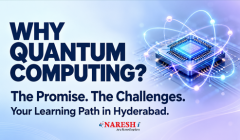
You've probably heard that quantum computers can solve certain problems differently from ordinary computers. But when you try learning the subject, unfamiliar terms appear everywhere: qubits, superposition, quantum gates, entanglement and complex mathematics.
It can feel like you need a physics degree before writing your first program.
You don't.
If you're wondering how to learn Quantum Computing, the best approach is to start with simple concepts, build basic mathematical understanding and gradually experiment with quantum circuits. Students, software developers and working professionals can all begin without owning quantum hardware.
This guide explains where to start, which skills matter and how to turn theoretical knowledge into practical experience.
Quantum computing uses principles of quantum mechanics to process information.
Traditional computers store information using bits represented as 0 or 1. Quantum computers use qubits, which can exist in superpositions of the states 0 and 1 until measurement.
Three important quantum computing basics are:
Quantum computers aren't automatically faster at every task. Their potential advantages depend on the problem and algorithm.

You don't need advanced physics knowledge to begin introductory lessons.
However, understanding the following quantum computing prerequisites will make programming easier.
|
Skill |
What You Should Learn |
Priority |
|
Mathematics |
Algebra, vectors, matrices |
High |
|
Python |
Variables, functions, libraries |
High |
|
Probability |
Outcomes and distributions |
High |
|
Physics |
Basic quantum mechanics |
Medium |
|
Computer science |
Logic and algorithms |
Medium |
Start with vectors, matrices and probability before studying the mathematics behind quantum states. Deeper topics can come later.
A structured quantum computing learning roadmap prevents beginners from getting overwhelmed.
Begin by comparing bits and qubits. Learn what measurement means and why quantum algorithms behave differently from classical programs.
Avoid complex equations initially. Focus on understanding the ideas.
Study common gates such as:
Experiment with one-qubit circuits before combining multiple qubits.
Quantum computing with Python is a practical starting point for learners with basic programming skills.
IBM's Qiskit allows developers to create quantum circuits, simulate computations and work with supported quantum hardware.
IBM Quantum Learning+1Try this introductory circuit:from qiskit import QuantumCircuit
qc = QuantumCircuit(1, 1)qc.h(0)qc.measure(0, 0)
print(qc.draw())
The Hadamard gate creates a superposition from the initial zero state. Measurement produces either 0 or 1, each with 50% probability in an ideal simulator.
Once you're comfortable with circuits, investigate:
Understand their assumptions and limitations before attempting advanced implementations.
Several established platforms support quantum computing programming for beginners.
|
Tool |
Main Purpose |
Suitable For |
|
Qiskit |
Building quantum circuits in Python |
Beginners |
|
IBM Quantum Composer |
Visual circuit experimentation |
Non-programmers |
|
Google Cirq |
Python-based circuit simulation |
Python developers |
|
Microsoft Q# |
Quantum programming exercises |
Programming learners |
IBM provides introductory courses, while Microsoft's Quantum Katas offer guided coding exercises. Google's Cirq documentation supports learners who already understand basic quantum concepts.
Watching tutorials helps, but small experiments reveal whether you understand the concepts.
Start with three projects:
Document each project's objective, circuit, results and limitations on GitHub.
A working project with a clear explanation demonstrates more understanding than copied code.
Quantum computing is a developing specialist field rather than a guaranteed shortcut into software employment.
Relevant career paths include quantum software development, research engineering, quantum algorithms and Quantum Hardware Engineering.
Research-intensive roles often require advanced mathematics, physics or postgraduate study.
For Indian students and working professionals, a practical starting combination is Python, linear algebra, classical algorithms and introductory quantum programming.
These skills also remain useful in broader software and scientific computing careers.
Start with qubits, gates, probability and basic linear algebra. Then practise simple circuits using Qiskit or a visual simulator.
No, but Python is highly useful because popular quantum development frameworks such as Qiskit and Cirq support it.
Yes. Non-IT students can begin with introductory concepts and gradually develop the required mathematics and programming skills.
A few weeks of consistent study may be enough to understand introductory concepts and simple circuits. Advanced proficiency takes considerably longer.
Yes. Quantum simulators and visual circuit tools allow beginners to experiment on ordinary computers without physical quantum hardware.

Learning quantum computing doesn't require mastering everything at once.
Begin with the fundamentals, strengthen your mathematics, practise Python and build small quantum circuits. Once these ideas become familiar, exploring algorithms and advanced applications becomes more manageable.
The most useful first milestone isn't a certificate. It's building a quantum circuit and understanding why it produces its results.
Discussion Question: If you're starting quantum computing today, would you prefer learning the theory first or experimenting directly with Python-based quantum circuits?
 +91 8179191999

 +91
8179191999