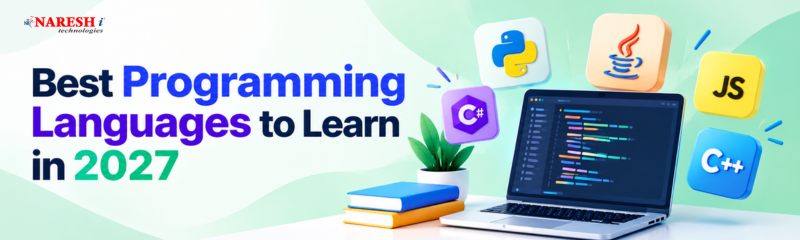
Learning programming is an important step for students and professionals interested in software development, artificial intelligence, automation and technology careers. However, choosing between Python, Java, JavaScript and C# can be confusing, especially when every language offers different opportunities.
The best way to learn programming is to select a language that matches your career goals, understand its fundamentals and build practical projects.
As 2027 approaches, Python, JavaScript, Java and C# remain relevant choices based on established developer usage and software ecosystems. Understanding their applications can help beginners make better learning decisions.
Programming powers websites, mobile applications, enterprise software, AI systems and business automation.
Companies need developers who can write reliable code, solve problems and build applications using modern tools.
Learning programming also develops logical thinking, debugging ability and problem-solving skills. These capabilities are useful across software engineering, data analytics, cloud computing and artificial intelligence.
Rather than choosing a language based only on popularity, learners should consider its practical applications and their preferred career direction.

Python is frequently recommended as an easiest coding language to learn option because of its readable syntax and beginner-friendly structure.
It supports automation, data science, machine learning and AI application development.
Popular tools: Pandas, NumPy, Django, FastAPI and scikit-learn.
Career opportunities: Python Developer, Automation Developer and Data Scientist.
A Python Programming Course can establish the foundations needed for advanced learning.
Java is widely used for enterprise applications, backend services and large-scale software systems.
To learn Java effectively, start with core concepts such as object-oriented programming, collections, and exception handling. Once you understand these fundamentals, move on to advanced topics like Spring Boot, database integration, and REST API development.
Popular tools: Spring Boot, Hibernate, Maven and IntelliJ IDEA.
Career options: Learning Java can open up career paths such as Java Software Developer, Backend Developer, and Full Stack Developer.
JavaScript makes websites interactive and supports backend development through Node.js.
TypeScript adds static type checking, helping developers maintain complex applications.
Popular tools: React, Angular, Node.js and TypeScript.
Career opportunities: Frontend Developer, React Developer and Full Stack Developer.
C# is widely used to build business applications, cloud-based solutions, desktop programs, and video games. Developers often combine it with ASP.NET Core to create web applications and Microsoft Azure to deploy and manage cloud services.
Popular tools: Visual Studio, ASP.NET Core, Entity Framework Core and SQL Server.
Career opportunities: .NET Developer, Backend Developer and Software Engineer.
C++ is used in embedded systems, performance-sensitive applications, game engines and systems software.
Although it requires greater attention to memory management, it helps learners understand computer systems and efficient programming.
Career opportunities: Systems Programmer, Embedded Developer and Game Developer.
|
Language |
Difficulty |
Main Applications |
Suitable For |
|
Python |
Beginner-friendly |
AI, automation, data science |
Beginners |
|
Java |
Moderate |
Enterprise applications |
Backend developers |
|
JavaScript |
Beginner to moderate |
Web development |
Web developers |
|
TypeScript |
Moderate |
Large web applications |
JavaScript developers |
|
C# |
Moderate |
.NET and cloud applications |
Enterprise developers |
|
C++ |
More challenging |
Systems and embedded software |
Systems developers |
Difficulty depends on previous experience and learning background.
The best way to learn coding combines structured study, daily practice and real-world projects.
Understand variables, operators, loops, functions, data structures and object-oriented programming.
Build calculators, number-guessing games, expense trackers and simple automation scripts.
Improve your programming abilities by practising with development tools such as VS Code, Git, GitHub, and code-debugging software.
Create a student management application, REST API or personal portfolio website.
For learners exploring the best way to learn Python, combining coding exercises with small applications is a practical approach.
The best place to learn Python should provide structured lessons, practical assignments, experienced instruction and constructive feedback.
Different programming careers require different learning paths.
|
Career Interest |
Relevant Course |
|
Python development |
Python Programming Course |
|
Enterprise Java development |
Java Full Stack Development Course |
|
Web application development |
Full Stack Development Course |
|
Microsoft technologies |
C# .NET Developer Course |
|
Machine learning and analytics |
Data Science with Python Course |
|
AI applications and intelligent automation |
Generative AI & Agentic AI |
For example, someone interested in AI can begin with Python fundamentals, then explore Data Science and AI application development.
Developers aiming to create backend applications for enterprise environments can consider learning Java or C#.
Evaluate course syllabi, coding assignments, trainer expertise and projects before enrolling.
Employers evaluate practical development ability alongside language knowledge.
Important skills include:
Building these skills helps learners move beyond syntax and understand complete software development workflows.
Python is a strong beginner-friendly option because of its readable syntax and applications in automation, data science and AI.
Python is generally approachable for beginners. JavaScript is another suitable choice for learners interested in interactive websites.
Yes. Java remains useful for enterprise applications, backend development and large-scale software systems.
Yes. Students from non-IT backgrounds can begin with programming fundamentals, practise coding regularly and gradually build practical projects.
Choose Python for automation, data science and AI interests. Choose Java for enterprise backend development and Java-based applications.

Choosing a programming language in 2027 depends on your learning goals and the type of career you want to pursue. Python is a good starting point for beginners, Java is widely used in enterprise software, JavaScript and TypeScript are essential for web development, while C# is commonly used to build applications with the .NET framework.
Focus on mastering one language, solving programming problems and building projects rather than collecting multiple certificates without practical experience.
Discussion Question: Which programming language would you choose to learn in 2027—Python, Java, JavaScript or C#—and what career goal would influence your decision?
 +91 8179191999

 +91
8179191999